
CIP / Food & Beverage
Alkaline CIP Cleaner
An alkaline clean-in-place concentrate for food and beverage processing lines, developed and produced to order under EU detergent and REACH documentation rules.
- REACH SDS
In brief
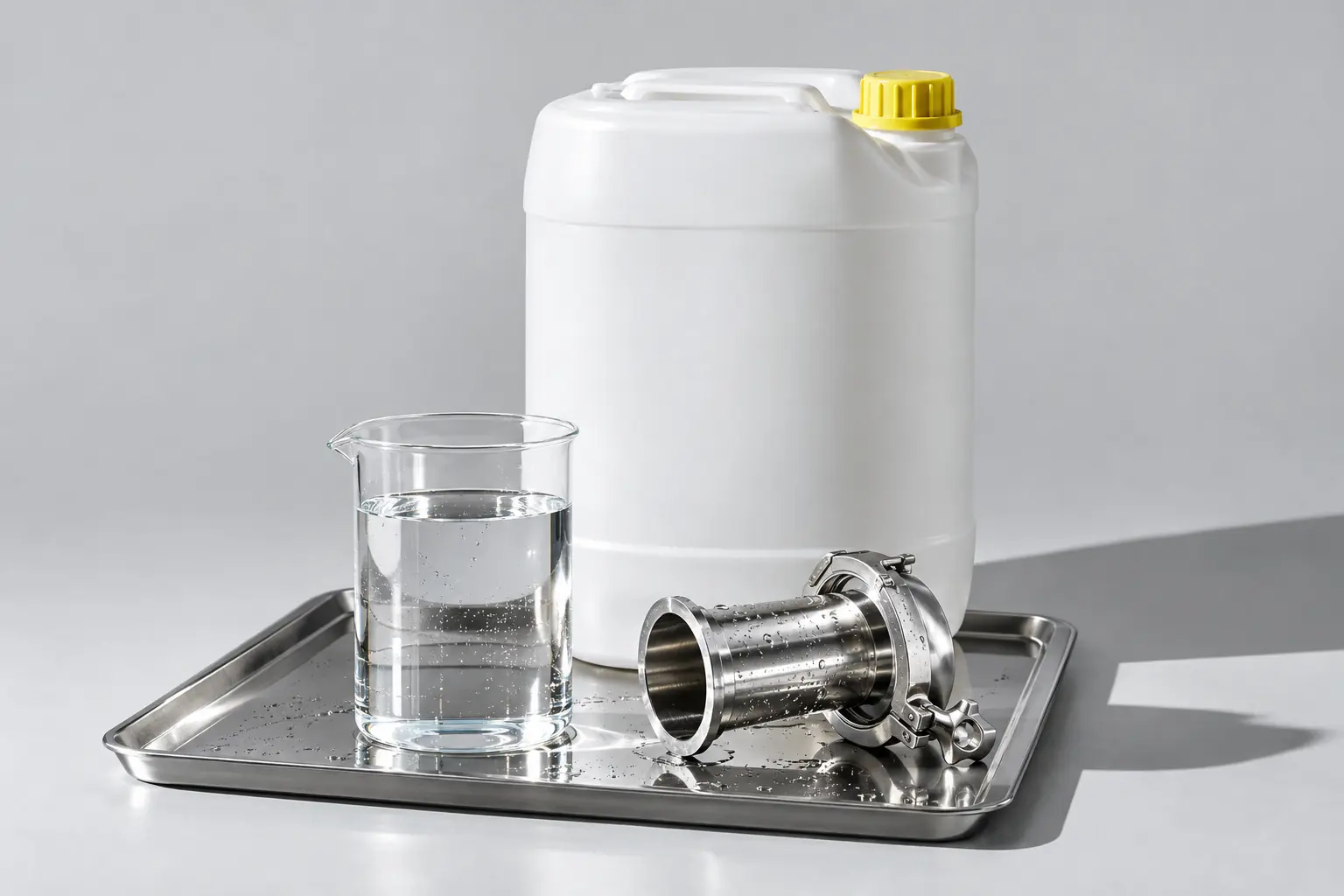
An alkaline CIP (clean-in-place) cleaner is a concentrated formulation used to degrease and remove protein and fat soil from food and beverage processing tanks, lines and pipework without dismantling the equipment. AKTO develops and manufactures alkaline CIP cleaners to order on its liquid-formulation lines, drawing on its KVED 20.41 registration, ISO 9001/ISO 22000 (HACCP) quality system and bulk liquid-production capacity in Kyiv (Ukraine) and Warsaw (Poland).
01
What an alkaline CIP cleaner is and who uses it
An alkaline CIP (clean-in-place) cleaner is a concentrated cleaning formulation circulated through tanks, lines and pipework of food and beverage processing equipment without taking the system apart. The alkaline wash removes fat, protein and other organic soil from stainless-steel surfaces, after which an acid wash is carried out where needed to remove mineral scale. Buyers are dairies, breweries, beverage bottlers and other food and beverage producers, together with brands that supply CIP chemistry to such plants under their own label.
02
Composition, packaging and production conditions
Company AKTO LLC (AKTO) supplies this category as a liquid formulation, one of its standard production formats, with a minimum order from 50 kg. Its standard liquid packaging range spans bottles with a flip-top, pump or trigger closure, sized to the client's dosing format. Production runs on lines held at a controlled humidity of 20-60% and temperature of 16-25°C, checked twice per shift — conditions that matter for a concentrate that has to keep a consistent alkalinity from batch to batch.
03
EU regulatory framework
Regulation (EC) No 648/2004 on detergents applies to alkaline CIP cleaning concentrates supplied for the automated cleaning of food and beverage processing equipment, and under Article 9(3) and Annex VII Section C requires the manufacturer to provide medical personnel, on request, without delay and free of charge, with the ingredient data sheet; the further public-website version under Section D is not required for an industrial or institutional detergent supplied with a technical or safety data sheet. Where the concentrate is classified as corrosive or irritant to skin and eyes, Regulation (EC) No 1272/2008 (CLP) requires harmonised hazard classification, labelling and packaging before it can be supplied to professional users, and under Regulation (EC) No 1907/2006 (REACH) Article 31 the supplier must automatically provide a 16-section safety data sheet in the official language of the Member State where the product is placed on the market.
04
What AKTO offers
AKTO's registered KVED classification 20.41 (“manufacture of soap and detergents, cleaning and polishing preparations”) covers CIP-type industrial cleaning concentrates for food and beverage lines, and its combined ISO 9001:2015 and ISO 22000:2018 (HACCP) certificate (No. 44600111204) documents a food-safety-oriented quality management system relevant to producing them. Monthly liquid-production capacity runs up to 150 tonnes in Kyiv (Ukraine) and up to 50 tonnes in Warsaw (Poland), scale suited to bulk-format industrial concentrates. AKTO develops and manufactures alkaline CIP cleaners to order on these liquid-formulation lines, matching the concentrate to the client's CIP cycle rather than offering a fixed catalogue product.
05
How to start
A project starts with the client's CIP cycle: the plant type, the soil being removed, and whether an acid-stage partner formula is needed alongside it (see AKTO's acid CIP cleaner below). AKTO's team checks the CLP hazard classification of the target formulation, prepares the REACH-compliant safety data sheet for the relevant market language, and scales the batch to the client's liquid-packaging format at the Kyiv (Ukraine) or Warsaw (Poland) plant.
06
See also
Frequently Asked Questions
Does AKTO manufacture alkaline CIP cleaners?
What documentation does an alkaline CIP concentrate need in the EU?
How does an alkaline CIP cleaner differ from an acid CIP cleaner?
What production capacity does AKTO have for bulk CIP concentrates?
 Kateryna Khromykh
 Oleksandra Vovk
Standards we work to
 ISO 22716 (GMP)
 ISO 22000 (HACCP)
 Regulation (EC) No 1223/2009
 Directive 2002/46/EC
 Halal
Why AKTO
- KVED 20.41 registration covers CIP-type industrial cleaning concentrates
- Food-safety-oriented quality system: ISO 9001:2015 + ISO 22000:2018 (HACCP), certificate No. 44600111204
- Liquid capacity up to 150 tonnes a month in Kyiv (Ukraine), up to 50 tonnes in Warsaw (Poland)
- Production held at controlled humidity (20-60%) and temperature (16-25°C), checked twice per shift