
SPF 30
Sun Protection & Self-Tan (Face)
Private-label sunscreen emulsions and self-tanning formulas for the face, built to EU UV-filter and DHA concentration limits.
- ISO 22716 GMP
In brief
Sun protection and self-tan for the face cover two distinct formats: UV-filter sunscreens tested for SPF and UVA protection, and dihydroxyacetone (DHA) self-tanners capped at 10% under EU rules. Company AKTO LLC (AKTO) manufactures a confirmed SPF 30 broad-spectrum sunscreen for face and body, and develops self-tan formulas for private-label brands within the same emulsion and liquid-formulation capability.
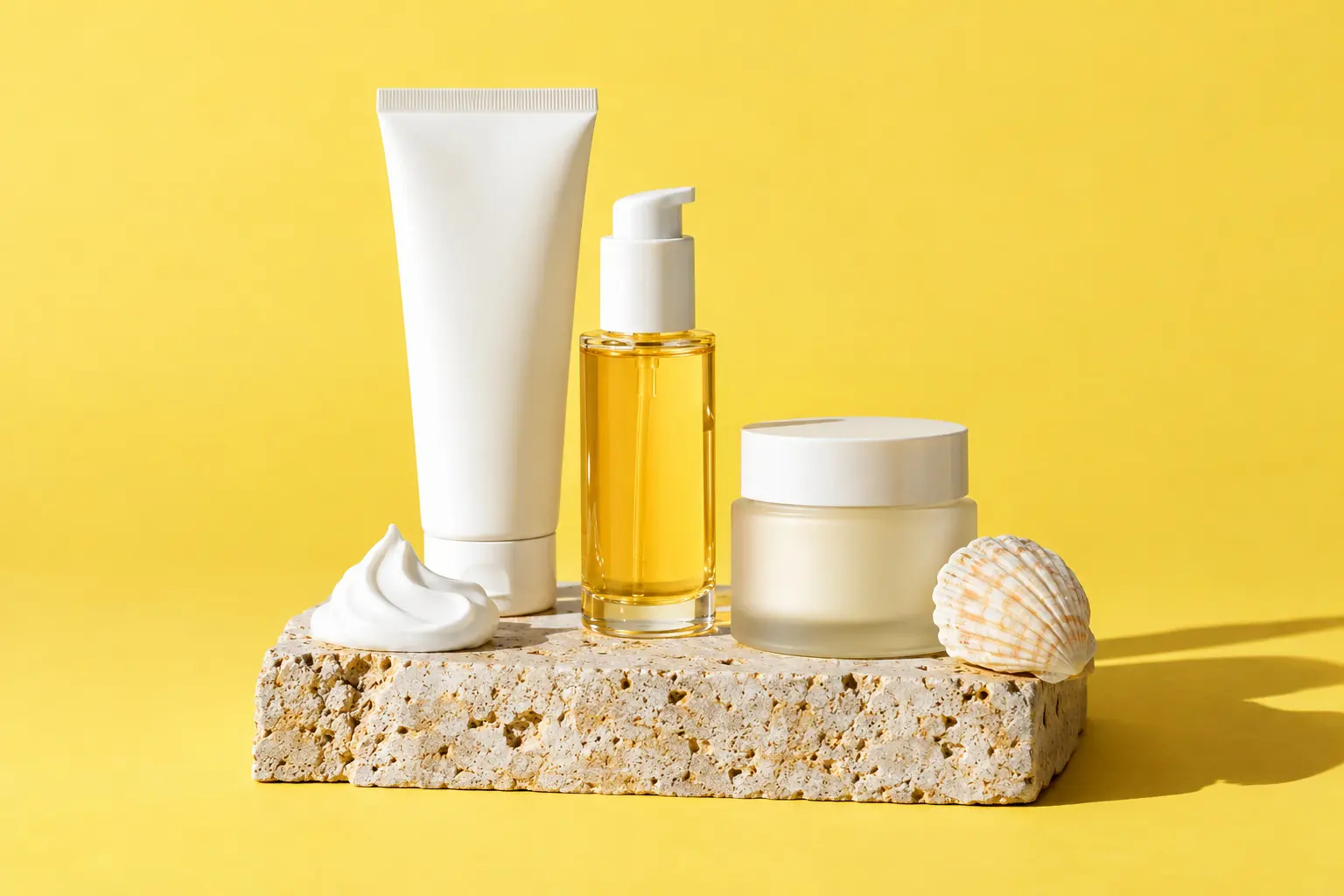
Explore this section
01
Sun protection and self-tan for the face, for private-label brands
This product type covers two related but distinct formats for the face: sunscreen emulsions and creams that protect against UV radiation, and self-tanning products that colour the skin using dihydroxyacetone (DHA) instead of sun exposure. A brand usually asks for one or the other rather than a combined formula, since the testing paths differ. AKTO develops and manufactures face-care liquids and emulsions for private-label partners building an SPF or self-tan line for the EU, UK, Ukrainian or Gulf market.
02
What a compliant formula has to meet
Under EU Commission Recommendation 2006/647/EC, a product can only be labelled and presented as a sunscreen if it reaches a sun protection factor (SPF) of at least 6, with an ultraviolet A protection factor of at least one third of the labelled SPF, and a minimum critical wavelength of 370 nm. Regulation (EC) No 1223/2009 Annex VI sets the closed list of UV filters permitted in an EU cosmetic product, each with its own maximum authorised concentration, so a formula cannot add a new filter without checking that list first. For self-tan, Commission Regulation (EU) 2021/1099 added dihydroxyacetone to Annex III of Regulation 1223/2009, capping it at 10% in self-tanning products. SPF and UVA claims need testing support: ISO 24444 for the in-vivo SPF method, ISO 24443 for the in-vitro UVA method.
- Minimum SPF 6 and a UVA-to-SPF ratio of at least one third for any sunscreen claim
- Minimum critical wavelength of 370 nm
- UV filters limited to the Annex VI list, each at its authorised concentration ceiling
- DHA capped at 10% in a self-tanning formula
03
Regulatory basis in the EU and Ukraine
The EU side rests on Regulation (EC) No 1223/2009 (Annex VI for filters, Annex III for DHA), Recommendation 2006/647/EC for SPF labelling, and ISO 24444 together with ISO 24443 for claim substantiation. In Ukraine, a sunscreen or self-tan product is classified as a cosmetic product under technical specification TU U 20.4-43961492-001:2020, backed by sanitary-epidemiological expert opinion No. 12.2-18-2/2361.
04
What AKTO manufactures
AKTO already manufactures an SPF 30 sunscreen for body and face, with UVA/UVB broad-spectrum, water-resistant and PA+++ claims declared on the label, packaged in 250 ml and 100 ml pump bottles. A new formula goes through mandatory microbiology, preservative challenge and stability/compatibility testing, with patch testing recommended for sun-exposure products. A DHA-based self-tan formula for the face is made as a liquid formulation and goes through the same testing programme: AKTO develops it to order for the brand, so a brand starting here works with AKTO's R&D team from the formulation stage rather than choosing from an existing sample.
- Formats: emulsions/creams, liquid formulations
- Packaging: PBL tubes 15-200 ml, pump/flip-top/trigger/dropper bottles, jars 50-250 g
- Minimum order quantity from 50 kg
- Production in Kyiv, Ukraine and Warsaw, Poland
- ISO 9001 + ISO 22000 (HACCP; certificate No. 44600111204), ISO 22716 (GMP)
05
How to start a project
A brand shares its target SPF or self-tan concept, preferred packaging and target market, and AKTO checks the filter or DHA concentration against the relevant Annex before formulation begins.
- Brief and reference-sample review
- Formulation and safety-relevant testing: microbiology, stability, preservative challenge
- Production run at the Kyiv (Ukraine) or Warsaw (Poland) facility
- Dossier and label compliance check for the target market
See also: Face and Cosmetics & Personal Care.
Frequently Asked Questions
What SPF does a product need to be labelled 'sunscreen' in the EU?
Which UV filters can be used in an EU sunscreen formula?
Is there a concentration limit for self-tanning actives?
Does AKTO already manufacture a sunscreen for the face?
Expert review
Reviewed by
 Illia Mariutsa
Researcher, organic chemistry
Google Scholar Anastasiia Bespalova
Paediatric orthopaedic and trauma surgeon
ORCID
Standards we work to
 ISO 22716 (GMP)
 ISO 22000 (HACCP)
 Regulation (EC) No 1223/2009
 Directive 2002/46/EC
 Halal
Why AKTO
- SPF 30 broad-spectrum, water-resistant sunscreen formula
- Mandatory microbiology, preservative-challenge and stability testing for new formulas
- Production humidity and temperature monitored and logged twice per shift
- ISO 22716 (GMP), ISO 9001 + ISO 22000 (HACCP)
- Two plants: Kyiv, Ukraine and Warsaw, Poland