
Private Label
Bug Remover
AKTO develops and manufactures bug remover to order, matching an alkaline or enzyme-boosted surfactant blend to residue on the bumper and hood.
- Reg. 648/2004
In brief
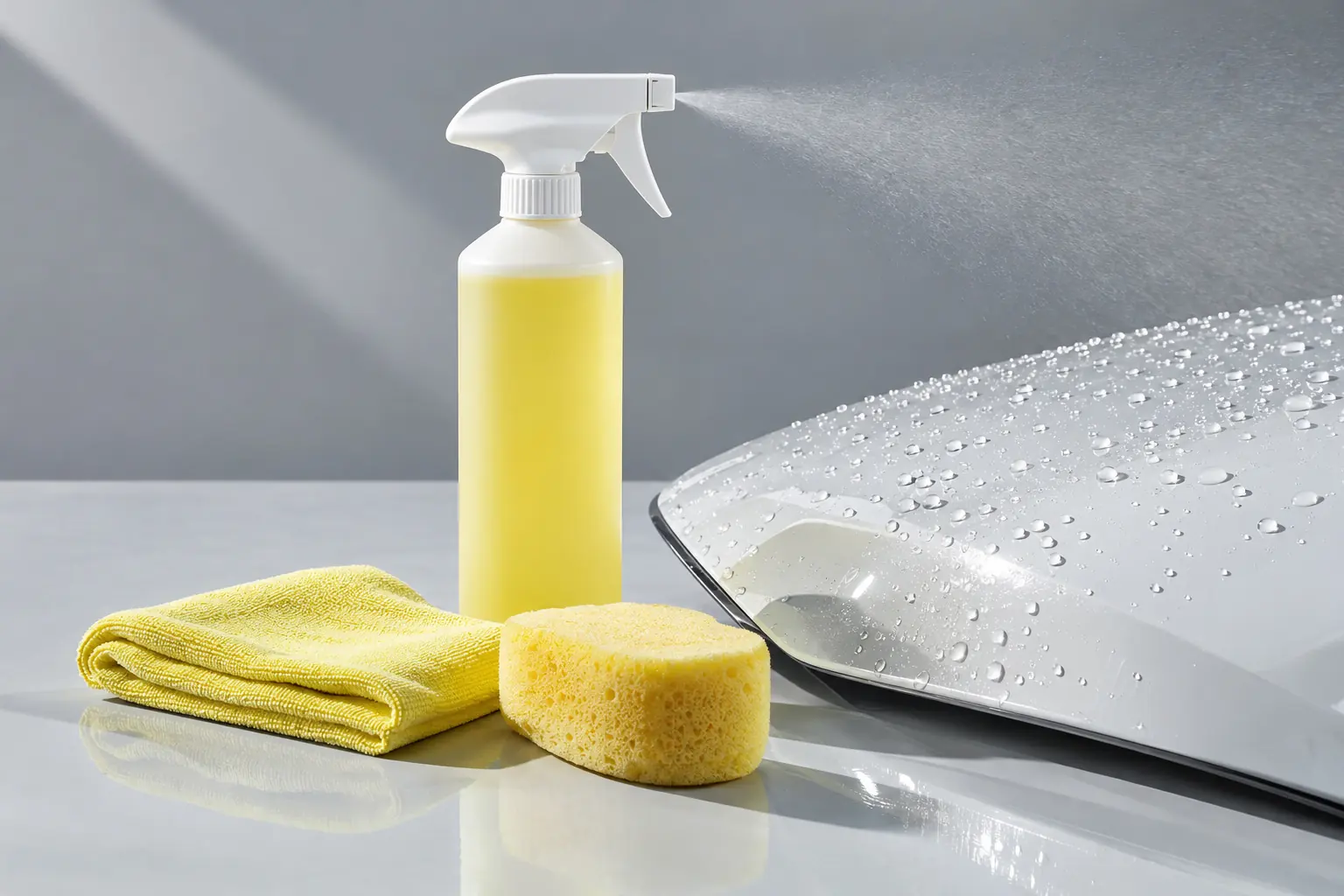
AKTO develops and manufactures bug remover to order on its liquid-formulation line, matching an alkaline or enzyme-boosted surfactant blend to protein-based insect residue on a bumper or hood. The formula is checked against Regulation (EC) No 648/2004 on detergents and CLP classification before filling starts.
01
What a bug remover has to break down
Insect residue bakes onto a front bumper, hood and mirrors within hours in the sun, and a general spray cleaner just smears it across the paint instead of lifting it. The longer a residue sits in direct sun, the harder the protein bonds to the clear coat, so the formula has to target that specific buildup rather than the dust and road grime a general car shampoo already handles. AKTO develops and manufactures bug remover to order on its liquid-formulation line, matching the surfactant blend to that specific residue rather than supplying a general-purpose cleaner from stock.
02
How the formula works
An effective bug remover relies on dwell time rather than scrubbing — an alkaline or enzyme-boosted surfactant blend softens protein-based residue before it is rinsed away.
- The spray is applied to a dry surface — bumper, hood, mirrors, headlights.
- The formula is left to dwell while the alkaline or enzyme blend loosens baked-on insect residue.
- The surface is rinsed or wiped, without abrasive scrubbing on the paint.
03
EU requirements for a surfactant-based formula
As a surfactant-based cleaning formulation, bug remover falls under Regulation (EC) No 648/2004 on detergents: the surfactants must meet ultimate-biodegradability criteria, and under Annex VII Section A the listed constituent classes (e.g. surfactants, phosphates, bleaching agents, hydrocarbons) added above 0.2% by weight must be declared in weight bands, with enzymes, disinfectants, optical brighteners, perfumes and preservatives listed irrespective of concentration. Where the alkaline or enzyme blend is classified as a skin or eye irritant under Regulation (EC) No 1272/2008 (CLP), the label carries the matching hazard pictograms. Regulation (EU) 2023/988, applicable since 13 December 2024, applies to the safety aspects and risks not covered by specific Union law, and requires the manufacturer to carry out an internal risk analysis and draw up technical documentation before placing the product on the market (Article 9(2)).
04
Production and packaging
- Liquid formulation
- 250 ml trigger-spray bottle
- Pump bottle up to 1000 ml
AKTO fills bottles on its line in Kyiv (Ukraine), with a parallel site in Warsaw (Poland). Orders from 50 kg of liquid formula come with ISO 22716 (GMP) and ISO 9001:2015 + ISO 22000:2018 (HACCP; No. 44600111204).
05
Getting started
A brand brief states the target market and whether the formula should be a quick spray or a longer-dwell product. AKTO's team checks the surfactant blend's CLP classification, confirms the detergents-regulation labelling and matches the bottle format to the order volume before filling starts in Kyiv (Ukraine).
06
Seasonal demand and batch planning
Demand for bug remover rises in spring and summer, when drivers spend more time on the road, so brands more often order several smaller batches in a row rather than a single volume for the whole season. AKTO schedules filling around that seasonal peak and keeps the same surfactant recipe from batch to batch, so a buyer sees no difference between the first bottle and the last one purchased that season.
07
See also
See also: Automotive Care, Tar & Glue Remover and Car Glass Cleaner.
Frequently Asked Questions
Does AKTO manufacture bug remover?
How long should the formula dwell on the surface?
What EU rules apply to a surfactant-based formula?
What packaging does AKTO use for bug remover?
 Kateryna Khromykh
 Oleksandra Vovk
Standards we work to
 ISO 22716 (GMP)
 ISO 22000 (HACCP)
 Regulation (EC) No 1223/2009
 Directive 2002/46/EC
 Halal
Why AKTO
- The formula relies on surfactant dwell time, not abrasive scrubbing
- Checked against Regulation (EC) No 648/2004 on detergents and CLP
- 250 ml trigger-spray or pump bottle up to 1000 ml
- ISO 22716 (GMP), ISO 9001:2015 + ISO 22000:2018 (HACCP) certified