
Private Label
Nail Polish
AKTO develops nail-polish formulas to a brand's brief and prepares the technical documentation required for cosmetics in the EU and Ukraine.
- Reg. 1223/2009
In brief
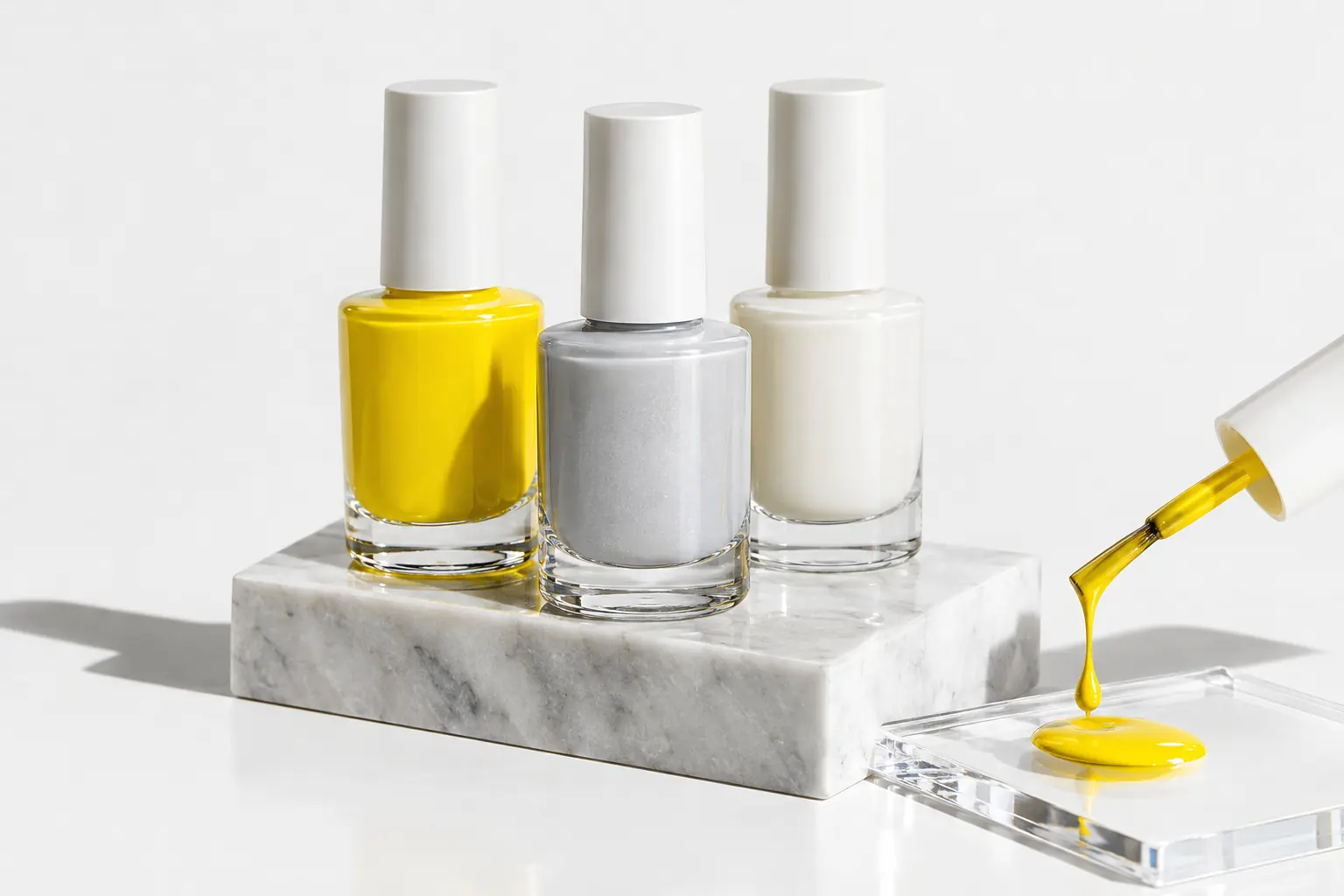
Nail polish is regulated as a cosmetic product under Regulation (EC) No 1223/2009 in both the EU and Ukraine, with toluene capped at 25% and dibutyl phthalate banned. AKTO develops and manufactures nail-care products to order on its emulsion and cream production lines; a solvent-based lacquer extends beyond this format, so shade, plasticiser and packaging are worked out individually with AKTO's R&D team during formula development for the brand.
01
What nail polish is and who it is for
Nail polish is a decorative cosmetic product built on film-forming resins and solvents, applied to the nail plate for colour, gloss and protection. The category interests decorative-cosmetics brands, nail studios and retail chains looking for a contract manufacturer for their own label. Company AKTO LLC (AKTO) develops nail polish to a brand's brief: formula, shade and packaging are worked out individually for each project.
02
What EU rules say about composition
In the EU, nail polish is regulated as a cosmetic product under Regulation (EC) No 1223/2009 rather than under Regulation (EC) No 1272/2008 (CLP) on hazard classification: CLP Article 1(5)(c) expressly excludes finished cosmetic products from its scope, so a nail polish does not need flammability labelling despite containing volatile solvents. Annex III to Regulation (EC) No 1223/2009 caps toluene at 25% and requires warnings that keep the product away from children and restrict use to adults. Annex II to the same Regulation bans dibutyl phthalate (CAS 84-74-2), a plasticiser once used in nitrocellulose-based lacquers.
03
AKTO's technological format for nail polish
AKTO develops and manufactures nail-care products to order on its emulsion and cream production lines. A nail polish built on solvent-based nitrocellulose technology extends beyond this format: shade, plasticiser and glass-bottle-with-brush packaging are worked out individually with AKTO's R&D team during formula development for the brand. A nail-polish project starts with technology selection and formula agreement rather than an existing production line.
04
The legal basis for registering in Ukraine
In Ukraine, nail-care products are labelled under the general cosmetics labelling regime (Resolution No. 65). AKTO does not own any B2C brands of its own: under its agreement, a formula developed for a partner brand stays that brand's trade secret and is not reused for a competing product.
05
Commercial terms and the development process
AKTO's standard commercial terms for a cosmetic product are production from 4 weeks, a minimum order from 50 kg and 100% prepayment. A new product moves through an Operational Development Sheet (OLR), then an Operational Production Sheet (OLP) and a raw-material loading table, with a First Production Report (OPP) required for the first 3-5 batches. The same steps apply to a nail-polish project, with one extra step: choosing a technology compatible with AKTO's emulsion/cream format, or agreeing a separate solvent-based formula.
06
How to get started
A project starts with a brand brief: target shade, bottle format and market. AKTO's team checks how closely the brief matches its current technological format and, where needed, proposes an alternative, such as a water-based nail-strengthening treatment. Once the formula is agreed, development runs through the standard OLR-OLP-OPP cycle, with cosmetics labelling built to Resolution No. 65.
07
See also
Frequently Asked Questions
Does AKTO manufacture nail polish?
How much toluene is allowed in nail polish in the EU?
Why is dibutyl phthalate banned in nail polish?
What labelling rules apply to a nail product in Ukraine?
 Kateryna Khromykh
 Oleksandra Vovk
Standards we work to
 ISO 22716 (GMP)
 ISO 22000 (HACCP)
 Regulation (EC) No 1223/2009
 Directive 2002/46/EC
 Halal
Why AKTO
- Labelling under CMU Resolution No. 65 for cosmetic products
- Standard OLR-OLP-OPP development cycle for a new product
- A brand's formula stays that brand's trade secret
- Minimum order from 50 kg, production from 4 weeks