
Private Label
Baby Leave-In Conditioner
AKTO develops and manufactures a baby leave-in conditioner to order on its cream-emulsion and liquid-formulation lines, applied without rinsing.
- ISO 22716 GMP
In brief
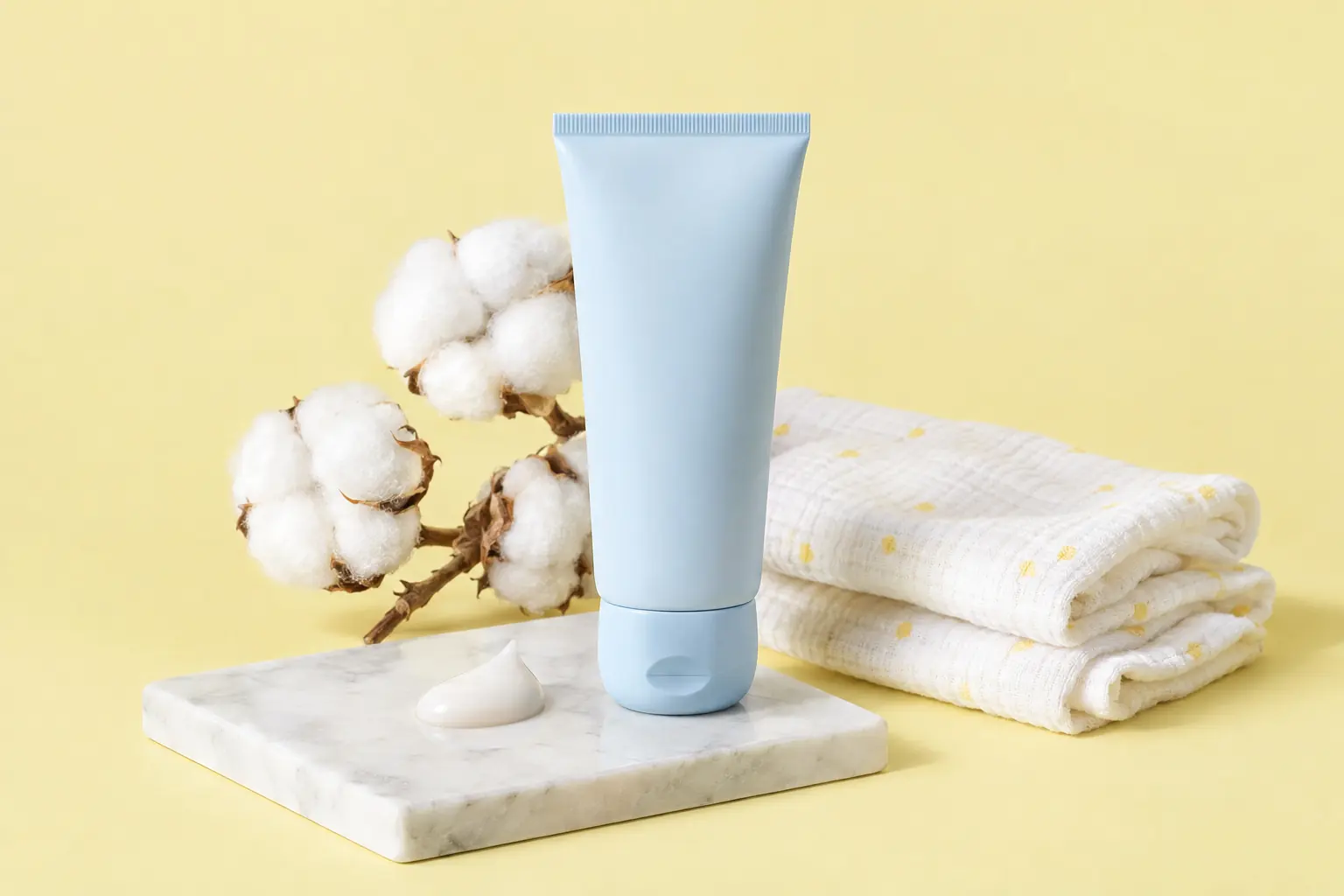
A baby leave-in conditioner is an emulsion for a child's hair that is applied and not rinsed out, which places it in a different labelling category than an ordinary shampoo. AKTO develops and manufactures this conditioner to order on its cream-emulsion line, in a 200 ml tube, with preservatives and allergens selected against the leave-on limits of Regulation (EC) No 1223/2009.
01
Leave-on hair care for babies
Company AKTO LLC (AKTO) develops and manufactures a baby leave-in conditioner to order on its cream-emulsion and liquid-formulation lines. Regulation (EC) No 1223/2009 splits cosmetic products into leave-on, not rinsed off after application, and rinse-off; a leave-in conditioner falls into the first category, which carries different allergen-labelling and preservative rules than an ordinary shampoo. The format suits curly or thick children's hair that is hard to detangle after washing: it goes on wet or dry hair and is not rinsed out, which removes a step from the morning routine and shortens the time it takes to get a child ready for daycare or school.
02
Why the preservative and allergen threshold differ
Under the Annex III allergen-labelling rules of Regulation (EC) No 1223/2009, a leave-on product such as a leave-in conditioner declares an allergen once its concentration exceeds 0.001% by weight, a lower threshold than the 0.01% that applies to a rinse-off shampoo. Methylisothiazolinone (MIT) is not permitted in leave-on cosmetic products: Commission Regulation (EU) 2016/1198 removed its leave-on use from Annex V entry 57, applicable from 12 February 2017, while Commission Regulation (EU) 2017/1224 separately lowered the rinse-off limit from 0.01% to 0.0015% (15 ppm), applicable to products placed on the market from 27 January 2018 and made available to the end user from 27 April 2018. Annex V of Regulation (EC) No 1223/2009 permits phenoxyethanol as a preservative up to a maximum concentration of 1% in the finished product, one of the alternatives used in leave-on formulations since the MIT ban. For a brand, this means the preservative choice is worth settling with AKTO at the formulation stage rather than after the label artwork is finished, since swapping a preservative in a leave-on formula can change both shelf life and the warning text on the pack.
03
The regulatory basis in Ukraine
AKTO's cosmetics, including a leave-in conditioner, fall under its own technical specification, TU U 20.4-43961492-001:2020 'Cosmetic Products' (code 20.42.15), backed by sanitary-epidemiological expert opinion No. 12.2-18-2/2361 dated 15.02.2021, issued after review by the competent state authority. Manufacturing is registered under KVED 20.42, 'manufacture of perfumes and toilet preparations'.
04
What AKTO manufactures
AKTO produces the conditioner as an emulsion in a 200 ml tube, the format and consistency documented for the company's hair-conditioner/balm line and applicable to a leave-in baby conditioner. Manufacturing runs at plants in Kyiv, Ukraine and Warsaw, Poland; certification covers ISO 9001:2015, ISO 22000:2018 (HACCP; combined certificate No. 44600111204), ISO 22716 (GMP); minimum order quantity for cosmetics starts from 50 kg. A leave-in conditioner pairs well with a baby hair-care range - shampoo, conditioner, detangling spray - when a brand wants a matching fragrance across the whole line. AKTO manufactures all of these formats on the same liquid line, so a brand can order the range in one project and get the same fragrance composition in every product instead of matching scent SKU by SKU.
05
How to start a project
- The brand sets the texture, a light emulsion or a richer cream, and the target fragrance.
- AKTO selects a preservative that respects the leave-on MIT ban and drafts allergen labelling against the lower threshold.
- A sample and the 200 ml tube are signed off.
- Production starts on the cream-emulsion line.
See also: Baby Hair Care and Kids & Baby Care.
Frequently Asked Questions
Does AKTO manufacture a baby leave-in conditioner?
How does leave-in conditioner labelling differ from shampoo?
Can MIT be used as a preservative in a leave-in conditioner?
What is AKTO's minimum order quantity for a leave-in conditioner?
Expert review
Reviewed by
 Anastasiia Bespalova
Paediatric orthopaedic and trauma surgeon
ORCID Illia Mariutsa
Researcher, organic chemistry
Google Scholar
Standards we work to
 ISO 22716 (GMP)
 ISO 22000 (HACCP)
 Regulation (EC) No 1223/2009
 Directive 2002/46/EC
 Halal
Why AKTO
- Formula built for the 0.001% leave-on allergen threshold
- MIT-free preservation in line with the ban under Regulation (EU) 2017/1224
- 200 ml tube, the same format as AKTO's hair-conditioner line
- Own technical specification TU U 20.4-43961492-001:2020