
Private Label
Wheel Cleaner
AKTO develops and manufactures wheel cleaner to order, matching concentrate acidity to the wheel finish — alloy, painted or chrome.
- REACH/CLP
In brief
AKTO develops and manufactures wheel cleaner to order on its liquid-formulation line, matching the concentrate's acidity or alkalinity to the wheel type — alloy, painted or chrome. The formula is checked against CLP classification and a REACH safety data sheet is prepared before filling starts in Kyiv (Ukraine).
01
What a wheel cleaner has to do
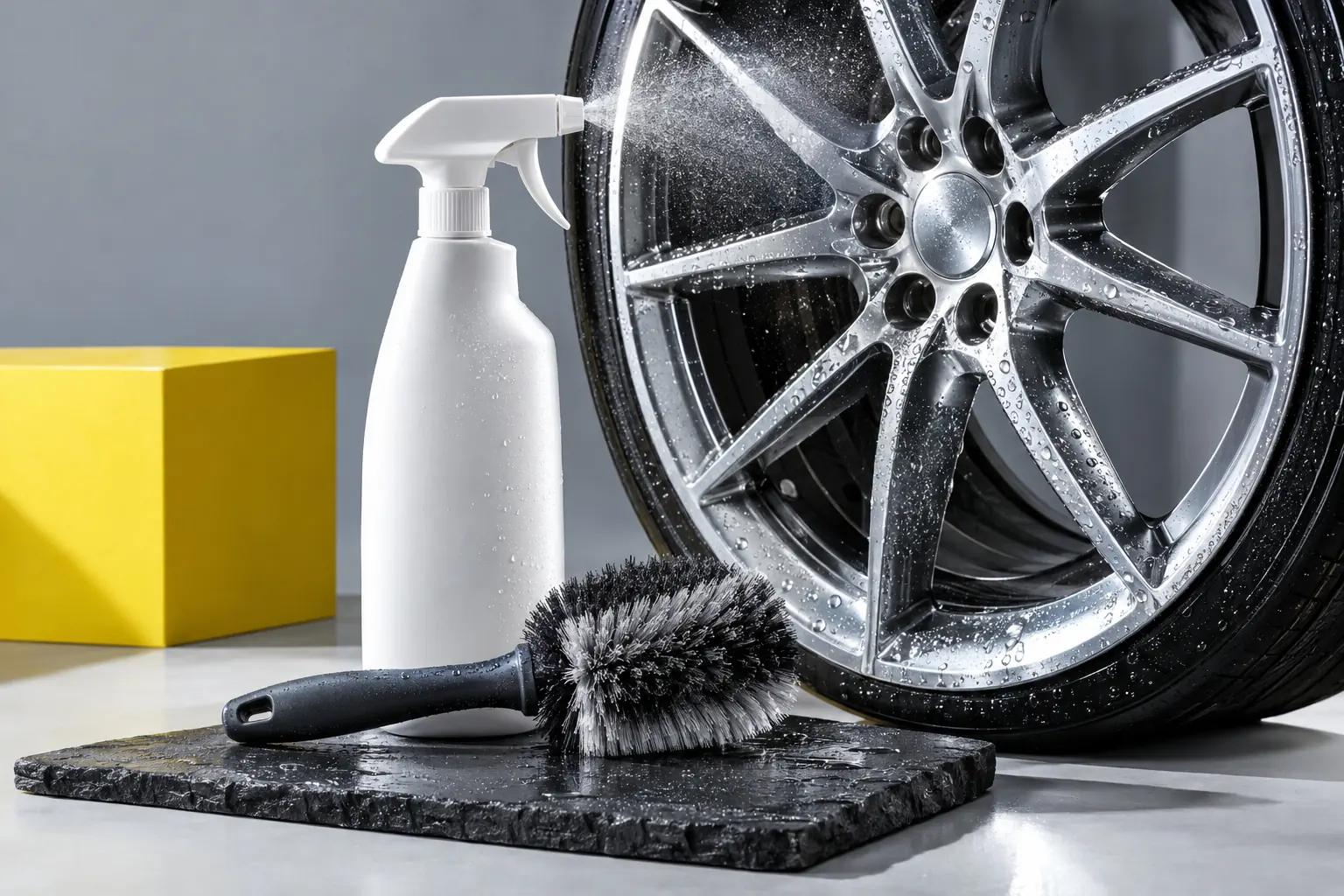
Wheels take the harshest exterior grime on a car: baked-on brake dust with iron particles bonds to alloy or painted metal every time the brakes bite, and a general car shampoo does not shift it. The formula works in the zone with the heaviest exposure to the road and the braking system, so alongside cleaning power it has to stay compatible with paint, alloy finish or chrome, without leaving spots or dulling the surface after repeated washes. AKTO develops and manufactures wheel cleaner to order on its liquid-formulation line, matching the concentrate's acidity or alkalinity to the type of buildup rather than offering one generic formula off the shelf.
02
Wheel type drives the formula
Alloy, painted and chrome wheels react differently to an aggressive concentrate, so the formula is matched to the finish rather than kept identical across the automotive-care range.
| Wheel type | What the formula accounts for |
|---|---|
| Alloy | needs a cleaner chosen for the wheel material and the type of protective finish |
| Painted steel | needs a milder blend to protect the paint layer |
| Chrome | needs a gentler pH balance, or the chrome finish dulls |
03
Hazard classification and required documents
A concentrate strong enough to break down baked-on iron particles from brake dust is usually acidic or strongly alkaline, which pushes it toward an irritant or corrosive classification under Regulation (EC) No 1272/2008 (CLP) — the label then carries the matching hazard pictograms and precautionary statements. The supplier of such a concentrate must issue a 16-section safety data sheet under Article 31 of Regulation (EC) No 1907/2006 (REACH). Regulation (EU) 2023/988, applicable since 13 December 2024, applies to the safety aspects and risks not covered by specific Union law and requires the manufacturer to carry out an internal risk analysis and draw up technical documentation before placing the product on the market (Article 9(2)); as a surfactant-based cleaning mixture, wheel cleaner is also a detergent under Regulation (EC) No 648/2004 and remains subject to CLP and REACH regardless. The UK's General Product Safety Regulations 2005 apply an equivalent regime.
04
Packaging and production
- Liquid formulation
- 250 ml trigger-spray bottle
- Pump bottle up to 1000 ml
Filling runs on AKTO's line in Kyiv (Ukraine), with a second site in Warsaw (Poland). Minimum order for a bottled format starts from 50 kg, backed by ISO 9001:2015 + ISO 22000:2018 (HACCP; certificate No. 44600111204) and ISO 22716 (GMP).
05
Getting started
A brand brief states the wheel type — alloy, painted or chrome — and the target market. AKTO's team matches the concentrate's acidity to that task, prepares the REACH safety data sheet, checks the CLP classification and fits the bottle format to the order volume before filling starts in Kyiv (Ukraine).
06
Quality control before dispatch
Before a batch ships, AKTO's lab checks the finished concentrate's consistency and active-ingredient concentration against the agreed recipe, verifies the seal on the trigger-spray or pump bottle, and checks the label copy against the target market's requirements. These checks run on every new batch, whichever wheel finish the brand is focused on, and the results are recorded in the accompanying documentation the brand receives with the shipment, ready to show its own buyers or customs.
07
See also
See also: Automotive Care, Car Glass Cleaner and Tar & Glue Remover.
Frequently Asked Questions
Does AKTO manufacture wheel cleaner?
Why are wheel-cleaner concentrates acidic or alkaline?
What hazard classification applies to wheel cleaner?
What packaging does AKTO use for wheel cleaner?
 Kateryna Khromykh
 Oleksandra Vovk
Standards we work to
 ISO 22716 (GMP)
 ISO 22000 (HACCP)
 Regulation (EC) No 1223/2009
 Directive 2002/46/EC
 Halal
Why AKTO
- Concentrate acidity is matched to alloy, painted or chrome finishes
- CLP classification and a REACH safety data sheet are prepared before filling starts
- 250 ml trigger-spray or pump bottle up to 1000 ml as standard formats
- Quality backed by ISO 9001:2015 + ISO 22000:2018 (HACCP), ISO 22716 (GMP)