
Industrial / Facade
Soot Remover (Tar Remover)
A degreasing concentrate for carbon and tar deposits on industrial equipment and surfaces, developed and produced to order under EU detergent and CLP rules.
- CLP · REACH
In brief
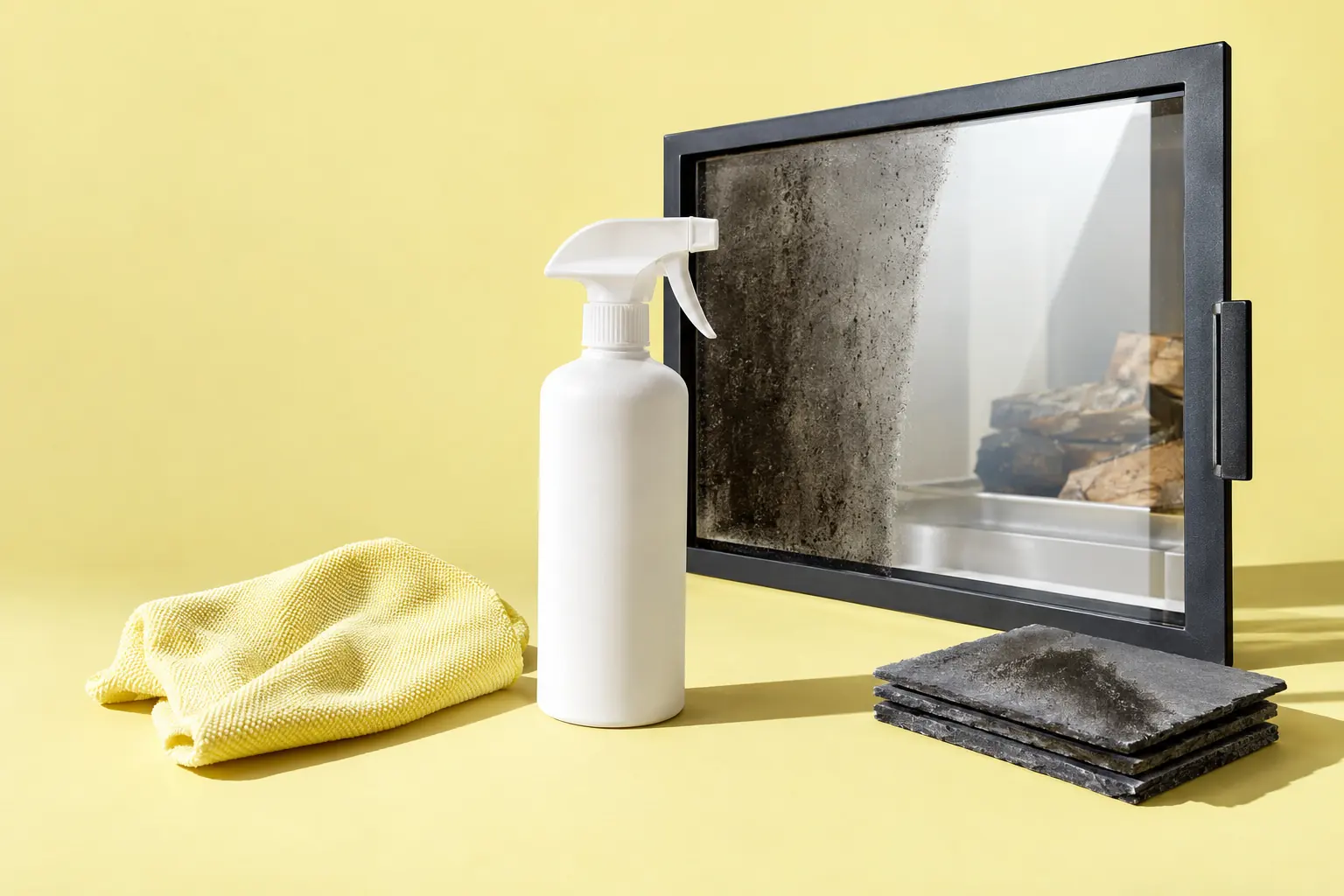
A soot remover (tar remover) is a degreasing concentrate built to break down carbon black and tar — a sticky, hydrocarbon-bound residue from combustion — rather than the mineral cement deposits an acid dissolves. AKTO develops and manufactures it to order, formulated solvent- or alkali-based to match the surface and how soon the equipment goes back into use.
01
Why soot needs a degreaser, not an acid
Soot and tar are combustion residue: fine carbon particles bound together by a sticky hydrocarbon film that builds up on chimneys, ovens, combustion equipment and facades exposed to smoke. Because that binder is organic, not mineral, it responds to a solvent- or alkali-based degreasing chemistry rather than to an acid — the reverse of a cement or mortar deposit, which is alkaline and dissolves in acid instead. A soot remover works alongside, not in place of, AKTO's general industrial degreaser: the target here is combustion residue rather than lubricating oil or process grease.
02
Where it gets used
The surface decides which chemistry and application method fit, since a flue that will be relit differs from a facade that only needs a one-off wash:
- Chimney flues and combustion equipment, where the product must be safe to use close to a heat source once it is back in service
- Facades and masonry affected by smoke damage, cleaned as a one-off after a fire or years of exposure
- Industrial machinery where carbon deposits build up gradually during normal operation
03
Solvent or alkaline: a flammability question
A solvent-based version cuts through tar fastest but is typically flammable, which matters more here than for most cleaning products, since the treated surface is often a chimney or oven about to go back into service near an open flame. A water-based alkaline degreaser usually carries a lower ignition risk but may need a longer dwell time, so AKTO agrees the chemistry with the client's technician before formulating the batch.
04
Documentation and who buys it
Regulation (EC) No 648/2004 on detergents applies to it only where the formula contains soaps and/or other surfactants (Article 2(1)) — typically the case for an alkaline degreasing version; a solvent-only remover falls outside the Regulation's definition of detergent. Where surfactants are present, Article 9(3) and Annex VII Section C require the manufacturer to provide medical personnel, on request, with the ingredient data sheet, and the further public-website version under Section D is not required for an industrial detergent supplied with a technical or safety data sheet. Where the formula is classified as flammable, irritant or corrosive, Regulation (EC) No 1272/2008 (CLP) sets the hazard labelling and REACH Article 31 requires a 16-section safety data sheet. Buyers are industrial-maintenance contractors, chimney-sweep and facade-cleaning specialists, and brands supplying carbon-removal chemistry to those trades under their own label.
05
Ordering from AKTO
AKTO produces this as a liquid formulation from a minimum of 50 kg under its KVED 20.41 registration and ISO 9001/22000 quality system, with capacity up to 150 tonnes a month in Kyiv (Ukraine) and up to 50 tonnes in Warsaw (Poland). A project starts from the target surface and whether the equipment needs to return to service quickly, which decides the solvent-or-alkali choice and the bottle format for the batch.
06
See also
Frequently Asked Questions
Why does a soot remover need a different chemistry than a cement remover?
Is a soot remover flammable?
How is it different from AKTO's industrial degreaser?
What documentation does it need in the EU?
 Kateryna Khromykh
 Oleksandra Vovk
Standards we work to
 ISO 22716 (GMP)
 ISO 22000 (HACCP)
 Regulation (EC) No 1223/2009
 Directive 2002/46/EC
 Halal
Why AKTO
- KVED 20.41 registration covers industrial removers, including soot and tar formulations
- Quality system: ISO 9001:2015 + ISO 22000:2018 (HACCP), certificate No. 44600111204
- Liquid capacity up to 150 tonnes a month in Kyiv (Ukraine), up to 50 tonnes in Warsaw (Poland)
- Solvent- or alkali-based chemistry chosen to match how soon the equipment returns to service