
Private Label
Car Glass Cleaner
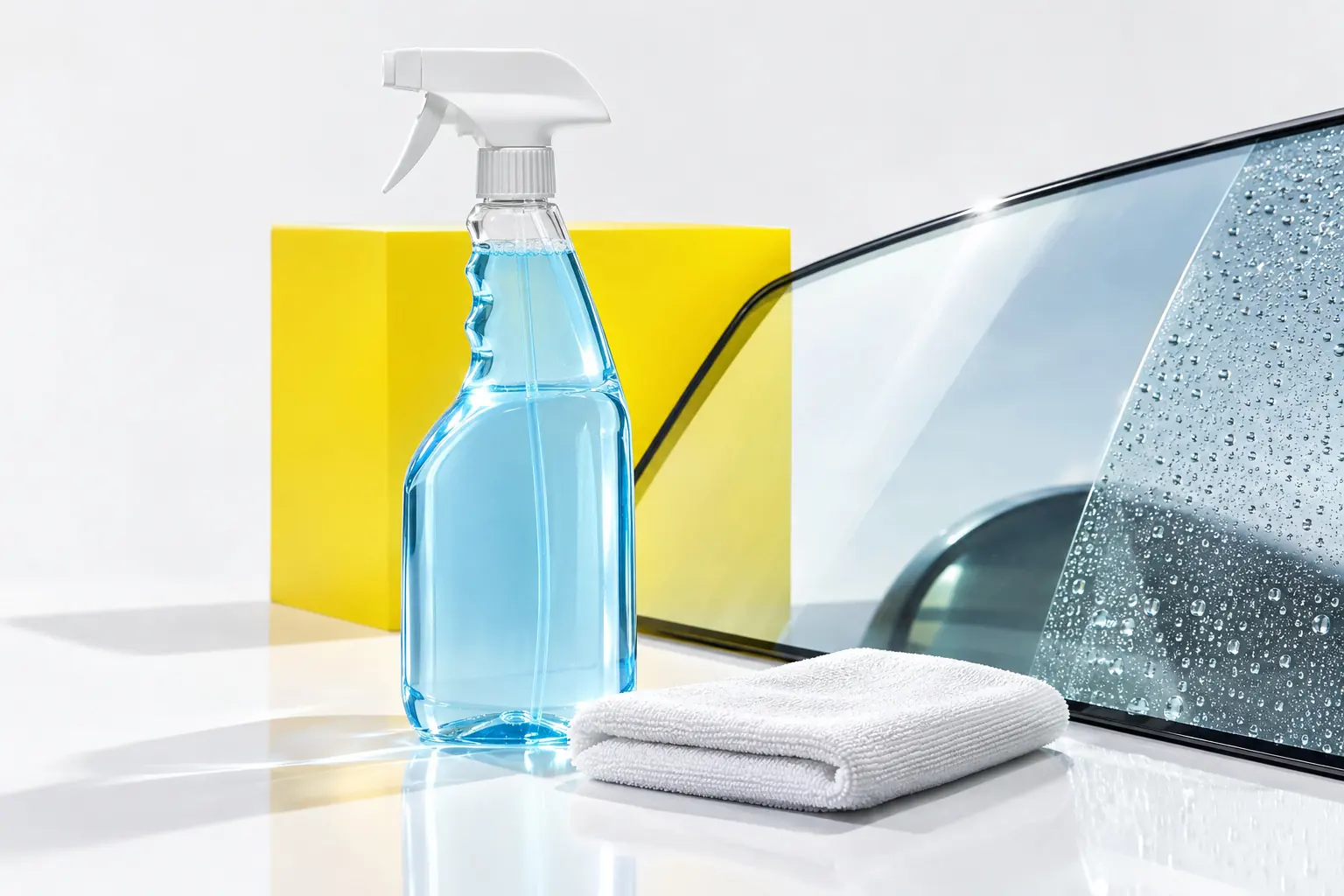
AKTO develops and manufactures a streak-free car glass cleaner to order, choosing an alcohol or ammonia base for the formula.
- REACH/CLP
In brief
AKTO develops and manufactures car glass cleaner to order on its liquid-formulation line, choosing an alcohol or ammonia base for the formula to match the brand's brief. The finished formula's CLP classification is checked and a REACH safety data sheet is prepared before filling starts in Kyiv (Ukraine).
01
Why glass cleaner is a separate product
A windscreen, side windows and mirrors have to stay streak- and film-free in any weather, since visibility on the road depends on it — the formula has to dry without residue rather than just rinse off dirt the way an interior spray does. The film on glass is a mix of road dust, exhaust particles and silicone polish residue carried over from other detailing products, which is why a glass cleaner has to meet a specific requirement: it must not leave its own trace that later smears under the wipers or throws glare at night. AKTO develops and manufactures car glass cleaner to order on its liquid-formulation line, matching the formula's base to the brand's brief.
02
Formula base
Alcohol base
An alcohol base dries fast without streaking, but at higher alcohol content the formula is classified as flammable, which affects labelling and transport.
Ammonia base
An ammonia base cuts through greasy film on glass more aggressively, but is more often classified as an eye irritant and needs clearer precautionary statements on the label.
03
EU and UK regulatory requirements
Depending on whether the alcohol or ammonia base is classified as flammable or as an irritant under Regulation (EC) No 1272/2008 (CLP), the label carries the matching hazard pictograms and precautionary statements. In the UK, the General Product Safety Regulations 2005 apply an equivalent baseline duty to place only a safe product on the market. The supplier of a mixture classified as hazardous must issue a 16-section safety data sheet under Article 31 of Regulation (EC) No 1907/2006 (REACH).
04
Production at AKTO
- Liquid formulation
- 250 ml trigger-spray bottle
- Pump bottle up to 1000 ml
The filling line runs in Kyiv (Ukraine), with a second site in Warsaw (Poland). From 50 kg of liquid, the product is delivered under ISO 9001:2015 + ISO 22000:2018 (HACCP; certificate No. 44600111204).
05
Steps for a brand
A brand brief states whether the base should be alcohol- or ammonia-led and the target market. AKTO's team checks the finished formula's CLP classification, prepares the REACH safety data sheet and matches the bottle format to the order volume before filling starts in Kyiv (Ukraine).
06
Streak test before launch
Before a final recipe is locked in, AKTO tests it on glass across a range of humidity and air temperature, the conditions where an alcohol or ammonia base is most likely to leave streaks or a thin film visible against sunlight. The test results shape the final ratio of alcohol, ammonia and surfactant in the formula, which is then fixed for series filling so that every later batch dries equally clean on glass.
07
See also
See also: Automotive Care, Wheel Cleaner and Interior Cleaner.
Frequently Asked Questions
Does AKTO manufacture car glass cleaner?
What is the difference between an alcohol and an ammonia base?
What CLP requirements apply to glass cleaner?
What packaging does AKTO use for glass cleaner?
 Kateryna Khromykh
 Oleksandra Vovk
Standards we work to
 ISO 22716 (GMP)
 ISO 22000 (HACCP)
 Regulation (EC) No 1223/2009
 Directive 2002/46/EC
 Halal
Why AKTO
- Alcohol or ammonia base is chosen to match the brand's brief
- CLP classification and a REACH safety data sheet are prepared before filling
- 250 ml trigger-spray or pump bottle up to 1000 ml
- Quality controlled to ISO 9001:2015 + ISO 22000:2018 (HACCP; No. 44600111204)