
ISO 22716 (GMP) and ISO 22000 (HACCP)
Stability & Compatibility Testing
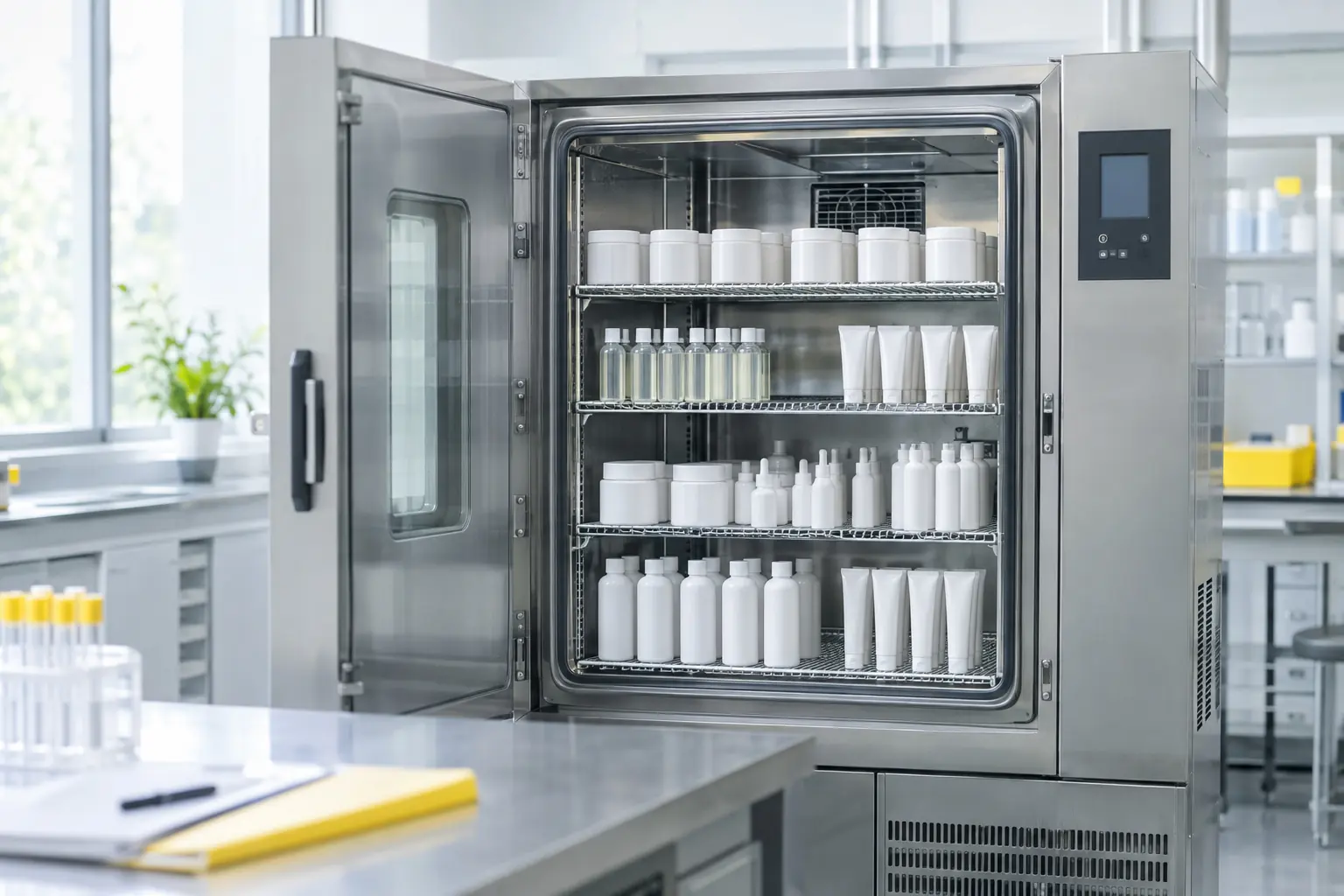
Comprehensive stability and compatibility testing services to validate shelf-life and packaging suitability for cosmetics and supplements. ISO 22716 (GMP) and ISO 22000 (HACCP) compliant.
Quick Answer Overview
What You Need To Know
Stability and compatibility testing verifies that a cosmetic or supplement formulation retains its physical, chemical, and microbiological integrity over its shelf life. At AKTO, this includes accelerated aging, freeze-thaw cycles, and packaging compatibility assessments to ensure safety and regulatory compliance before market release.
01
Ensuring Formulation Integrity Through Rigorous Science
In the world of private label cosmetics and dietary supplements, the stability of a formulation is the bedrock of brand reputation. Our stability and compatibility testing protocols are designed to predict how a product will perform over its entire shelf life under various environmental conditions. By leveraging advanced manufacturing services and R&D expertise, we ensure that every emulsion, serum, and suspension maintains its physical, chemical, and microbiological integrity from the moment of production until it reaches the consumer.
We operate strictly according to ISO 22716 (GMP) and ISO 22000 (HACCP) standards, utilizing a data-driven approach to validate product formula design. This allows us to assess how changes in temperature, light exposure, or humidity affect your product's quality.
02
Packaging Compatibility & Interaction
A great formula can fail if it reacts poorly with its container. Our compatibility testing evaluates the interaction between the bulk product and its primary packaging. We assess risks such as migration (packaging components leaching into the product), sorption (product ingredients being absorbed by the packaging), and physical deformation. This step is critical for new product development, ensuring that the final package preserves the quality of the content without leakage or degradation.
03
Testing Methodologies
- Accelerated Aging: Simulating long-term storage by subjecting samples to elevated temperatures (e.g., 40°C, 50°C) to predict shelf life efficiently.
- Freeze-Thaw Cycles: Stress-testing formulations by cycling them between freezing and heating to ensure emulsion stability during transport.
- Photostability: Assessing color and fragrance stability under intense light exposure.
- Microbiological Challenge Testing: Verifying the efficacy of the preservative system against microbial contamination.
04
Strategic R&D Support
Our laboratory does not just identify failures; we provide solutions. If a formulation shows signs of instability, our R&D related activities kick in to diagnose the root cause—whether it is an incompatible emulsifier, an oxidation-prone active, or a packaging mismatch—and re-engineer the solution for optimal performance.
See also: Incoming Quality Control, In-Process Quality Control, and Finished Product Quality Control.
Expertise & Compliance Information
05
Need Stability Testing?
Explore Related Quality Control Services
Discover our comprehensive approach to maintaining product integrity at every stage of the manufacturing cycle.
Frequently Asked Questions
Why is stability testing mandatory for cosmetics?
Do you offer R&D related activities if my formula fails testing?
How long does stability testing typically take?
What is included in compatibility testing?
How can I start the stability testing process?
Expert review
Reviewed by
 Illia Mariutsa
PhD Student (Postgraduate Researcher), Department of Organic Chemistry, National University of Pharmacy (Kharkiv, Ukraine)
Google Scholar
 ISO 22716:2007 (GMP)
 ISO 22000:2018 (HACCP)
 HALAL (Saudi Halal Center / recognized Halal CBs)
 GCC Standardization Organization (GSO) — Gulf Standards
 Saudi Arabia Conformity Assessment — SASO / SALEEM / SABER
 Regulation (EC) No 1223/2009 — EU Cosmetics Regulation