
Construction / Facade
Cement Residue Remover (Brick Acid)
An acid-based concentrate for removing cement and mortar residue from masonry after building work, developed and produced to order under EU detergent and CLP rules.
- CLP · REACH
In brief
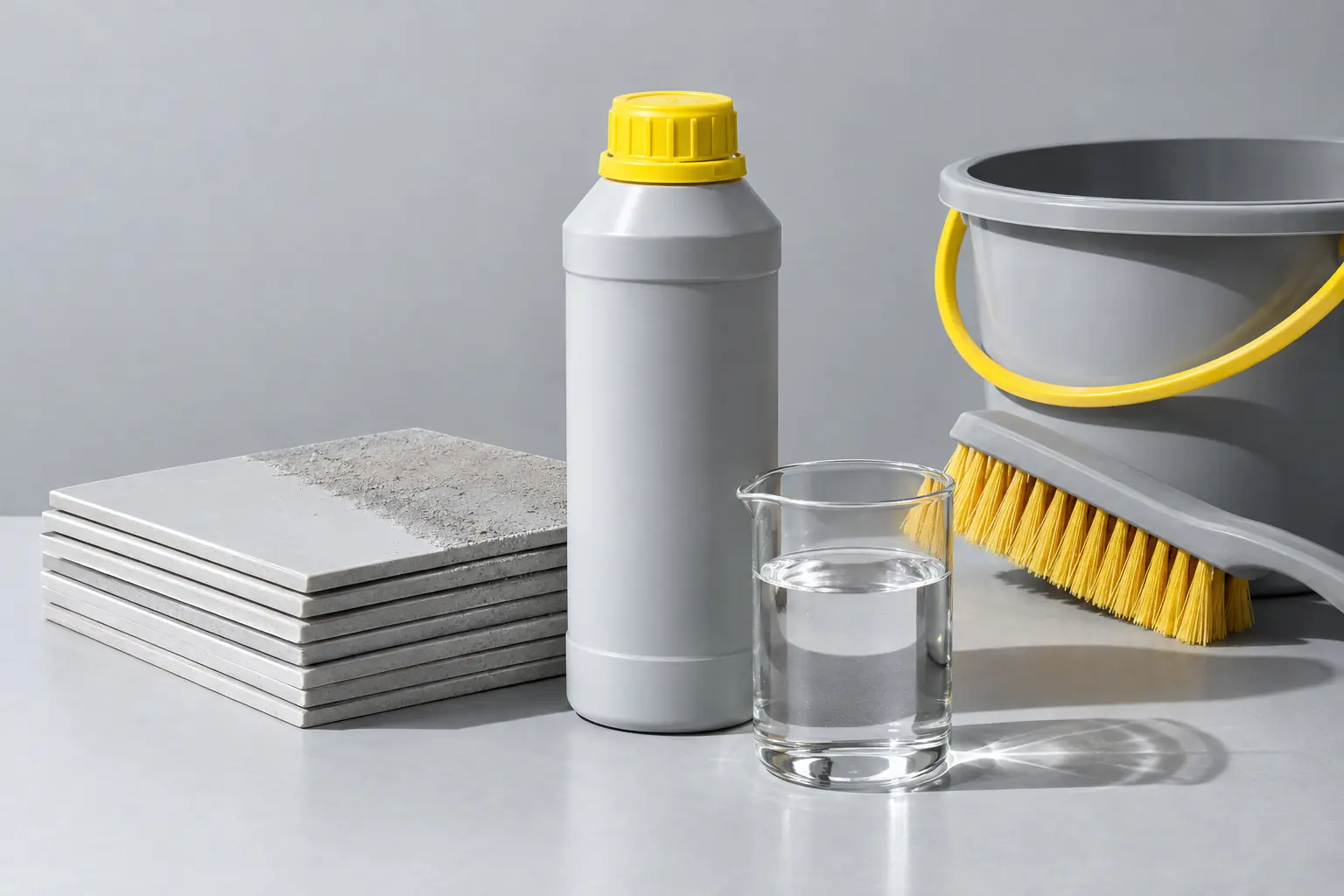
A cement residue remover (brick acid) is an acid concentrate that dissolves alkaline cement and lime deposits on masonry — the opposite chemistry from a soot remover, which lifts organic carbon deposits instead. AKTO develops and manufactures it to order, sized for a contractor's spot treatment or a full facade clean-up.
01
Why cement residue needs an acid, not a degreaser
Fresh cement, mortar and grout are alkaline: they contain calcium hydroxide and other lime compounds that react with an acid rather than dissolving in a surfactant-based degreaser. A cement residue remover, known in the trade as brick acid, is formulated around that reaction to dissolve splashes, grout haze and efflorescence from brick, stone and concrete before they cure into a permanent stain. This is the reverse problem to soot or tar, which is organic and carbon-based and calls for a degreasing chemistry instead of an acid. New masonry is the most common case: a bricklaying crew moves on before every trace of cement splash has been wiped off each course, leaving the finishing trade to remove it once the wall is otherwise complete.
02
How a facade clean-up typically runs
Timing and testing matter more for this category than for most professional cleaners:
- The residue is easiest to remove within days of the masonry work, before it fully cures
- A small, inconspicuous area is tested first, since the acid can etch some stone finishes or shift the colour of certain bricks
- The surface is pre-wetted, the product applied according to the manufacturer's instructions, then rinsed thoroughly to stop the reaction before it dries
03
Who buys it
Buyers are construction contractors, facade-cleaning crews and masonry restoration companies, along with brands supplying acid-based construction chemicals to that trade — a different customer base from AKTO's HoReCa- and food-oriented cleaning range, and often a single line item on a snagging list at the end of a build rather than a recurring order.
04
Corrosivity and documentation
Because it is typically classified as corrosive to skin and eyes, Regulation (EC) No 1272/2008 (CLP) governs its hazard labelling and packaging before supply to professional users, and under REACH Article 31 the supplier provides a 16-section safety data sheet. Regulation (EC) No 648/2004 on detergents applies to it only where the formulation contains soaps and/or other surfactants (Article 2(1)); a surfactant-free acid remover falls outside the Regulation's definition of detergent. Where it does contain surfactants, Article 9(3) and Annex VII Section C require the manufacturer to provide medical personnel, on request, with the ingredient data sheet, and the further public-website version under Section D is not required for an industrial or institutional detergent supplied with a technical or safety data sheet.
05
Ordering from AKTO
AKTO supplies this as a liquid formulation from a minimum of 50 kg, packaged in bottles with a flip-top, pump or trigger closure sized to the job — a small trigger bottle for one facade, or bulk containers for a full-site clean-up crew — and produced under its KVED 20.41 registration and ISO 9001/22000 quality system at plants in Kyiv (Ukraine) and Warsaw (Poland). A project starts from the target masonry and application method, and AKTO confirms the CLP corrosivity classification before scaling the batch.
06
See also
Frequently Asked Questions
Why does a cement residue remover use acid instead of a degreaser?
How soon after masonry work should it be used?
Will it damage the brick or stone?
What documentation does it need in the EU?
 Kateryna Khromykh
 Oleksandra Vovk
Standards we work to
 ISO 22716 (GMP)
 ISO 22000 (HACCP)
 Regulation (EC) No 1223/2009
 Directive 2002/46/EC
 Halal
Why AKTO
- KVED 20.41 registration covers acid-based construction and industrial cleaning formulations
- Quality system: ISO 9001:2015 + ISO 22000:2018 (HACCP), certificate No. 44600111204
- Liquid capacity up to 150 tonnes a month in Kyiv (Ukraine), up to 50 tonnes in Warsaw (Poland)
- Two-plant footprint in Kyiv (Ukraine) and Warsaw (Poland) for regional supply to construction-chemical brands