
Private Label
Upholstery Cleaner
AKTO develops a foaming upholstery and carpet cleaner to order for automotive-care brands, in trigger-spray or pump bottles, checked against REACH Annex XVII and Ukraine's phosphate limit.
- REACH XVII
In brief
AKTO develops upholstery cleaner to order as a foaming formula for seat fabric, carpet and headliners, filled into a 250 ml trigger-spray or a pump bottle up to 1000 ml. Any solvent-boosted stain remover in the formula is checked against the REACH Annex XVII limit on halogenated solvents, and the surfactant against Ukraine's phosphate cap for detergents.
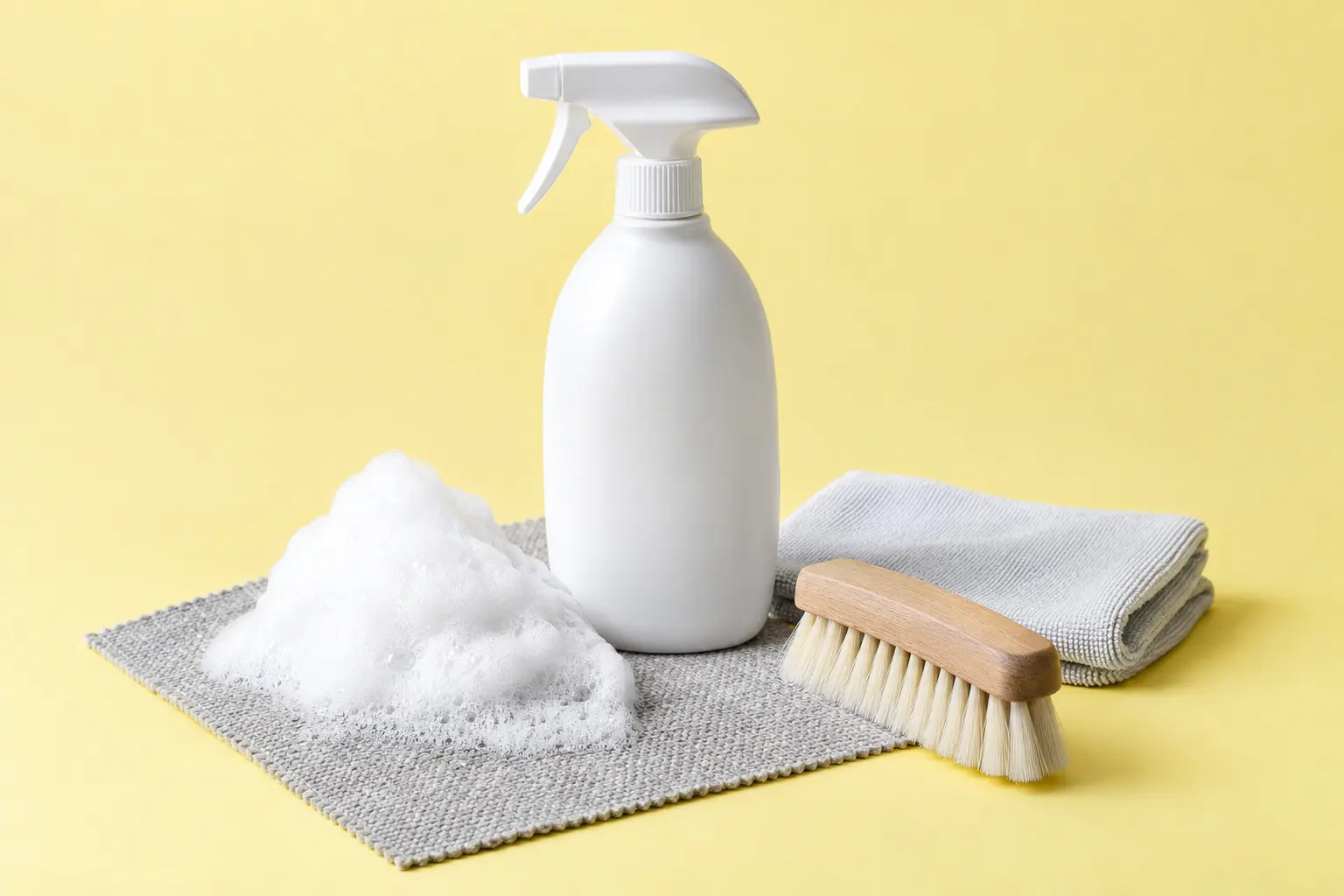
01
Built for fibres, not hard trim
Upholstery cleaner is a foaming spray for seat fabric, floor mats and headliners - a different job from wiping a hard vinyl or plastic surface, because it has to work a stain out of fibres rather than just lift dust off the top. Detailing brands round out an interior-care range with it once they already carry a hard-surface interior cleaner. Company AKTO LLC (AKTO) develops the foaming system and bottle to order, matched to a brand's brief rather than supplied from stock.
02
Where it goes
| Surface | Typical soiling |
|---|---|
| Seat fabric | Body-contact stains, general grime |
| Floor mats and carpet | Ground-in dirt, mud |
| Headliner | Light surface soiling, requires a lower-moisture approach |
03
Two limits that shape the formula
REACH Annex XVII entries 32-38 cap chloroform, 1,1,2-trichloroethane, 1,1,2,2- and 1,1,1,2-tetrachloroethane, pentachloroethane and 1,1-dichloroethene at 0.1% by weight where the substance or mixture is intended for supply to the general public and/or for diffusive applications such as surface cleaning and cleaning of fabrics - a limit AKTO checks against any solvent-boosted stain remover before it goes into a formula. On the Ukrainian market, the Technical Regulation on Detergents (Resolution No. 717/2008, Annex 1 as restated by Resolution No. 1370/2023) sets a 0.05% total-phosphorus limit for the finished formula, binding from 90 days after the end of martial law in Ukraine and voluntary until then.
04
Production and packaging
AKTO fills the foaming formula into a 250 ml trigger-spray bottle or a pump bottle up to 1000 ml at its Kyiv (Ukraine) plant, alongside a second site in Warsaw, Poland; an order for this liquid format starts from 50 kg.
05
Getting started
A brand brief names the target surface - seat fabric, carpet, headliner - and the stain type it needs to lift. AKTO checks any solvent component against the REACH Annex XVII limit and the surfactant against the Ukrainian phosphate cap before matching the bottle to the order volume.
06
Keeping the compliance record with the batch
Any solvent-boosted stain-removal component gets checked against the REACH Annex XVII limit before it enters the formula, and that check is filed with the surfactant's phosphate data against the Ukrainian cap - both tied to a retained sample from the fill date. A brand exporting the same upholstery cleaner to more than one market can pull this record instead of re-verifying compliance for every shipment.
The same record makes a repeat order easier too: if a brand later wants to adjust the foaming system for a different fabric or add a fragrance-free variant, AKTO updates the formula while keeping the already-confirmed REACH and phosphate limits on file, rather than starting compliance checks over from scratch.
07
See also
See also: Automotive Care, Interior Cleaner and Cockpit Spray.
Frequently Asked Questions
Why does a halogenated-solvent limit matter for a fabric cleaner?
Does the formula have to be phosphate-free?
What packaging does AKTO use for upholstery cleaner?
What's the minimum order for upholstery cleaner?
 Kateryna Khromykh
 Oleksandra Vovk
Standards we work to
 ISO 22716 (GMP)
 ISO 22000 (HACCP)
 Regulation (EC) No 1223/2009
 Directive 2002/46/EC
 Halal
Why AKTO
- Foaming system built for fibres - seats, mats, headliners - not hard trim
- Solvent components checked against the REACH Annex XVII halogenated-solvent limit
- Surfactant kept under Ukraine's phosphate cap for detergents
- 250 ml trigger or up to 1000 ml pump, filled in Kyiv (Ukraine) alongside the Warsaw (Poland) plant