
Private Label
Probiotics (Bio-Cultures)
Live-culture capsule and sachet supplements sit under some of the strictest EU claims rules in the category - AKTO explains the regulatory path before taking on a formula.
- EFSA QPS Aware
In brief
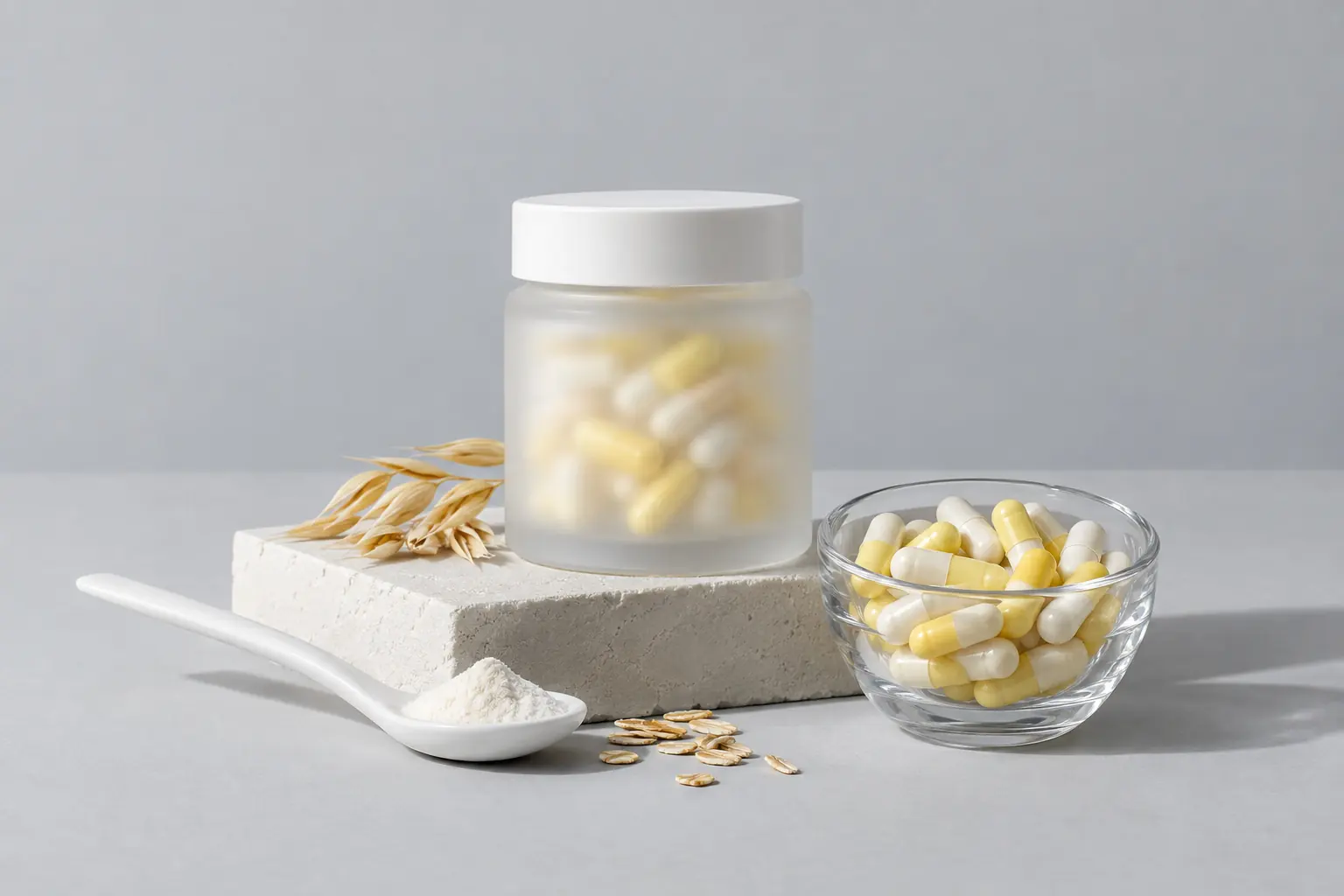
Probiotic or bio-culture supplements contain live microorganism strains, most often Lactobacillus or Bifidobacterium species, sold in a capsule or sachet format. Company AKTO LLC (AKTO) develops probiotic capsule and sachet formats to order; the word 'probiotic' is itself treated under EU guidance as implying a health claim, and no 'probiotic' health claim has been authorised to date, which shapes how any project in this category has to start.
Explore this section
01
What probiotic supplements cover and who this is for
A probiotic or bio-culture supplement delivers live microorganisms, typically Lactobacillus or Bifidobacterium species, in a capsule or sachet designed to survive to the point of use. This page is for a brand exploring the category for the first time and needing to understand why it behaves so differently, legally, from a vitamin or botanical supplement before briefing a formula. Two questions usually decide whether a probiotic project can move forward at all: is the strain already recognised as safe, and is there any authorised claim it can legally carry - both are covered below before AKTO's own formulation capability.
02
Why the word 'probiotic' is itself a regulatory question
The term 'probiotic' is not defined in Regulation (EC) No 1924/2006 itself, but the European Commission's 2007 implementation guidance treats it as implying a health benefit - in effect, a health claim. Under Article 10 of the Regulation, such a claim may only be used if it is authorised and included in the EU register of permitted claims, and no 'probiotic' health claim has been authorised to date. In practice this means a brand usually has to market the product by strain name and colony-forming-unit count rather than by the word 'probiotic' as a claim.
03
Safety status versus claims and novel-food status
EFSA's Qualified Presumption of Safety (QPS) list gives common probiotic genera such as Lactobacillus and Bifidobacterium species a pre-assessed safety opinion, but a QPS listing is a safety assessment only - it does not itself authorise a health claim. A strain without a documented history of significant consumption in the EU before 15 May 1997 additionally requires authorisation as a novel food under Regulation (EU) 2015/2283 before it can be marketed as a supplement ingredient. Directive 2002/46/EC's Annex I positive list covers only vitamins and minerals; live microorganism strains fall entirely outside it and are instead governed by these general food-safety and novel-food rules.
04
What AKTO offers in this category
AKTO develops probiotic and bio-culture supplements to order on its standard capsule and sachet/stick lines, applying the regulatory framework above and its general dietary-supplement capability to each project. AKTO's dietary-supplements service line states that its R&D team supports brands with tailored formulation strategies, excipient compatibility testing and active-ingredient verification - work directly relevant to a live-culture formula, where excipient choice and stability affect whether the strain survives to the point of use. The minimum order is from 10 kg of raw material or 20,000 capsules.
05
Starting a probiotic project with AKTO
A brand names its target strain or strains; AKTO's regulatory team checks the strain against the EFSA QPS list for a safety opinion, confirms whether it needs Novel Food authorisation under Regulation 2015/2283, and reviews which, if any, strain-specific claim is in the Regulation 1924/2006 register before marketing language is finalised. Because neither the safety opinion nor the Novel Food question can be shortcut, a realistic probiotic timeline should assume more regulatory lead time than a vitamin or mineral capsule of comparable complexity. See also: Extracts & Botanical Blends, Functionals & Antioxidants, Capsules and Dietary Supplements.
Frequently Asked Questions
Has AKTO manufactured a probiotic supplement before?
Why can't a brand just call a product 'probiotic' on the label?
Does an EFSA QPS safety listing mean a claim is allowed?
When does a probiotic strain need Novel Food authorisation?
 Svitlana Mysiura
 Anastasiia Bespalova
Standards we work to
 ISO 22716 (GMP)
 ISO 22000 (HACCP)
 Regulation (EC) No 1223/2009
 Directive 2002/46/EC
 Halal
Why AKTO
- R&D support for excipient compatibility and strain verification
- Standard capsule and sachet/stick formats available
- Regulatory check against EFSA QPS and Novel Food status before launch
- Minimum order from 10 kg or 20,000 capsules