
Private Label
Nail Polish Remover (Acetone-Based)
The classic acetone solvent for fast polish removal - AKTO develops and manufactures it under a brand's own label in a spill-resistant bottle.
- Nails & Cuticle Care
In brief
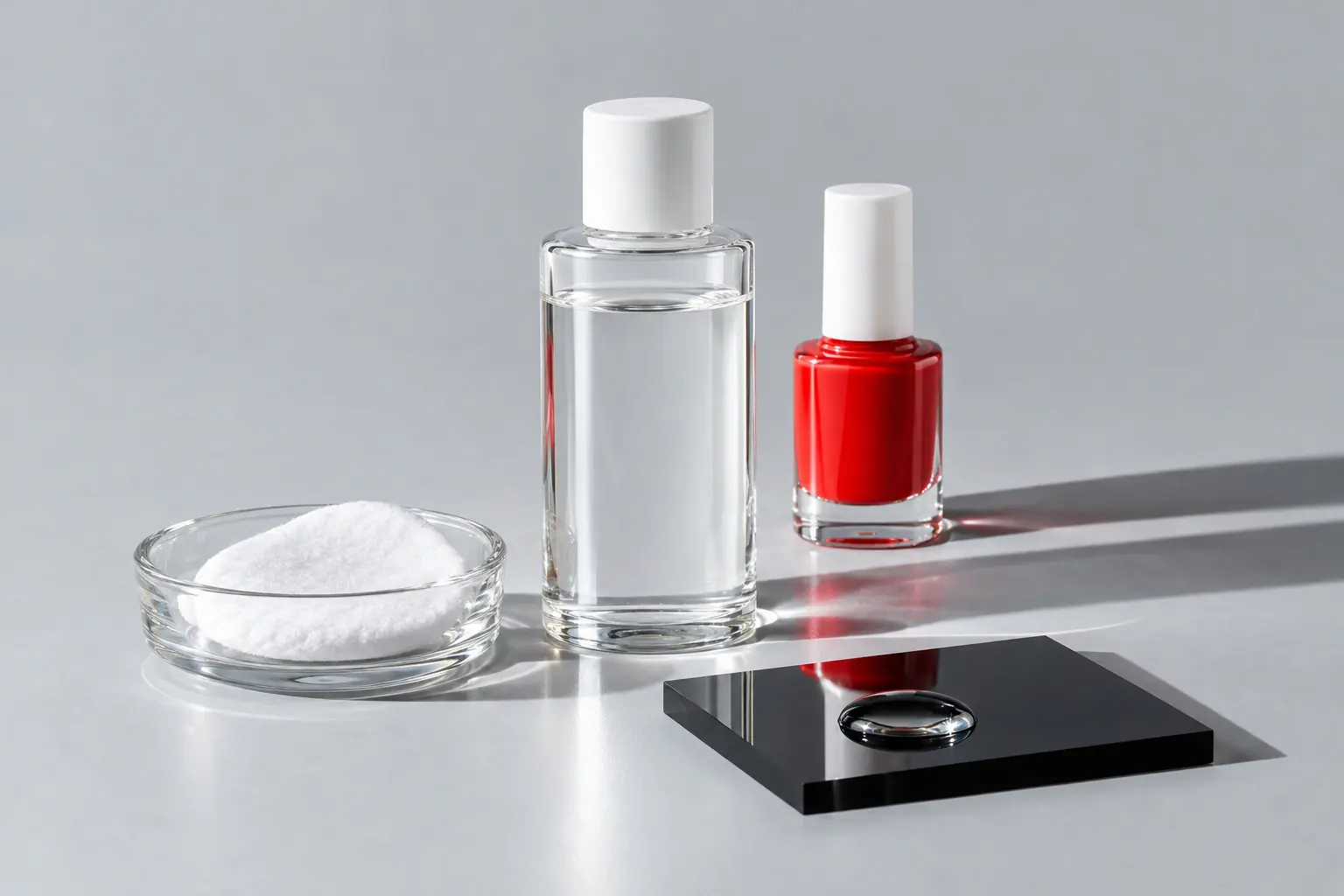
An acetone-based nail polish remover is a cosmetic liquid built on acetone, classified as a highly flammable liquid. AKTO develops and manufactures this liquid on its solvent-formulation lines to order, in a control-cap bottle, with a lead time from 4 weeks and 100% prepayment.
01
Acetone: the formula's core chemistry
Acetone (PubChem CID 180) carries a consistent GHS hazard classification of H225 'Highly flammable liquid and vapour' across regulatory data sources, and this property drives the solvent's flammability in an acetone-based nail polish remover. A classic acetone formula is one of the common options for quickly removing stubborn polish or gel coating, which is why many brands keep it alongside a gentler acetone-free formula in the same range, especially for the salon segment, where speed of removal matters as much as gentleness on the nail plate.
02
No Annex III cap, despite the flammability
Despite its flammability and defatting effect on the nail plate, acetone has no dedicated entry in Annex III to Regulation (EC) No 1223/2009, the list of restricted cosmetic substances, so its use in a nail polish remover is governed only by the Regulation's general safety-assessment requirement rather than a substance-specific concentration cap. Unlike toluene - a nail-lacquer solvent capped at 25% under the same Annex's entry 185, with mandatory child-safety and adult-use warnings - acetone carries no equivalent cap despite being the dominant solvent in an acetone-based remover.
03
The finished bottle sits outside CLP
A finished acetone-based nail polish remover, being a cosmetic product under Regulation (EC) No 1223/2009, is exempt from the classification, labelling and packaging requirements of Regulation (EC) No 1272/2008 (CLP) under Article 1(5)(c), so the finished retail bottle need not carry CLP hazard labelling even though the raw acetone solvent is classified as highly flammable before formulation.
04
What AKTO offers
AKTO's packaging range includes control-cap dispenser bottles - a spill-resistant closure suited to a flammable, spill-sensitive liquid such as an acetone-based remover - alongside flip-top bottles. Lead time runs from 4 weeks, with 100% prepayment. Integrating modern manufacturing technologies with AKTO's research capabilities shortens time-to-market while keeping the product's efficacy intact, which matters for a volatile solvent that needs tight packaging and a fast cycle from formula to finished batch. Manufacturing takes place at plants in Kyiv (Ukraine) and Warsaw (Poland), certified to ISO 9001:2015, ISO 22000:2018 (HACCP), ISO 22716 (GMP).
05
Getting started
- The brand supplies a technical brief: acetone concentration, scent, bottle format.
- AKTO formulates the liquid and checks it against the general safety requirement.
- The brand approves the sample and the lead time from 4 weeks.
- AKTO starts series production against 100% prepayment and an agreed delivery schedule.
See also: Nails & Cuticle Care, Nail Polish Remover (Acetone-Free) and Cuticle Softener Treatment.
Frequently Asked Questions
What GHS hazard classification does acetone carry?
Does Annex III cap the concentration of acetone?
Does a finished acetone-based bottle need CLP hazard labelling?
What is the lead time for an acetone-based polish remover?
 Kateryna Khromykh
 Oleksandra Vovk
Standards we work to
 ISO 22716 (GMP)
 ISO 22000 (HACCP)
 Regulation (EC) No 1223/2009
 Directive 2002/46/EC
 Halal
Why AKTO
- Control-cap bottles resist spilling of a flammable liquid
- Lead time from 4 weeks
- Modern manufacturing technology shortens time-to-market
- Manufacturing to ISO 22716 (GMP) at plants in Kyiv (Ukraine) and Warsaw (Poland)