
Private Label
Liquid Extracts
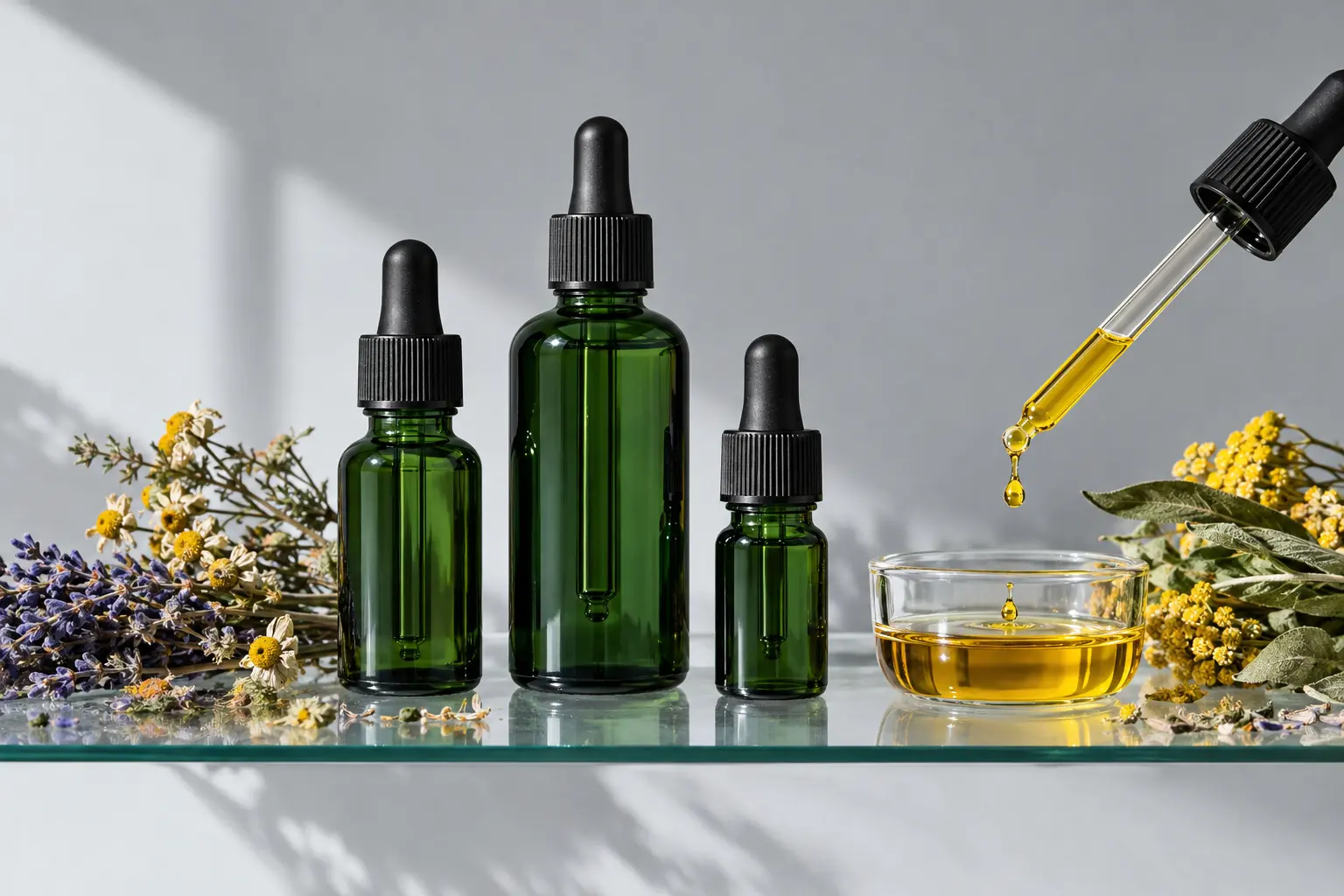
A concentrated botanical liquid taken in drops: AKTO develops and manufactures liquid extracts to order on its liquid-formulation lines.
- ISO 22000 (HACCP)
In brief
A liquid extract is a concentrated, tincture-style botanical preparation taken in drops or diluted in water. Company AKTO LLC (AKTO) develops and manufactures liquid extracts to order on its liquid-formulation lines, setting the extraction ratio, carrier and preservation per project at the technical-brief stage, in line with EU rules for botanical actives.
Explore this section
01
What a liquid extract is and who it suits
A liquid extract is a concentrated botanical preparation, usually carried in a water-glycol base, dosed in drops or diluted in water rather than swallowed as a capsule or tablet. It suits a brand whose active ingredient is a specific plant material and who wants a dosing format more concentrated than a syrup and more flexible than a fixed capsule fill. AKTO develops and manufactures liquid extracts to order on its liquid-formulation lines, alongside its wider range of liquid dietary-supplement formats built on the same water-propylene-glycol carrier and drop-dosing principle.
02
Concentration, carrier and preservation
Extraction ratio, solvent system and preservative are set individually for each formula at the technical-brief stage. AKTO already specifies standardised botanical concentration on its raw-material loading tables for capsule formulas - for example a 45% saw palmetto extract, or extracts expressed at a 5:1 ratio such as pygeum bark or nettle root - and applies the same loading-table logic to a liquid extract's active-to-carrier ratio. A brand's technical brief records the desired plant material, target concentration and any free-from claims before a development operating sheet is opened, and preservation is set against the food category that applies to liquid supplements.
03
EU rules for a botanical active
A plant-derived liquid extract sits outside the EU-harmonised vitamin/mineral list in Annex I/II of Directive 2002/46/EC, so it is instead assessed under Member States' own national rules and general EU food-safety law. EFSA's Compendium of Botanicals is a safety-screening reference listing plant species and preparations that may contain natural substances of possible toxicological concern, such as pyrrolizidine alkaloids or hydroxyanthracene derivatives - a relevant check for a concentrated liquid extract. Regulation (EU) 2015/2283 requires pre-market authorisation for a plant extract without a significant history of human consumption in the EU before 15 May 1997, and separately for food resulting from a production process not used in the EU before that date where the process gives rise to significant changes in the food's composition or structure. Regulation (EC) No 1925/2006, Annex III, lists substances whose addition to food is prohibited, restricted or under Community scrutiny - a further screening step applied to the botanical inputs of an extract.
04
AKTO's lines, minimum order and certification
AKTO's liquid-formulation lines run up to 150 t of liquid product a month at the Kyiv (Ukraine) plant and up to 50 t a month in Warsaw (Poland) - the capacity into which a liquid-extract batch is blended and bottled. Dietary supplements start from a minimum order of 10 kg of formula or 20,000 capsules for solid-dose lines, with the liquid-extract quantity agreed per project. Manufacturing runs under ISO 9001:2015 and ISO 22000:2018 (HACCP; certificate No. 44600111204) across both plants.
05
Starting a liquid-extract project
A brand names the plant material, the target concentration and the intended dosing; AKTO checks the botanical against the EFSA Compendium and the Novel Food rule in Regulation 2015/2283, sets the extraction ratio and preservation on a development operating sheet, and runs a test batch on its liquid-formulation line before the product moves toward market placement. See also: Liquid Drops, Liquid Supplements "shots" and Dietary Supplements.
Frequently Asked Questions
Does AKTO manufacture liquid botanical extracts?
How is a botanical active checked under EU rules?
What liquid production capacity does AKTO offer?
What is the minimum order for a liquid-extract project?
 Svitlana Mysiura
 Anastasiia Bespalova
Standards we work to
 ISO 22716 (GMP)
 ISO 22000 (HACCP)
 Regulation (EC) No 1223/2009
 Directive 2002/46/EC
 Halal
Why AKTO
- Extraction ratio and carrier set per project at the technical-brief stage
- Raw-material loading-table approach already used for standardised botanical actives
- Liquid lines up to 150 t/month in Kyiv (Ukraine), up to 50 t/month in Warsaw (Poland)
- ISO 9001:2015, ISO 22000:2018 (HACCP; No. 44600111204)