
Development to order
Alcohol-free Hand Sanitizer
Without alcohol, the disinfecting action rests on a different active substance, and a disinfection claim moves the product into biocide regulation.
In brief
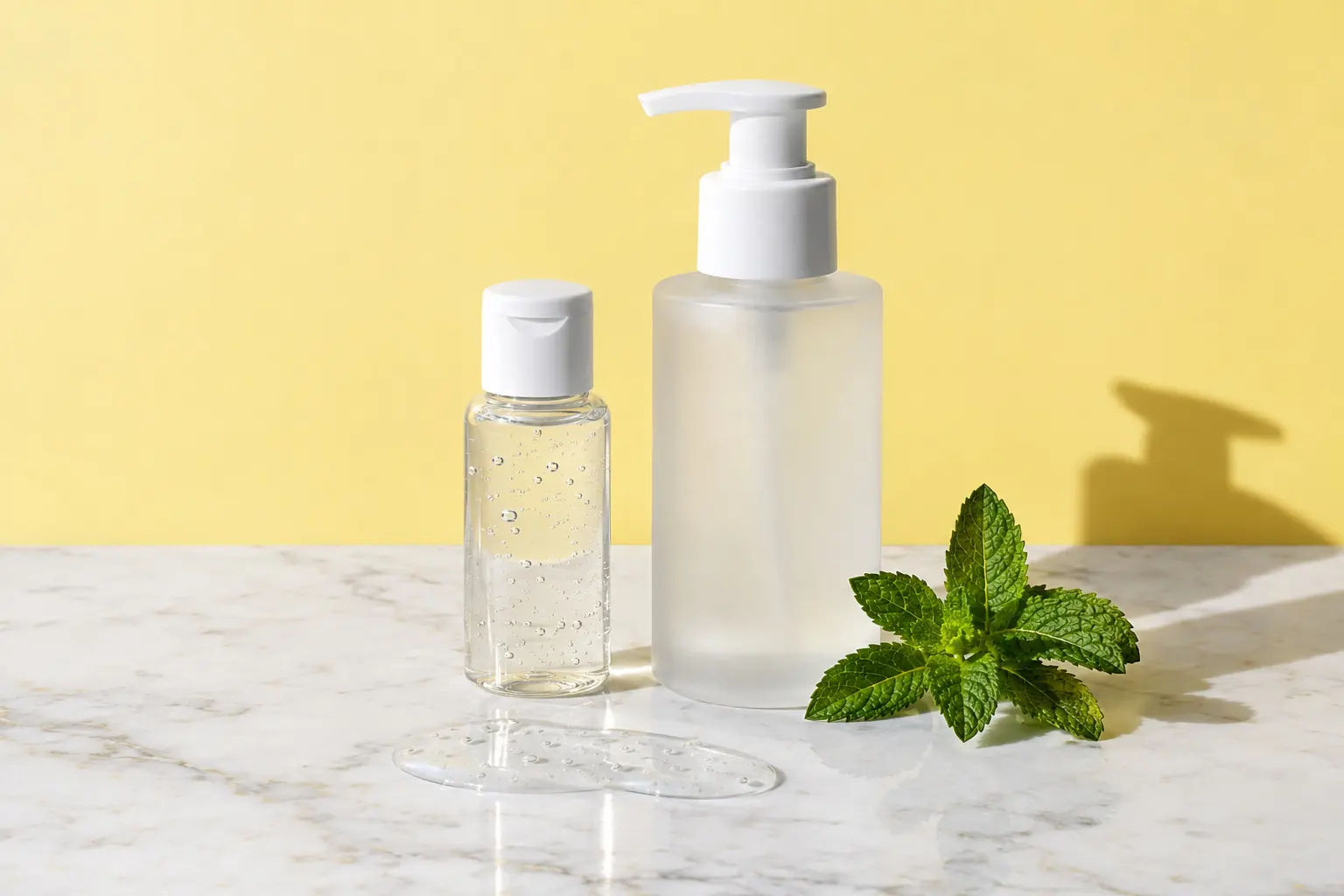
An alcohol-free hand antiseptic is a cosmetic gel until a disinfection claim is added; with that claim, the product falls under Regulation (EU) No 528/2012 as a Product-Type 1 (human hygiene) biocide, whether or not it contains alcohol. AKTO develops an alcohol-free sanitizer to order on the same line that already produces its hand gel in 300-500 ml pump bottles. The specific alcohol-free active and its status under biocide regulation are agreed with the brand before formulation.
01
Alcohol-free hand sanitizer: the claim decides the regulation
Without alcohol, the disinfecting action rests on a different active substance - and it's the label claim, not the presence or absence of alcohol, that decides whether the product stays a cosmetic or falls under biocide regulation. A gel that only cleanses or moisturises hands without a germ-reduction claim stays a cosmetic product regardless of the formula type.
02
Requirements while the product stays a cosmetic
Without a disinfection claim, a hand gel is a cosmetic under Regulation (EC) No 1223/2009: Article 10(1) requires a safety assessment before the product is placed on the market, and label claims - moisturising or cleansing - must meet the common criteria of Regulation (EU) No 655/2013. Manufacturing follows ISO 22716:2007 for the production, control, storage and shipment of cosmetic products, for as long as the product is marketed as a cosmetic and not as a biocidal one.
03
Where the biocide boundary falls
Annex V to Regulation (EU) No 528/2012 defines a Product-Type 1 ('human hygiene') biocidal product as one used for human hygiene purposes, applied on or in contact with human skin, for the primary purpose of disinfecting the skin. An alcohol-free formula relies on a different active substance, whose approval or review status for Product-Type 1 under biocide regulation is confirmed per substance, before a disinfection claim ever reaches the label. In Ukraine, a product without that claim is classified as a cosmetic under Cabinet of Ministers Resolution No. 65; with a disinfection claim, separate biocidal registration is required.
04
What AKTO offers
AKTO develops an alcohol-free sanitizer to order on the same line that already produces its hand gel in pump bottles of 300 ml and 500 ml. MOQ for cosmetics starts from 50 kg of finished formulation at AKTO's plants in Kyiv, Ukraine, and Warsaw, Poland, certified to ISO 9001:2015 and ISO 22000:2018 (HACCP, combined certificate No. 44600111204), ISO 22716 (GMP).
AKTO's production certificates and market requirements are described in the Quality & Compliance section.
05
Getting started
A brand specifies the target claim - disinfection, or moisturising and cleansing only, without alcohol - and works with AKTO to assess the active substance's status under Regulation 528/2012 before a disinfection claim goes on the label.
- Brief: target claim, active substance, bottle volume
- Assessment of the regulatory regime - cosmetic or biocide
- Formulation, samples and stability testing
- Production start and label review
See also: Hand Antiseptics, Intimate Care & Lubricants, Body and Cosmetics & Personal Care.
Frequently Asked Questions
Does AKTO manufacture an alcohol-free hand sanitizer?
When does an alcohol-free antiseptic fall under biocide regulation?
Can a disinfection claim be made without alcohol in the formula?
What packaging is used on AKTO's hand-gel line?
Expert review
Reviewed by
 Illia Mariutsa
Researcher, organic chemistry
Google Scholar Anastasiia Bespalova
Paediatric orthopaedic and trauma surgeon
ORCID
Standards we work to
 ISO 22716 (GMP)
 ISO 22000 (HACCP)
 Regulation (EC) No 1223/2009
 Directive 2002/46/EC
 Halal
Why AKTO
- Alcohol-free version developed on the active hand-gel line
- Pump bottles 300-500 ml
- Active-substance status under Regulation 528/2012 assessed before any label claim
- Manufacturing to ISO 22716 (GMP) in Kyiv (Ukraine) and Warsaw (Poland)