
Private Label
Ashwagandha (KSM-66) Supplement Manufacturing
An ashwagandha root extract for capsules and liquid formats: a different regulatory path than a vitamin or mineral project.
- Art. 28(5) Claims Hold
In brief
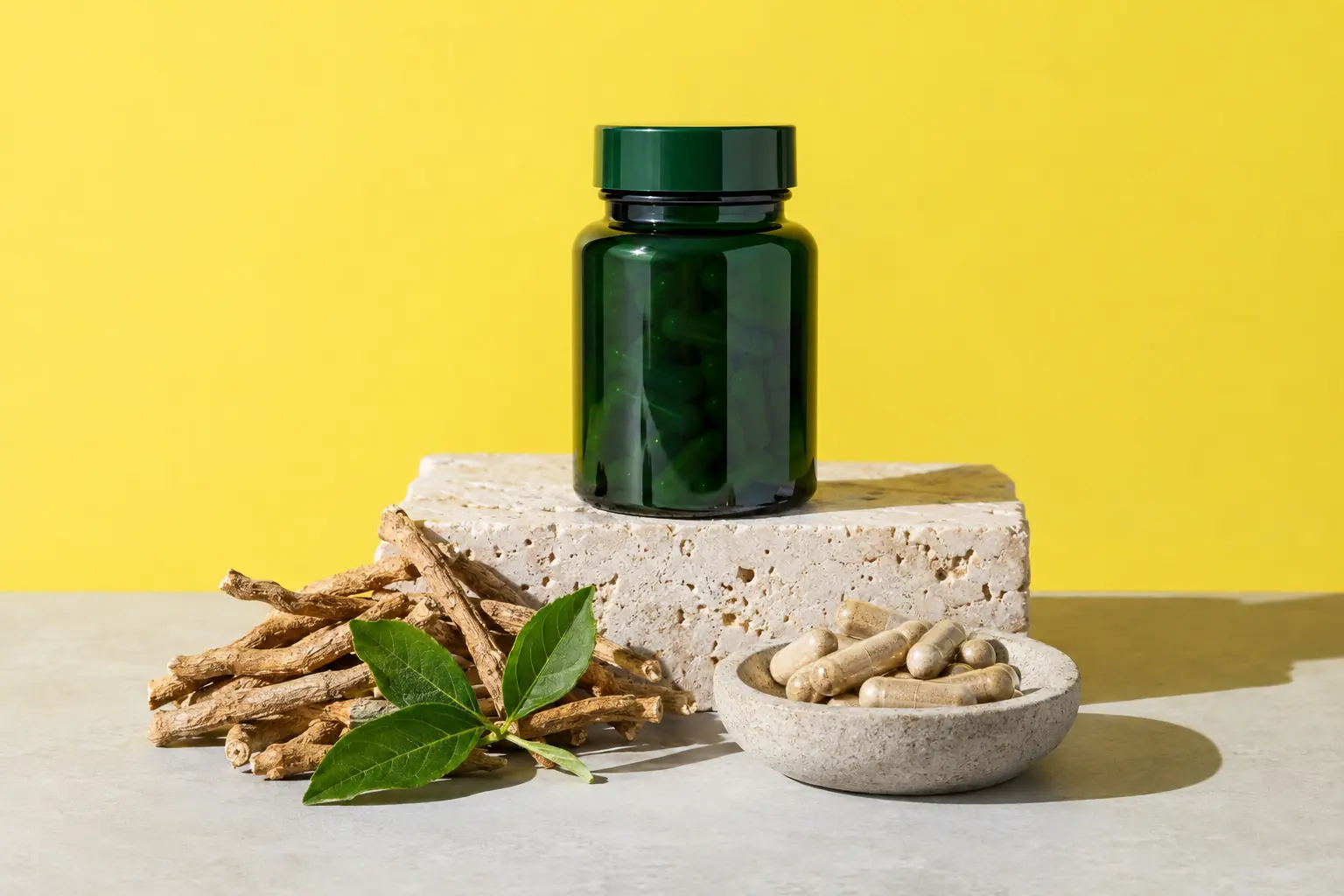
Ashwagandha (Withania somnifera) root is used as a botanical extract in capsule or liquid dietary supplements; KSM-66 in this category's name is a trademark for a standardised root extract held by an ingredient supplier, not an AKTO brand. Company AKTO LLC (AKTO) develops ashwagandha supplements to order on its capsule, liquid-formulation and sachet lines, checking the chosen extract against the target market's national rules.
01
What ashwagandha (KSM-66) is in a dietary supplement
Ashwagandha root is used as a botanical extract in capsule or liquid dietary supplements; KSM-66 in this category's name is a trademark for a standardised ashwagandha root extract held by an ingredient supplier, not a brand or product line of AKTO's own. This page is for a brand that has already settled on this raw material and wants to understand the extract's regulatory path in the EU before agreeing on a specific standardised-extract supplier or a plain root powder.
02
Why botanical extracts sit on a different legal footing
Unlike vitamins and minerals, botanical extracts in EU food supplements, ashwagandha root included, are not subject to a harmonised positive list under Directive 2002/46/EC; whether a given extract is permitted, and at what level, is set primarily at national level. Regulation (EC) No 1925/2006 Article 8 empowers the European Commission to restrict, impose conditions on, or prohibit a non-vitamin, non-mineral substance - including one of botanical origin - EU-wide where evidence points to a potential health risk when it is added to food. A botanical raw material without a documented history of significant consumption in the EU before 15 May 1997 additionally requires authorisation as a novel food under Regulation (EU) 2015/2283 before it can be sold as a supplement ingredient. The UK, Ukraine and the Gulf states each apply their own national supplement-labelling rules; no EU-harmonised claim exists for ashwagandha in any of these markets.
03
Where health claims stand
Most health claims for botanical ingredients, ashwagandha included, remain formally unresolved: under the transitional measure in Article 28(5) of Regulation (EC) No 1924/2006, 'general function' claims under Article 13(1)(a) may continue to be used under the food business operator's own responsibility until the European Commission completes the Article 13(3) list. In practice, a brand markets a botanical formula through the ingredient description, dose and positioning rather than through an EU-authorised health claim, unlike a vitamin or mineral.
04
What AKTO offers
AKTO already produces botanical supplements in three formats - capsules, a syrup and oral drops - using at least 13 different plant extracts in total. AKTO develops and manufactures ashwagandha supplements to order on its capsule, liquid-formulation and sachet lines, checking the chosen raw material or standardised extract against the target market's national rules. The minimum order is 10 kg of raw material or 20,000 capsules, at facilities in Kyiv (Ukraine) and Warsaw (Poland) under ISO 9001:2015, ISO 22000:2018 (HACCP; combined certificate No. 44600111204).
05
Starting a project with AKTO
A brand names its target ashwagandha extract - a standardised one such as KSM-66, or a plain root powder - and its intended positioning; AKTO checks the ingredient against the target market's national rules, since no single EU list governs botanicals, and assesses whether novel-food authorisation under Regulation 2015/2283 is required. Because botanical claims are not pre-authorised the way vitamin claims are, this stage usually takes longer than a mineral or vitamin project of comparable complexity. See also: Extracts & Botanical Blends, Rhodiola, Probiotics (Bio-Cultures) and Dietary Supplements.
Frequently Asked Questions
Does AKTO manufacture ashwagandha supplements?
Is KSM-66 an AKTO brand?
Why doesn't ashwagandha have an EU-harmonised list like vitamins?
Can a health benefit of ashwagandha be stated on the label?
 Svitlana Mysiura
 Anastasiia Bespalova
Standards we work to
 ISO 22716 (GMP)
 ISO 22000 (HACCP)
 Regulation (EC) No 1223/2009
 Directive 2002/46/EC
 Halal
Why AKTO
- Ingredient checks against the target market's national rules
- Experience with at least 13 different botanical extracts across three formats
- Capsule, liquid-formulation and sachet lines for botanical supplements
- Minimum order from 10 kg or 20,000 capsules