
Private Label
Bath Milk
AKTO develops and manufactures bath milk to order on its emulsion lines, positioned as a gentle, moisturising alternative to a foaming bubble bath.
- ISO 22716 GMP
In brief
Company AKTO LLC (AKTO) develops and manufactures bath milk to order on its emulsion-cosmetics lines in Kyiv (Ukraine) and Warsaw (Poland). A bath milk diluted in bathwater is formulated and assessed as a rinse-off cosmetic under Regulation (EC) No 1223/2009, sitting outside CLP. Minimum order quantity starts from a 50 kg batch.
01
What bath milk is
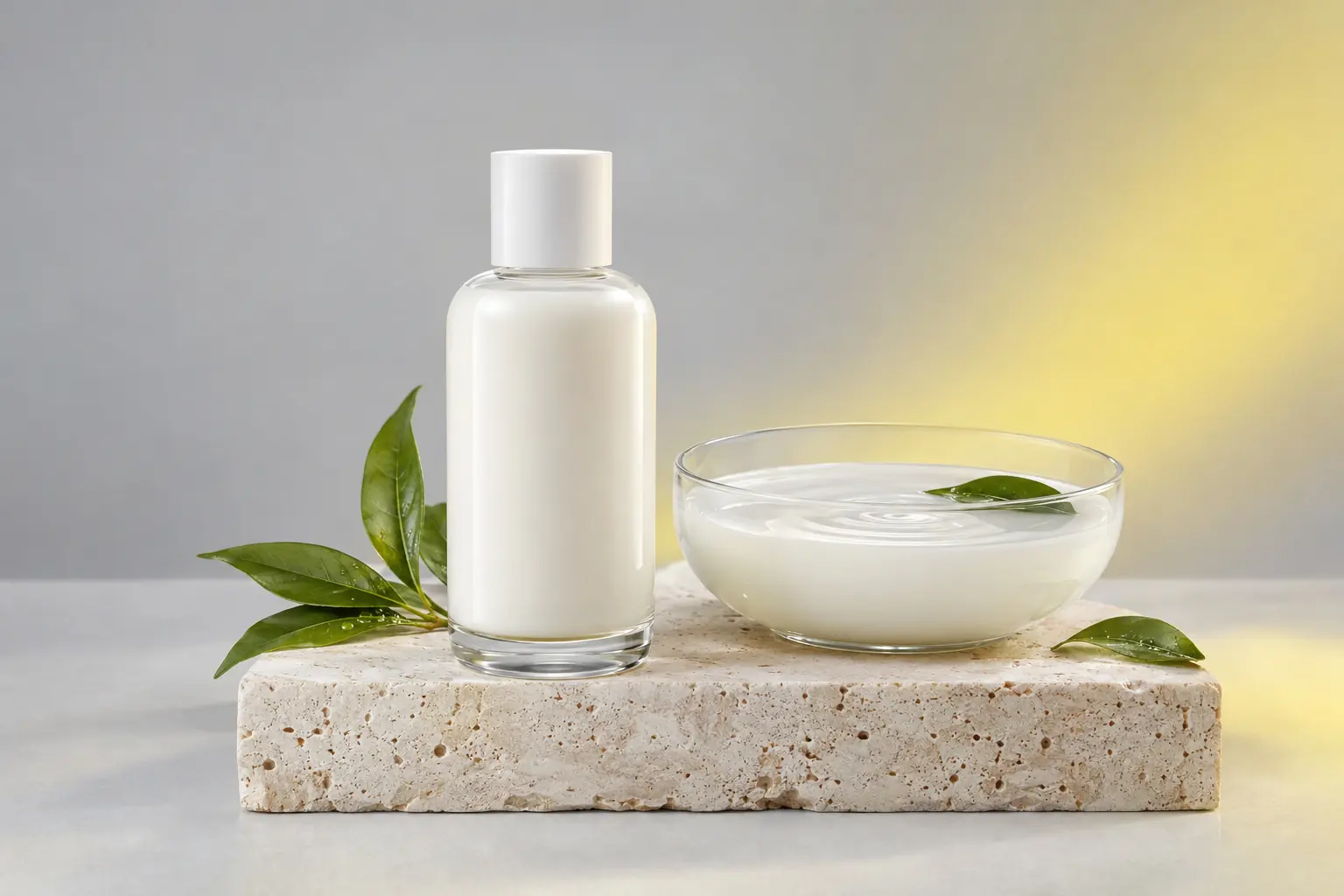
Bath milk is an emulsion-type liquid that turns bathwater a soft, milky colour and leaves skin feeling moisturised rather than simply clean, which is why brands position it as the gentle, sensitive-skin alternative next to a foaming bubble bath in the same range. Where bubble bath sells on foam volume, bath milk sells on the caring, spa-like feel of the water itself.
02
A rinse-off product, with one nuance worth knowing
The Preamble to Annexes II to VI of Regulation (EC) No 1223/2009 defines a 'rinse-off product' as one intended for removal after application on skin, hair or mucous membranes, and a 'leave-on product' as one intended to stay in prolonged contact with them; the two categories carry different fragrance-allergen labelling thresholds, 0.01% for rinse-off against 0.001% for leave-on. A bath milk diluted in bathwater that is then drained away would ordinarily be treated as rinse-off under this definition, though the Regulation does not name bath products specifically - the safety assessor documents that classification for the formula in question rather than relying on a blanket rule.
03
Preservatives and the CMR framework
Regulation (EC) No 1223/2009 Annex V entry 23, as set by Regulation (EU) 2024/996, permits Triclocarban as a preservative up to 0.2% in all cosmetic products except mouthwash, a category broad enough to include an emulsion-type bath milk. Article 15's two-tier CMR mechanism governs the emulsifiers, colourants and fragrance in the mix the same way as in any other cosmetic.
04
Regulatory footing
A finished bath milk sits outside CLP: Article 1(5)(c) of Regulation (EC) No 1272/2008 excludes finished-state cosmetic products as defined in Directive 76/768/EEC, read as Regulation (EC) No 1223/2009 under its Article 38; CLP applies to the emulsifier, oil and fragrance raw materials instead, not to the bottled emulsion. ISO 22716:2007 covers an emulsion-type bath milk the same way as any other cosmetic form.
05
What AKTO offers
AKTO's stated monthly emulsion-production capacity reaches up to 30 tonnes in Kyiv (Ukraine) and up to 10 tonnes in Warsaw (Poland), the capacity line relevant to an emulsion product such as bath milk. The minimum order quantity starts from a 50 kg batch, with the pump-bottle format set per brief. Production is certified to ISO 9001:2015 and ISO 22000:2018 (combined certificate No. 44600111204) and ISO 22716 (GMP).
06
Getting started
A brand briefs the target skin-feel, fragrance and colour of the milky wash-off, and AKTO develops the emulsion, documents its safety assessment and sets the packaging and technical documentation for the target market. A brand can position the finished bath milk either as a standalone SKU or as a companion product sold alongside its shower gel or bubble bath in the same range. See also: Bath Additives, Bath Salts, Bubble Bath and Bath Bomb.
Frequently Asked Questions
Does AKTO manufacture bath milk?
Is bath milk a rinse-off or leave-on product?
Which preservative can a bath milk formula use?
What is AKTO's minimum order quantity for bath milk?
Expert review
Reviewed by
 Illia Mariutsa
Researcher, organic chemistry
Google Scholar Anastasiia Bespalova
Paediatric orthopaedic and trauma surgeon
ORCID
Standards we work to
 ISO 22716 (GMP)
 ISO 22000 (HACCP)
 Regulation (EC) No 1223/2009
 Directive 2002/46/EC
 Halal
Why AKTO
- Bath milk developed and manufactured to order as a gentle emulsion cosmetic
- Emulsion-production capacity up to 30 t/month in Kyiv (Ukraine), up to 10 t/month in Warsaw (Poland)
- Rinse-off safety-assessment documentation handled per formula
- MOQ from 50 kg, pump-bottle format set per brief
- ISO 9001:2015, ISO 22000:2018 (HACCP), ISO 22716 (GMP)