
Private Label
Biotin
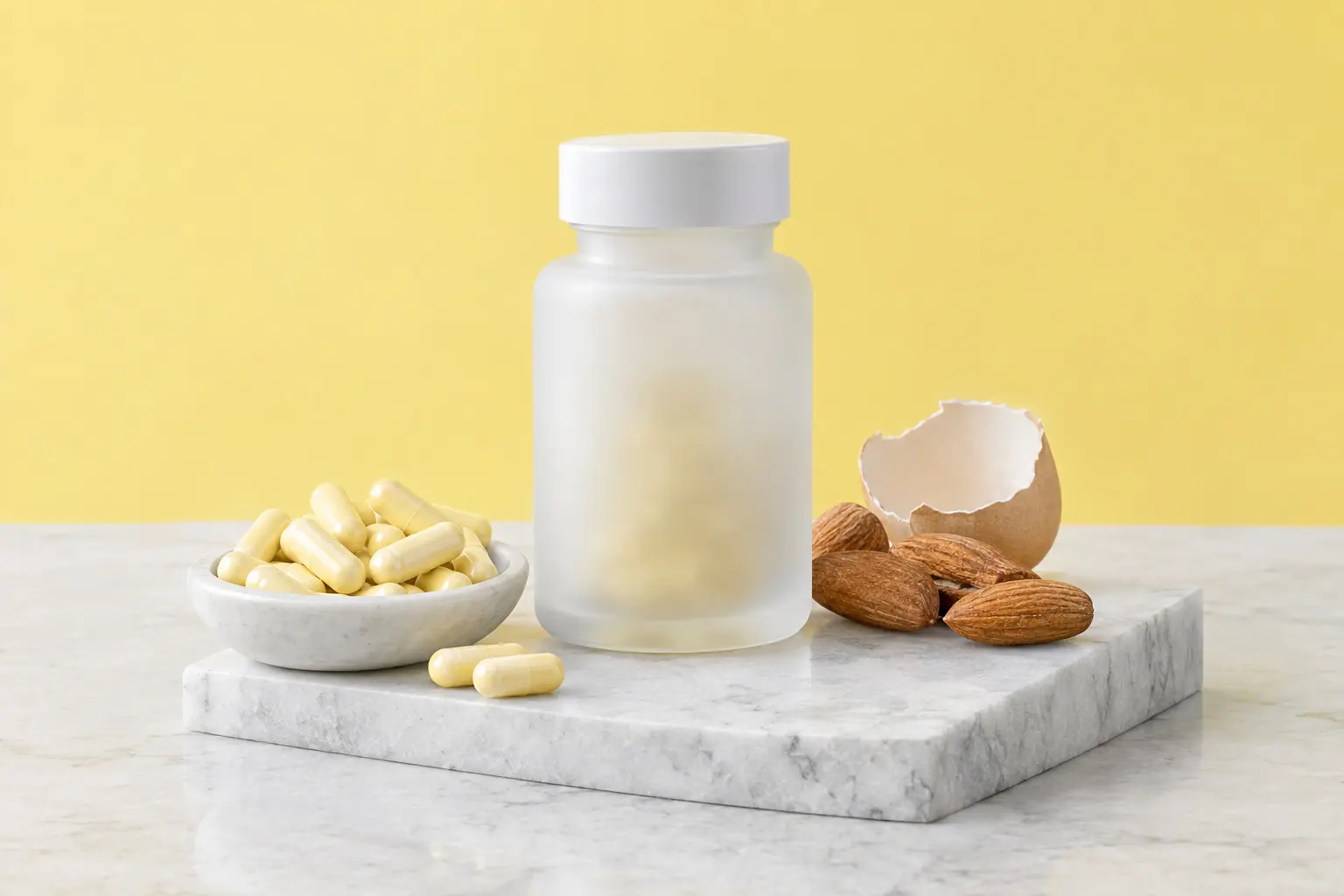
Biotin in a food-supplement capsule: AKTO matches the ingredient to authorised claims for metabolism, the nervous system and mucous membranes.
- ISO 22000 (HACCP)
In brief
Biotin (vitamin B7) is a vitamin on the EU's harmonised list for food supplements, with separately authorised claims for energy metabolism, the nervous system, macronutrient metabolism, psychological function and mucous membranes. AKTO develops and manufactures biotin capsules to a brand's own specification on its capsule line.
01
What biotin capsules are and who they're for
Biotin (vitamin B7) is a vitamin authorised for food supplements under the EU's harmonised list, typically brought to market in the "Beauty Supplements (Capsules)" format - one of AKTO's dosage-form categories for dietary supplements. This page focuses on biotin's claims beyond hair and skin, which are covered on AKTO's beauty-supplements page.
02
Authorised claims and dosage
Commission Regulation (EU) No 432/2012 authorises the claims that biotin contributes to normal energy-yielding metabolism, normal functioning of the nervous system, normal macronutrient metabolism, normal psychological function and the maintenance of normal mucous membranes - each usable only on a food that is at least a source of biotin under Regulation (EC) No 1924/2006 - in addition to its separately authorised hair- and skin-maintenance claims. Regulation (EU) No 1169/2011 Annex XIII Part A sets the EU nutrient reference value (NRV) for biotin at 50 micrograms a day for an adult - the base for the %NRV that a food-supplement label declares under Directive 2002/46/EC. Directive 2002/46/EC's Annex I/II harmonised list includes biotin among the vitamins that may be added to food supplements, in its listed chemical forms.
03
What AKTO develops and manufactures
AKTO develops and manufactures biotin capsules to a brand's own specification on its Kyiv (Ukraine) capsule line, with capacity of up to 10 million units a month (up to 2 million a month at the Warsaw (Poland) plant), matching the dose to whichever authorised claim the brand wants to lead with. "Beauty Supplements (Capsules)" is one of six dosage-form categories on AKTO's dietary-supplements list. Production is certified to ISO 9001:2015 and ISO 22000:2018 (HACCP, No. 44600111204).
04
Packaging and supporting documentation
AKTO packs biotin capsules into blister strips or jars, 10-20 capsules per pack; the packaging is agreed individually with the brand for the format and target market. AKTO's two facilities, in Kyiv (Ukraine) and Warsaw (Poland), let a brand choose the production site by target market: the Kyiv (Ukraine) capsule line runs at up to 10 million units a month, the Warsaw (Poland) line at up to 2 million. Every batch of biotin capsules is accompanied by a physicochemical testing protocol that AKTO's dietary-supplements team hands over to the brand alongside the rest of the technical documentation for the chosen market - a protocol that confirms the batch's actual biotin content against the %NRV declared on the label.
05
Getting started
A brand picks which of biotin's authorised claims will anchor the product and sets a target dose relative to the 50 mcg NRV; AKTO checks the formula against Directive 2002/46/EC's harmonised list and manufactures from a minimum order of 10 kg of raw material or 20,000 capsules. See also: Beauty Supplements (Capsules), Hyaluronic Acid and Hair, Skin & Nails.
Frequently Asked Questions
Does AKTO manufacture biotin capsules today?
Which biotin claims, beyond hair and skin, are authorised in the EU?
What is biotin's nutrient reference value for labelling?
Is biotin on the EU's harmonised list for food supplements?
 Svitlana Mysiura
 Anastasiia Bespalova
Standards we work to
 ISO 22716 (GMP)
 ISO 22000 (HACCP)
 Regulation (EC) No 1223/2009
 Directive 2002/46/EC
 Halal
Why AKTO
- Biotin capsules developed to order, matched to an authorised claim
- Five Regulation 432/2012 claims beyond the hair-and-skin ones
- Capsule-line capacity of up to 10 million units a month in Kyiv (Ukraine)
- ISO 9001:2015, ISO 22000:2018 (HACCP; No. 44600111204)