
Private Label
Bleach
AKTO develops and manufactures chlorine bleach based on sodium hypochlorite in a pump bottle, to a brand's brief.
- EUH031
In brief
AKTO develops and manufactures liquid chlorine bleach based on sodium hypochlorite in a 200-1,000 ml pump bottle. Sodium hypochlorite carries a harmonised Skin Corr. 1B (H314) classification under Regulation (EC) No 1272/2008, and at 5% content or above the label must carry the EUH031 warning that contact with acids liberates toxic gas. The minimum batch is 50 kg at AKTO's facilities in Kyiv (Ukraine) and Warsaw (Poland).
01
What chlorine bleach is and who it's for
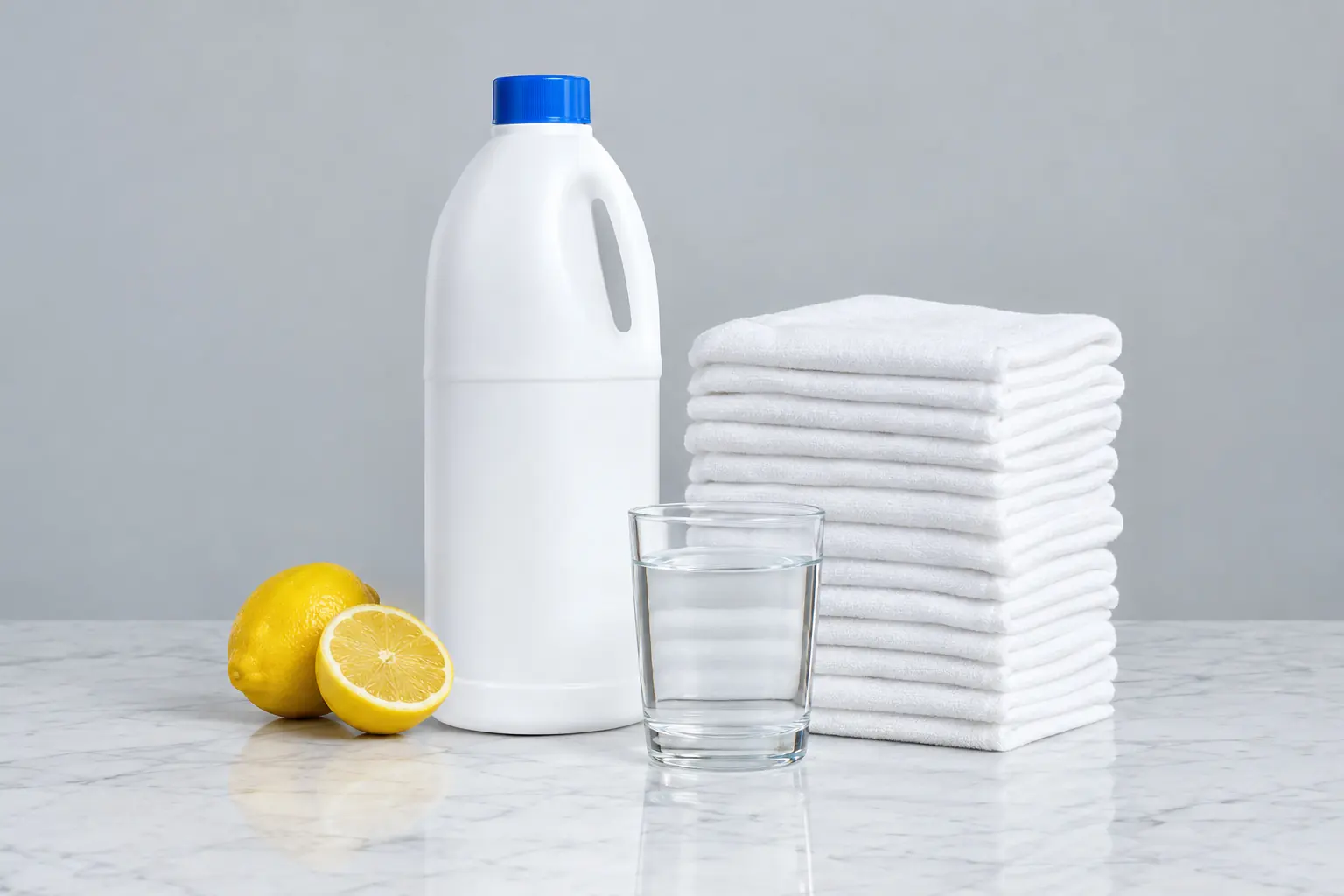
Chlorine bleach based on sodium hypochlorite bleaches and disinfects fabric far more aggressively than percarbonate-based oxygen bleach, making it better suited to whites and towels than to coloured textiles. For a brand, this is a product for customers who value disinfecting power over a gentler formula - often bought alongside bathroom-cleaning products, where hypochlorite is also used.
02
Hazard classification and labelling
Sodium hypochlorite carries a harmonised CLP classification under Regulation (EC) No 1272/2008, including Skin Corr. 1B (H314: causes severe skin burns and eye damage) and the supplemental hazard statement EUH031 ('contact with acids liberates toxic gas'); this harmonised entry, unlike sodium percarbonate in oxygen bleach, is fixed in the ECHA classification and labelling record. The EUH031 statement is mandatory for a mixture containing sodium hypochlorite at 5% or above; below that threshold it isn't required under this entry. A liquid classified Skin Corr. 1B and supplied to the general public must carry both a fastening resistant to opening by children (Annex II point 3.1.1.1) and a tactile warning of danger (Annex II point 3.2.1.1), under Article 35(2) of the CLP Regulation. Article 17 of the same Regulation requires the label to show the product identifier, nominal quantity, hazard pictograms, signal word, hazard and precautionary statements (including EUH031 where applicable), and supplier details.
03
The 'detergent' definition and product safety
Because it can be formulated as a sodium hypochlorite solution without an added soap or surfactant, chlorine bleach may fall outside the 'detergent' definition of Article 2 of Regulation (EC) No 648/2004 unless a surfactant is included. Regulation (EU) 2023/988 on general product safety, in force since 13 December 2024, requires an internal risk analysis and technical documentation under Article 9(2) regardless of the CLP classification.
04
What AKTO offers
AKTO documents a liquid formulation for this category, packaged in a pump bottle from 200 to 1,000 ml. The minimum batch is 50 kg; the Warsaw (Poland) plant's stated liquid-production capacity reaches up to 50 tonnes a month and up to 200,000 filled bottles. The 'Big Game' development tier supports up to 10 formulation attempts across up to 25 samples, including recipe and packaging audits. Production runs under the combined ISO 9001:2015 and ISO 22000:2018 (HACCP) certificate (No. 44600111204), ISO 22716 (GMP).
05
Getting started
The brand sets the sodium hypochlorite concentration in the formula; AKTO checks whether the EUH031 warning is required against the 5% threshold, prepares the child-resistant fastening and tactile warning under Article 35(2), and the Article 17 label. Chlorine bleach's disinfecting action complements a gentler oxygen bleach within a brand's range, giving customers a choice of formats. See also: Textile / Laundry, Oxygen Bleach and Laundry Gel.
Frequently Asked Questions
Does AKTO manufacture chlorine bleach?
When does chlorine bleach's label need the EUH031 warning?
What packaging does CLP require for a liquid classified Skin Corr. 1B?
What format does AKTO use for chlorine bleach?
 Kateryna Khromykh
 Oleksandra Vovk
Standards we work to
 ISO 22716 (GMP)
 ISO 22000 (HACCP)
 Regulation (EC) No 1223/2009
 Directive 2002/46/EC
 Halal
Why AKTO
- Chlorine bleach developed to a brand's brief
- EUH031 labelling and child-resistant fastening checked under CLP
- Up to 10 formulation attempts across up to 25 samples in the 'Big Game' tier
- Liquid-production capacity up to 50 tonnes a month in Warsaw (Poland)
- MOQ from 50 kg, facilities in Kyiv (Ukraine) and Warsaw (Poland)