
Private Label
Bronzer Contract Manufacturing
AKTO develops and manufactures a bronzer to order as an emulsion, cream or powder, with pigments checked against EU colorant rules.
- ISO 22716 GMP
In brief
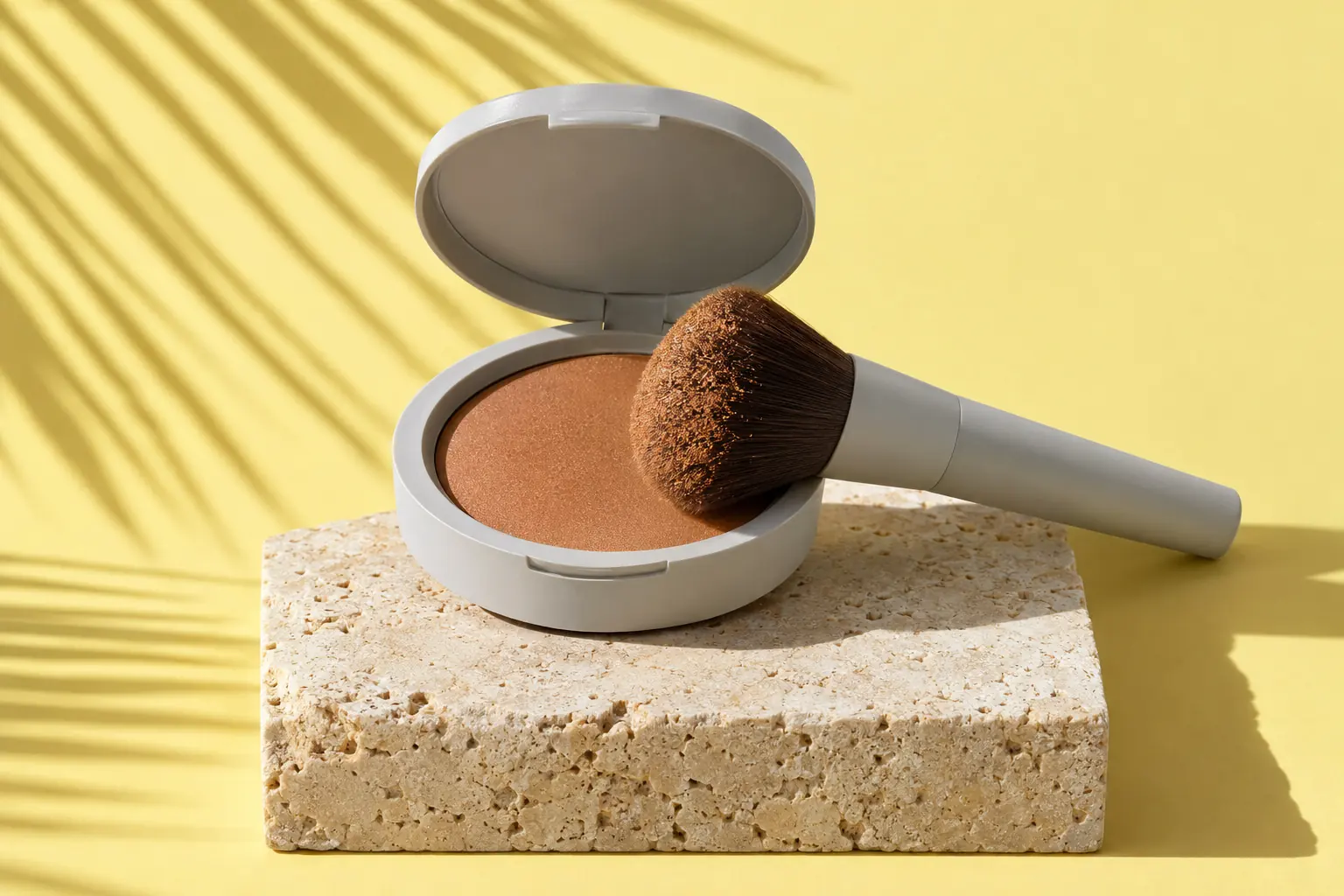
A bronzer is a pigmented colour-cosmetics product that gives skin a warm, sun-kissed tone, usually added to a makeup line alongside a base and a contour. Company AKTO LLC (AKTO) develops and manufactures a bronzer to order on its emulsion, cream and pressed- or loose-powder lines. Pigments are checked against Annex IV of Regulation (EC) No 1223/2009, and the minimum order for a new private-label line starts at 50 kg.
01
Bronzer in a makeup line: what it is and who it is for
A bronzer is a pigmented colour-cosmetics product that gives the skin a warm, sun-kissed tone and adds shape to the face through a warm shade rather than a cool shadow. It comes as a pressed or loose powder, a cream, or a cream-gel, depending on whether the brand wants a matte or a luminous finish. A brand usually adds a bronzer to an existing makeup line next to a base and a contour product: it carries steady repeat demand and a modest batch size, so it rarely needs a marketing launch of its own once the line already has an audience.
02
Pigments and formulation requirements
Most bronzer formulas get their warm cast from a blend of iron oxides. Annex IV of Regulation (EC) No 1223/2009 permits CI 77491, CI 77492 and CI 77499 with no restriction by product type, subject to the purity criteria of Commission Directive 95/45/EC (E172). These are the same pigments used in a cream contour or a face sculptor, so checking their purity is a routine step for any shade-based formula. Before a bronzer reaches the EU market, Article 10 of the Regulation requires a safety assessment covering every pigment and base ingredient in the finished formula.
03
Production standards
ISO 22716 sets out the rules for production, control, storage and shipment of pigmented cosmetic products, and it applies equally to a cream or a powder bronzer.
04
What AKTO offers
AKTO develops and manufactures a bronzer to order on its general emulsion and cream lines and its pressed- or loose-powder lines, so a brand picks the texture that fits its range and the formula is built from scratch around that brief. A technical brief intake form fixes the target texture, appearance, packaging type and volume, and the target price per kilogram before formulation starts.
- Formats: emulsions and creams, pressed or loose powder
- Packaging: tubes, jars, airless pump bottles
- Minimum order: from 50 kg for a new private-label line
- Production: Kyiv, Ukraine, and Warsaw, Poland
- Certification: ISO 9001:2015 + ISO 22000:2018 (HACCP; certificate No. 44600111204), ISO 22716 (GMP)
05
How to start a project
A brand shares a brief covering the target texture, shade and packaging; AKTO checks the pigments against Annex IV, develops the formula and prepares the documentation for the chosen market. Every bronzer project starts from that brief rather than a ready-made sample to pick from. When a brand orders a highlighter or a sculptor at the same time, the formulas can share an emulsion or powder base, which shortens the raw-material approval cycle and lets several shades be tested in parallel instead of one after another. See also: Makeup Base & Complexion, Highlighter and Face Sculptor.
Frequently Asked Questions
Does AKTO manufacture a bronzer?
Which pigments are permitted in a bronzer under EU rules?
What is the minimum order for a new private-label bronzer?
How is an AKTO bronzer labelled in Ukraine?
Expert review
Reviewed by
 Illia Mariutsa
Researcher, organic chemistry
Google Scholar Anastasiia Bespalova
Paediatric orthopaedic and trauma surgeon
ORCID
Standards we work to
 ISO 22716 (GMP)
 ISO 22000 (HACCP)
 Regulation (EC) No 1223/2009
 Directive 2002/46/EC
 Halal
Why AKTO
- Bronzer developed to order as an emulsion, cream or powder
- Pigments checked against Annex IV of Regulation (EC) No 1223/2009
- Technical brief fixes texture, appearance, packaging and price per kg before formulation
- MOQ from 50 kg for a new private-label line
- Certified ISO 9001:2015, ISO 22000:2018 (HACCP), ISO 22716 (GMP)