
Private Label
Creatine Monohydrate (Micronized)
AKTO develops and manufactures micronized creatine monohydrate to order, with 3 g/day as the condition for its two authorised claims.
- ISO 22000 (HACCP)
In brief
Company AKTO LLC (AKTO) develops and manufactures micronized creatine monohydrate to order. Regulation (EU) No 432/2012 and Regulation (EU) 2017/672 authorise two claims for creatine, each conditioned on a daily intake of 3 g — a condition of use for the claim, not an EU-set maximum dose. AKTO controls the humidity and temperature of its production environment, both critical for a hygroscopic micronized powder.
01
What micronized creatine monohydrate is
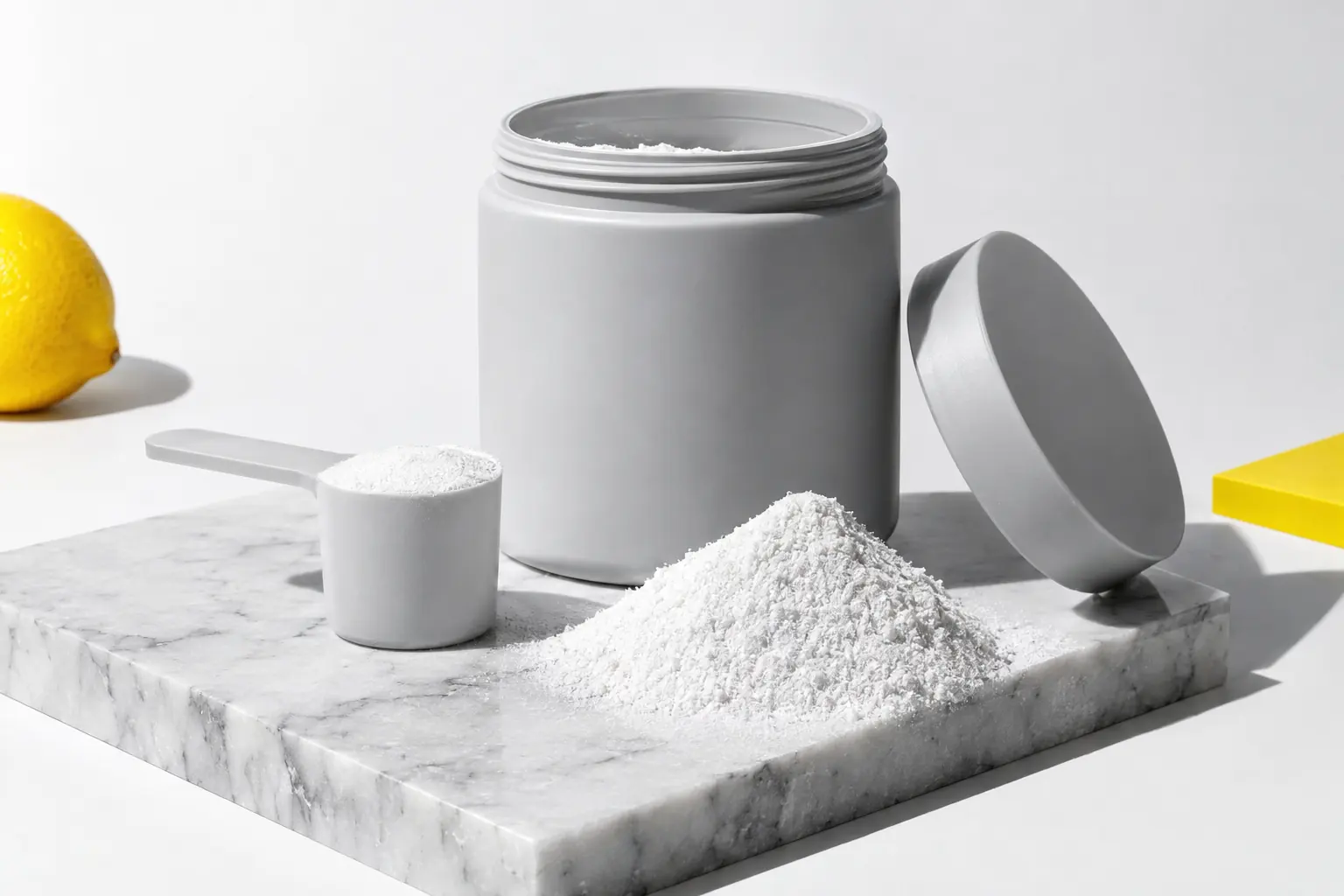
Creatine monohydrate is a powder sports supplement for strength and short-burst power training; micronizing it breaks the particles down to a finer size for better solubility in water compared with a standard-grade powder. It suits a brand launching a base sports-nutrition item with no other actives mixed in.
02
The Regulation 432/2012 claim
Regulation (EU) No 432/2012 authorises "Creatine increases physical performance in successive bursts of short-term, high intensity exercise" — conditioned on the product providing a daily intake of 3 g of creatine, that condition being disclosed to the consumer, and the product being aimed at adults performing high intensity exercise.
03
The Regulation 2017/672 claim for adults over 55
Regulation (EU) 2017/672 added to the Regulation 432/2012 Annex the claim "Daily creatine consumption can enhance the effect of resistance training on muscle strength in adults over the age of 55" — conditioned on the product being aimed at that age group performing resistance training, with the consumer told the effect is obtained with 3 g of creatine daily combined with resistance training that allows increasing workload, performed at least three times a week for several weeks at an intensity of at least 65-75% of one-repetition-maximum load.
04
3 g a day is a condition, not a dose ceiling
Creatine is not one of the vitamins or minerals listed in Annexes I-II of Directive 2002/46/EC, so the Article 5 mechanism for setting an EU-wide maximum does not apply to it. The "3 g a day" figure in both Regulations is a condition of use for the authorised claim — the product must provide exactly that daily intake — not a safety ceiling set by the EU; any maximum-dose limit is a matter of national law. Article 6 of Directive 2002/46/EC still requires the label to carry the name "food supplement", the recommended daily portion and a warning not to exceed it.
05
What AKTO develops and manufactures
AKTO develops and manufactures micronized creatine monohydrate to order; its production environment is controlled to 20-60% relative humidity and 16-25°C, checked twice per shift, a point that matters for a hygroscopic powder. AKTO's example serial-order specification runs a 6-week production timeline from the moment of payment. Production is certified to ISO 9001:2015 and ISO 22000:2018 (HACCP; No. 44600111204).
06
Getting started
A brand sets the target dose (with the 3 g/day condition for the claims) and the packaging format; AKTO checks the claim wording against the register and prepares the production documentation. The minimum order for dietary supplements starts at 10 kg of raw material or 20,000 capsules. See also: Sports Blends, BCAA / EAA Powders and Pre-Workout Blends.
Frequently Asked Questions
Does AKTO manufacture micronized creatine monohydrate today?
What does the "3 g a day" condition for creatine claims mean?
Which claim applies to adults over 55?
How long does AKTO's creatine production cycle run?
 Svitlana Mysiura
 Anastasiia Bespalova
Standards we work to
 ISO 22716 (GMP)
 ISO 22000 (HACCP)
 Regulation (EC) No 1223/2009
 Directive 2002/46/EC
 Halal
Why AKTO
- Micronized creatine monohydrate developed to order
- Two authorised claims — Regulation 432/2012 and 2017/672
- Humidity controlled to 20-60% and temperature to 16-25°C, twice per shift
- Example production cycle — 6 weeks from payment
- ISO 9001:2015 and ISO 22000:2018 (HACCP; No. 44600111204)