
Private Label
Deodorant Stick
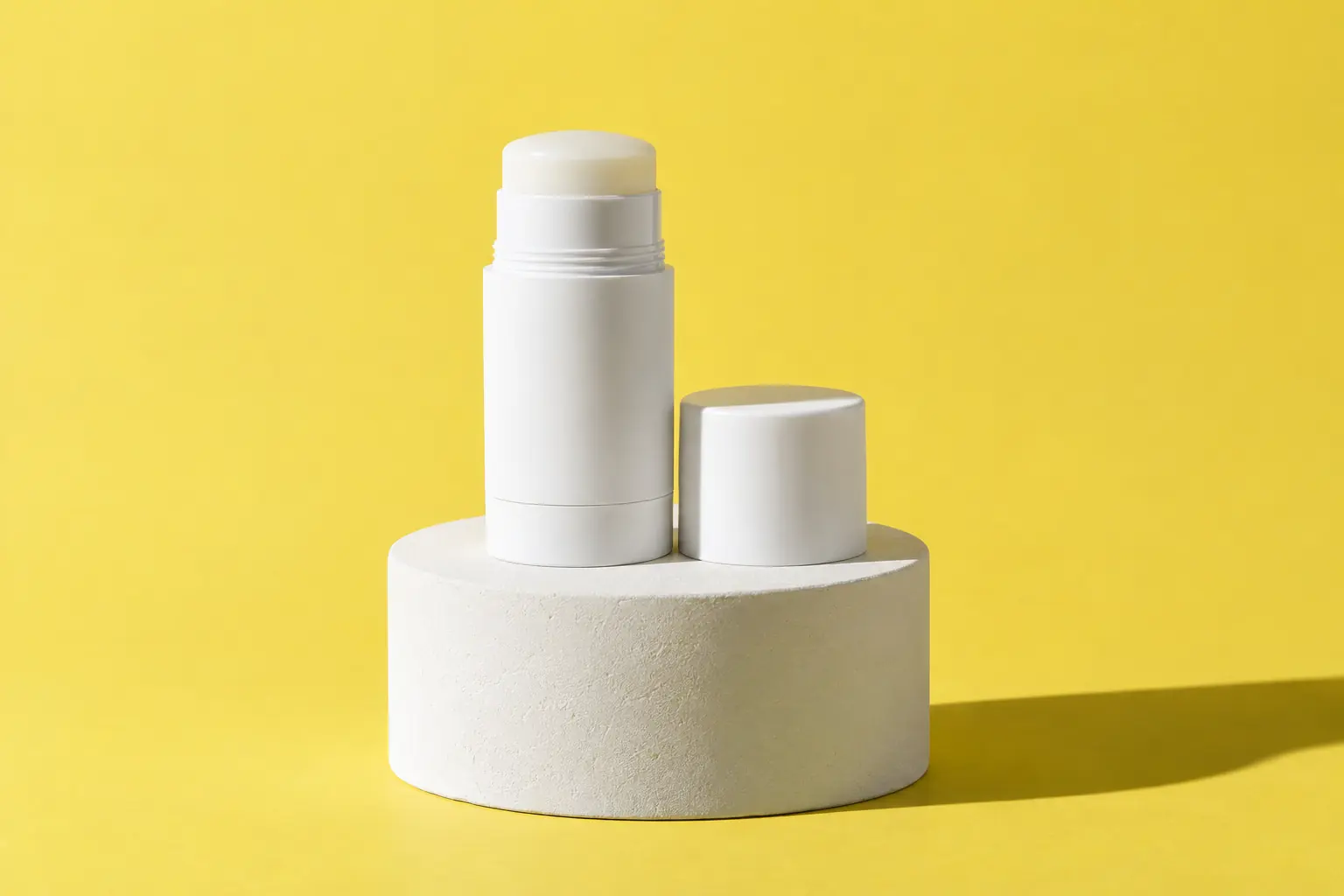
AKTO develops and manufactures a deodorant stick to order on a wax or ethanol-gel base, dispensed from a twist-up applicator, under the client's brand.
- ISO 22716 GMP
In brief
Company AKTO LLC (AKTO) develops and manufactures a deodorant stick to order on a wax or ethanol-gel base, on its own solid-format lines in Kyiv (Ukraine) and Warsaw (Poland), from a 50 kg batch. AKTO matches the base's hardness and glide in a twist-up dispenser to the brand's brief.
01
What a deodorant stick is and who it suits
A deodorant stick is a solid underarm format applied directly to the skin with no spray and no hand contact: a twist-up mechanism raises the stick out of its barrel to the right height. Brands choose this format when they want a clean, no-residue-on-clothing application and compact travel-friendly packaging. Within a line, a stick usually sits alongside a roll-on or cream format, giving the shopper a texture choice by season or skin type.
02
Stick base and formulation requirements
AKTO develops and manufactures a deodorant stick to order on a wax or an ethanol-gel base - the two base types its lab adapts to the brand's target hardness and glide. Where the stick is formulated as an antiperspirant on an aluminium-zirconium complex, entry 50 of Annex III to Regulation (EC) No 1223/2009 additionally requires an aluminium-to-zirconium atom ratio of 2 to 10 and an (aluminium+zirconium)-to-chlorine ratio of 0.9 to 2.1, on top of the 20% compound cap and the 5.4% zirconium cap. Annex II's entry 391 bans zirconium and its compounds in cosmetics generally, carving out this specific entry-50 use as the exception.
03
Packaging, labelling and EU rules
A twist-up dispenser with no propellant gas falls outside the aerosol-dispenser definition set by Directive 75/324/EEC, which covers only pressurised containers. Article 19(1)(g) of Regulation (EC) No 1223/2009 requires a stick's ingredient list - including its wax or gel base - in descending order of weight of the ingredients at the time they are added to the cosmetic product; ingredients under 1% can follow in any order after those above 1%. For the stick's narrow barrel label, Ukraine sets a minimum print size of 1.2 mm, or 0.9 mm on packaging under 80 cm2.
04
What AKTO offers
AKTO's monthly capacity for stick formats runs up to 100,000 units in Kyiv (Ukraine) and up to 50,000 in Warsaw (Poland), alongside its emulsion, liquid, tube and bottle lines. Formula development under the standard agreement runs 42 calendar days and includes up to 7 trial rounds before sign-off - the rounds used to match the base's target hardness and glide. Manufacturing is certified to ISO 9001:2015 and ISO 22000:2018 (combined certificate No. 44600111204), follows the ISO 22716 (GMP) guidelines for cosmetic production, control, storage and shipment. The two plants, in Kyiv (Ukraine) and Warsaw (Poland), let a brand pick the production site for its target market.
05
Getting started
- The brand sets the base type - wax or ethanol-gel - and the brief for the active ingredient and fragrance.
- AKTO's lab builds the formula and checks it against Annexes II and III of Regulation (EC) No 1223/2009.
- Up to 7 trial rounds tune the stick's hardness and glide with the brand.
- Once the sample is approved, AKTO runs series production from a 50 kg batch in the twist-up dispenser.
06
See also
Frequently Asked Questions
Does AKTO manufacture a deodorant stick?
What extra rules apply when the stick is formulated as an antiperspirant?
Is a twist-up dispenser considered an aerosol?
What is AKTO's minimum batch and development timeline for a stick?
Expert review
Reviewed by
 Illia Mariutsa
Researcher, organic chemistry
Google Scholar Anastasiia Bespalova
Paediatric orthopaedic and trauma surgeon
ORCID
Standards we work to
 ISO 22716 (GMP)
 ISO 22000 (HACCP)
 Regulation (EC) No 1223/2009
 Directive 2002/46/EC
 Halal
Why AKTO
- Develops and manufactures a stick to order on a wax or ethanol-gel base
- Capacity up to 100,000 units in Kyiv (Ukraine) and 50,000 in Warsaw (Poland) per month
- Up to 7 trial rounds, 42-day formula development
- ISO 9001:2015, ISO 22000:2018 and ISO 22716 (GMP) guidelines