
Private Label
Dishwasher Cleaner
AKTO develops and manufactures a maintenance cleaner for the dishwasher's own interior, to order in liquid, gel or sachet/powder format.
- ISO 22716 GMP
In brief
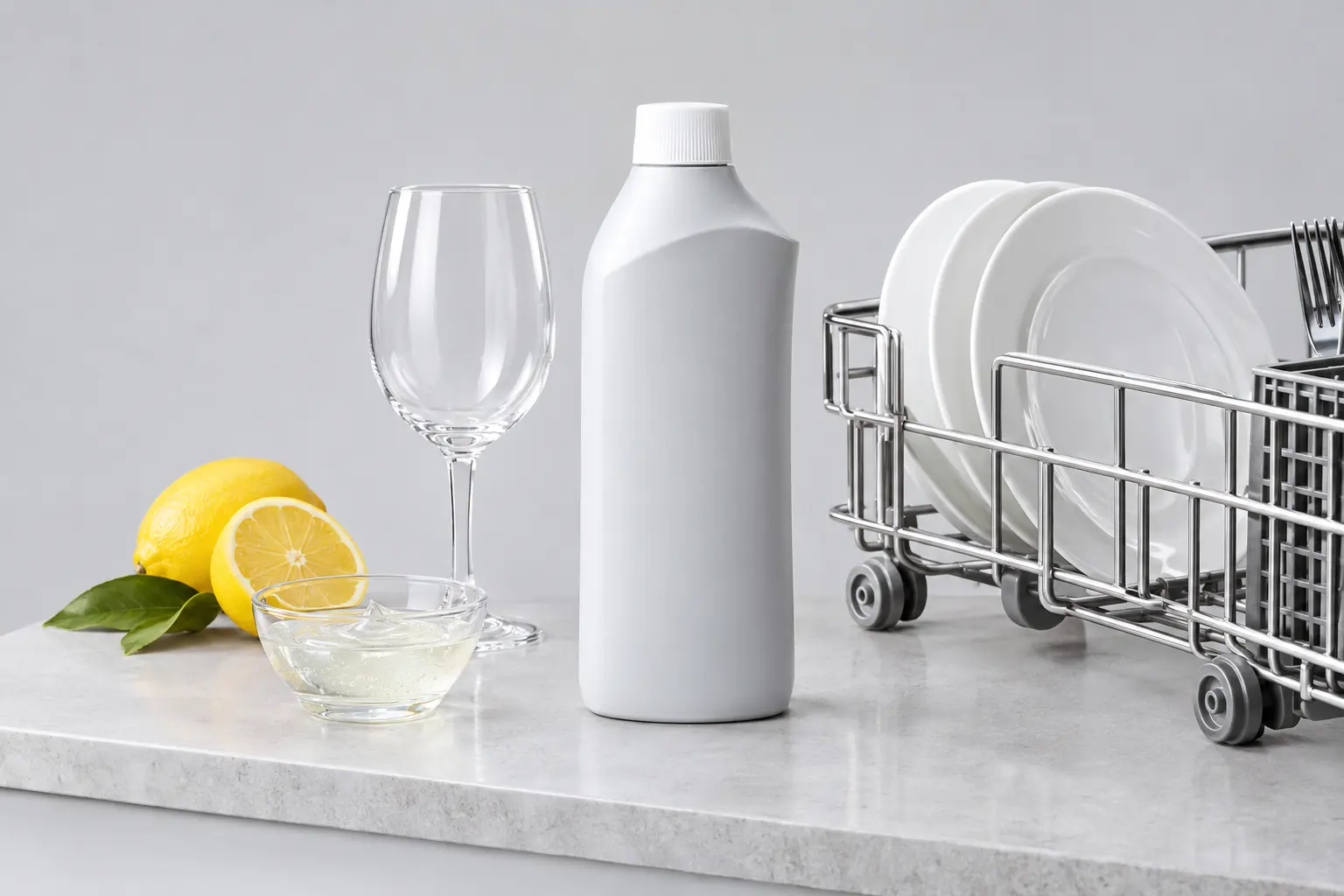
Company AKTO LLC (AKTO) develops and manufactures a dishwasher-machine cleaner to order, built on citric acid, in liquid, gel or sachet/powder format, distinct from a tableware detergent. The formula is classified under EU Regulation (EC) No 1272/2008 (CLP), and its status under Regulation (EC) No 648/2004 depends on whether it itself contains surfactants; the minimum batch is 50 kg at AKTO's plants in Kyiv (Ukraine) and Warsaw (Poland).
01
What a dishwasher cleaner is for
A dishwasher-machine cleaner maintains the appliance itself - removing limescale, grease and odour from its interior surfaces - rather than washing the tableware: it is a fundamentally different product from the tablets or gel used in a normal wash cycle. Appliance makers recommend periodic maintenance with a dedicated product, so in a brand's range this sits alongside, not instead of, a dishwasher detergent.
02
Acid formula, format and packaging
AKTO develops and manufactures a dishwasher-machine cleaner to order on a citric-acid base, in liquid, gel or sachet/powder format. Packaging follows the format: a 50-100 ml dropper-bottle, a 250 ml trigger-spray bottle, or a single-dose sachet for one machine-cleaning cycle.
03
Where it sits against dishwasher detergent, and its hazard classification
Regulation (EC) No 648/2004, point 2(1b), inserted by Regulation (EC) No 259/2012, defines a 'consumer automatic dishwasher detergent' as a product for washing tableware by a non-professional user; a machine-maintenance cleaner for limescale or grease is a separate product and only counts as a detergent under point 2(1) if it itself contains soap or other surfactants. Regulation (EC) No 1272/2008 (CLP) classifies the citric-acid formula through the Annex I tiered approach (sections 3.2 and 3.3), using pH for strong acids or the Table 3.2.4 thresholds otherwise. An anti-bacterial claim about the machine's interior surfaces brings the product within Biocidal Product-Type 2 (Type 4 if the claim concerns food-contact items such as tableware) under Regulation (EU) No 528/2012, requiring a product authorisation (Article 17(1)) or compliance with the transitional regime (Article 89(2)). In Ukraine, whether the Technical Regulation on Detergents (Resolution No. 717/2008) applies depends on whether AKTO's specific formula carries surfactants above 0.2%; a surfactant-free acid-based version falls outside its scope (para 5).
04
AKTO's production conditions
The product is registered under KVED code 20.59, distinct from code 20.41 for soap and detergents. Production premises are held at 20-60% relative humidity and 16-25 degC, checked twice per shift. The minimum batch is 50 kg at plants in Kyiv (Ukraine) and Warsaw (Poland), certified to ISO 9001:2015, ISO 22000:2018 (HACCP, No. 44600111204) and ISO 22716 (GMP).
05
Getting started
A brand decides whether the formula will carry surfactants - which affects whether Ukraine's detergent regulation applies - and whether to claim anti-bacterial action, which may bring additional requirements for biocidal products, or odour removal by cleaning away soiling, then picks packaging: dropper-bottle, trigger-spray or sachet. AKTO develops the formula, checks its CLP classification, and runs a batch from 50 kg. See also: Appliance Care & Descalers, Washing Machine Cleaner and Home Care & Cleaning.
Frequently Asked Questions
Is a dishwasher-machine cleaner the same as dishwasher detergent?
What packaging does AKTO use for a dishwasher-machine cleaner?
Does an anti-bacterial claim change the regulatory path?
What is AKTO's minimum batch for a dishwasher-machine cleaner?
 Kateryna Khromykh
 Oleksandra Vovk
Standards we work to
 ISO 22716 (GMP)
 ISO 22000 (HACCP)
 Regulation (EC) No 1223/2009
 Directive 2002/46/EC
 Halal
Why AKTO
- Citric-acid machine cleaner to order: liquid, gel or sachet/powder
- Dropper-bottle, trigger-spray or single-dose sachet packaging
- CLP classification and detergent status checked per formula
- Registered under KVED 20.59, minimum batch from 50 kg
- Plants in Kyiv (Ukraine) and Warsaw (Poland), ISO 9001, ISO 22000, ISO 22716