
Private Label
Dry Face Oil
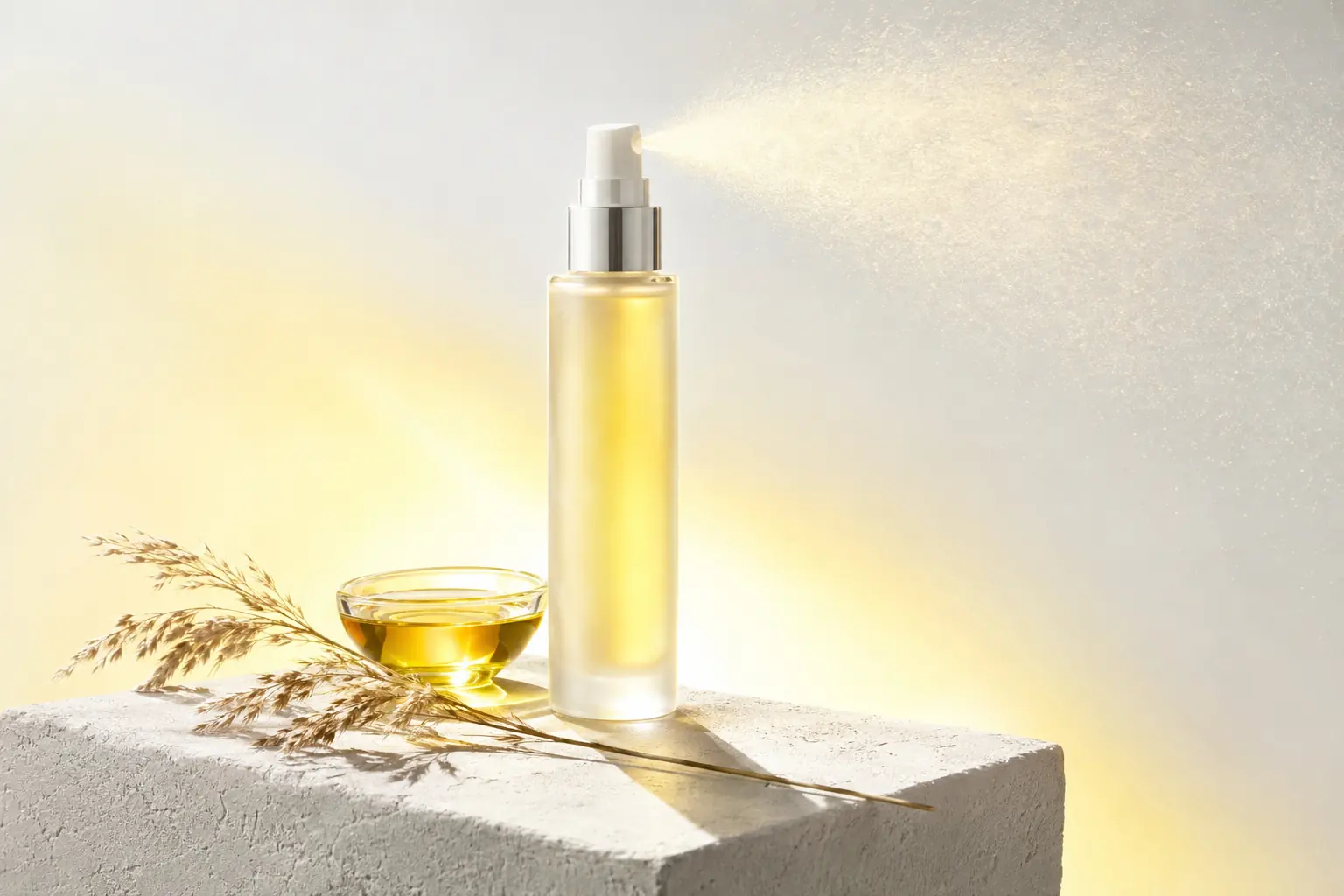
AKTO develops and manufactures a fast-absorbing dry face oil to order on the same lines as its dermatological balms, from a 50 kg batch.
- ISO 22716 GMP
In brief
A dry face oil is a lighter-texture oil blend that spreads and absorbs faster than a heavier facial oil, leaving no greasy film. AKTO develops and manufactures this format to order on its dermatological balm lines, under Regulation (EC) No 1223/2009 and ISO 22716, from a 50 kg batch.
01
What a dry face oil is
A dry oil is a lighter-texture variant of a face oil: the blend is formulated around lighter esters or oils so that it spreads and absorbs faster than a heavier, occlusive facial oil, leaving a dry rather than greasy finish. The format suits spot application and travel use, which is why brands often add a dry oil, stick or balm as a compact companion product alongside the core line. AKTO develops and manufactures a dry oil to order on the same lines that already produce its dermatological balms with beeswax, calendula, chamomile, allantoin and panthenol.
02
Stability of a lighter blend and frequency of use
Regulation (EC) No 1223/2009 Annex I Part A Section 2 requires an assessment of physical and chemical stability; for a dry face oil, this covers the oxidative stability of its lighter ester or oil blend, formulated to spread and absorb faster than a heavier facial oil. Section 6 of the same Annex requires the exposure assessment to reflect frequency and pattern of use, relevant to a dry oil that a brand may position for more frequent daytime reapplication than a heavier night-time oil, thanks to its fast-absorbing, non-greasy finish. Article 10 requires a safety assessment before a dry face oil is placed on the EU market.
03
Label claims and Ukraine regulatory requirements
A claim such as "non-greasy" or "absorbs instantly" on a dry face oil must be supported by evidence, for example sensory or instrumental testing, one of the six common criteria of Commission Regulation (EU) No 655/2013 for any cosmetic claim. ISO 22716 covers anhydrous oil formats as well. In Ukraine, cosmetics manufactured by AKTO are registered under its own technical specification TU U 20.4-43961492-001:2020, backed by a 2021 state sanitary-epidemiological expert conclusion.
04
What AKTO offers
The minimum batch for a cosmetic formulation, including a dry-oil format, is 50 kg of finished product at AKTO's facilities in Kyiv (Ukraine) and Warsaw (Poland). Production is certified to ISO 9001:2015 and ISO 22000:2018 (HACCP; combined certificate No. 44600111204) and to ISO 22716 (GMP). AKTO agrees the primary packaging type - a dropper bottle or a spray - with the brand separately, building on its confirmed PBL tube packaging for balms.
05
Getting started
A brand sets the target absorption speed, packaging type and positioning - daytime care or a compact travel companion; AKTO formulates the lighter ester or oil base on its existing anhydrous lines, runs oxidative-stability testing, and prepares the product's technical dossier for the chosen market. This lets a brand add a lighter format alongside a heavier oil or balm in its range. See also: Face Oil, Oils / Balms / Sticks (Face) and Face.
Frequently Asked Questions
Does AKTO manufacture a dry face oil?
How does a dry oil differ from a regular face oil under EU rules?
Can a dry oil be labelled "absorbs instantly"?
What is AKTO's minimum batch for a dry face oil?
Expert review
Reviewed by
 Illia Mariutsa
Researcher, organic chemistry
Google Scholar Anastasiia Bespalova
Paediatric orthopaedic and trauma surgeon
ORCID
Standards we work to
 ISO 22716 (GMP)
 ISO 22000 (HACCP)
 Regulation (EC) No 1223/2009
 Directive 2002/46/EC
 Halal
Why AKTO
- Dry oil developed on the confirmed dermatological balm lines
- Lighter blend checked for oxidative stability under Regulation (EC) No 1223/2009
- "Non-greasy" claims need evidence under Regulation (EU) No 655/2013
- Registered under TU U 20.4-43961492-001:2020 and a 2021 expert conclusion
- MOQ from 50 kg, facilities in Kyiv (Ukraine) and Warsaw (Poland)