
Private Label
Enzyme Cleansing Powder
A plant enzyme breaks down dead-cell proteins without mechanical rubbing; AKTO formulates the powder and keeps that enzyme active until the jar is opened.
- ISO 22716 GMP
In brief
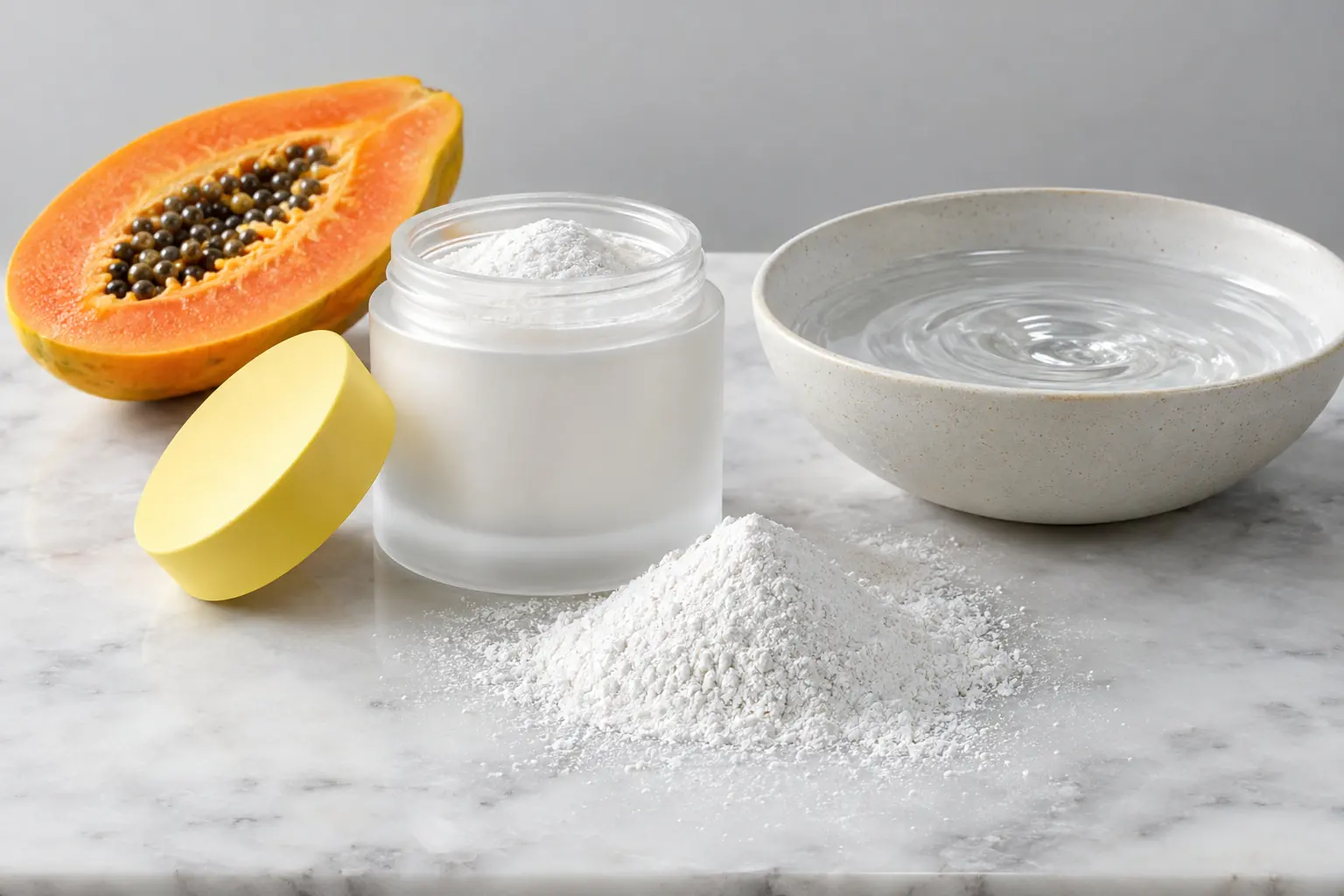
Enzyme cleansing powder is a dry product built on a proteolytic plant enzyme that, once mixed with water, breaks down dead-cell proteins chemically rather than scrubbing them away with particles. AKTO develops and manufactures this powder to order, fills it into a 50-100 g jar, and confirms the enzyme stays active through the product's full shelf life until reconstitution.
01
Enzyme powder: chemical, not mechanical, exfoliation
Unlike a gel-scrub or mineral powder, which lift dead skin cells mechanically with particles, an enzyme powder works chemically: a proteolytic plant enzyme, once it contacts water, breaks the protein bonds holding dead skin cells together, and they rinse away without friction. The format suits a brand positioning its range as gentle - for sensitive skin or daily use, where a mechanical scrub would be too much. AKTO selects the specific enzyme and its concentration to match a claimed intensity.
02
Formula and keeping the enzyme active
The dry, water-free format limits the microbiological load on the preservative system before reconstitution, unlike a water-based formula, but the enzyme still has to stay active through the jar's full shelf life, which is confirmed with physicochemical analysis and stability testing. Article 15 of Regulation (EC) No 1223/2009 bans the use in cosmetic products of substances classified under CLP as carcinogenic, mutagenic or toxic to reproduction (CMR): categories 1A and 1B save for rare exceptions under the conditions of Article 15(2), category 2 unless the SCCS has found them safe; the specific prohibited substances are listed in Annex II. This is a constraint on the enzyme-stabilising and preservative system. Because the powder is mixed with water and rinsed off, its fragrance-allergen labelling threshold under Annex III is 0.01% - higher than the 0.001% used for a leave-on product. Phenoxyethanol, an option for the preservative system, is capped at 1.0% in the ready-for-use preparation under Annex V.
03
The 'enzymatic exfoliation' claim
Commission Regulation (EU) No 655/2013 requires a claim such as 'enzymatic exfoliation' to meet six common criteria - legal compliance, truthfulness, evidential support, honesty, fairness and allowing informed decisions - before it is used in labelling or advertising; under Annex point 2(2), the plant enzyme's properties may not be implied for the finished powder unless it actually has them. In Ukraine, the Technical Regulation on Cosmetic Products (CMU Resolution No. 65 of 20 January 2021) applies to a rinse-off enzyme powder sold on the domestic market; it prohibits placing on the market a product whose final formulation or ingredients were tested on animals for the Regulation's purposes using a non-alternative method once a validated alternative method has been adopted (point 46).
04
What AKTO manufactures
AKTO fills enzyme cleansing powder into a 50-100 g jar or dispenser bottle. Physicochemical analysis and stability testing, run during dossier preparation, confirm that the enzyme - named by its specific INCI term in the ingredient list under Article 19(1)(g) - stays active until reconstitution. Manufacturing runs at plants in Kyiv (Ukraine) and Warsaw (Poland), certified to ISO 22716 (GMP) and the combined ISO 9001:2015/ISO 22000:2018 (HACCP) standard (certificate No. 44600111204). The minimum order for cosmetics is from 50 kg.
05
Getting started
- The brand defines the target skin (sensitive, daily use) and the claimed enzyme intensity.
- AKTO selects the enzyme and checks the stabilising system against Annexes II, III and V.
- Physicochemical analysis confirms the enzyme stays active through the full shelf life.
- Once the sample is approved, filling into a 50-100 g jar moves to production.
06
See also
See also: Face Cleansers and Face Cleansing Powder.
Frequently Asked Questions
How does enzyme powder differ from mineral cleansing powder?
What must the 'enzymatic exfoliation' claim meet before it appears on packaging?
How does AKTO confirm the enzyme stays active until the jar is opened?
What is the minimum order for enzyme cleansing powder?
Expert review
Reviewed by
 Illia Mariutsa
Researcher, organic chemistry
Google Scholar Anastasiia Bespalova
Paediatric orthopaedic and trauma surgeon
ORCID
Standards we work to
 ISO 22716 (GMP)
 ISO 22000 (HACCP)
 Regulation (EC) No 1223/2009
 Directive 2002/46/EC
 Halal
Why AKTO
- Plant enzyme and concentration matched to the claimed effect
- Enzyme activity confirmed by physicochemical analysis and stability testing
- Evidential support for the enzymatic-exfoliation claim under Regulation (EU) No 655/2013
- Filled into a 50-100 g jar, plants in Kyiv (Ukraine) and Warsaw (Poland)