
Private Label
Exfoliating Bar Soap
AKTO develops exfoliating bar soap to order, with mechanical-exfoliation particles chosen to meet the REACH ban on synthetic-polymer microbead abrasives.
- ISO 22716 GMP
In brief
Company AKTO LLC (AKTO) develops and manufactures exfoliating bar soap to order on its cosmetics lines in Kyiv (Ukraine) and Warsaw (Poland). A solid soap bar intended for skin cleansing is a cosmetic under Regulation (EC) No 1223/2009, not a detergent, and its abrasive particles must avoid the synthetic-polymer microbeads banned outright under REACH Annex XVII entry 78. Production runs under AKTO's own technical specification, with a minimum order quantity from 50 kg.
01
What exfoliating bar soap is
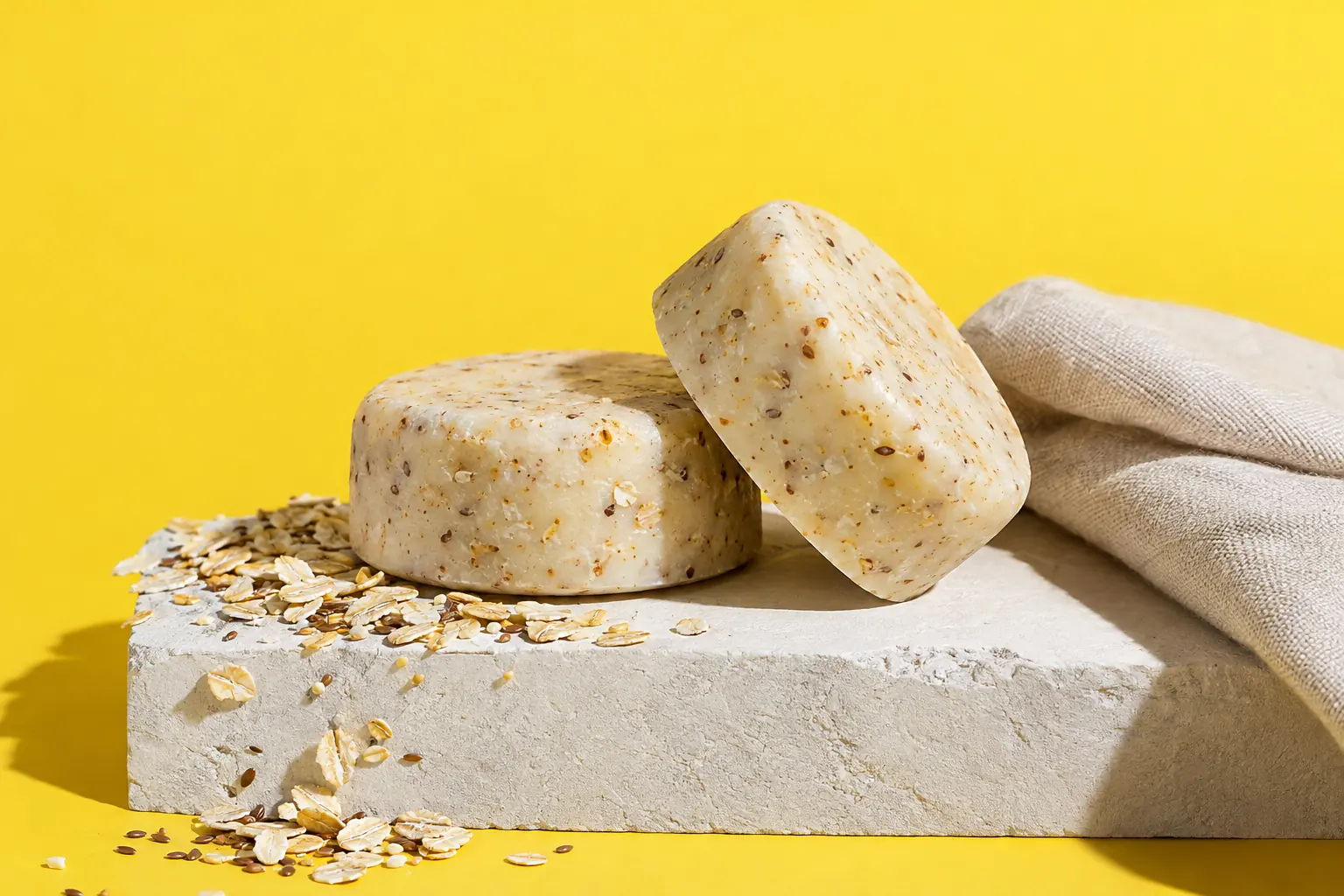
Exfoliating bar soap is a solid soap format that carries a mechanical-abrasive ingredient alongside the usual cleansing surfactants, so a single bar cleans and physically buffs the skin in one step. Brands typically pitch it into a natural or eco-positioned niche next to a plain bar soap: the visible particles in the bar are the whole point of the shelf story, so the choice of abrasive matters as much as the fragrance or the surfactant base.
02
Why the solid form doesn't decide the rules
A soap bar intended for cleansing the skin is a cosmetic product under Article 2(1)(a) of Regulation (EC) No 1223/2009, the same as a liquid gel. Regulation (EC) No 648/2004 defines 'detergent' broadly enough to name 'bar, cake' among its covered forms, but its definition of 'washing' in Article 2(2) is limited to cleaning laundry, fabrics, dishes and other hard surfaces - so it is the intended use on the body, not the solid shape of the bar, that keeps an exfoliating bar soap inside the cosmetics regime rather than the detergents one.
03
Choosing the exfoliating particle
Commission Regulation (EU) 2023/2055, amending REACH Annex XVII entry 78, bans synthetic-polymer microparticles used 'as an abrasive, i.e. namely to exfoliate, polish or clean' - so-called microbeads - in rinse-off products outright, with no transitional period; other synthetic-polymer microparticle uses in rinse-off cosmetics still get a transitional period running to 17 October 2027. Because the abrasive ban carries no such window, an exfoliating bar soap's particles have to come from outside that entry from day one: ground seed or shell powder, sugar, salt, pumice or other inorganic materials, or a polymer specifically excluded from the entry's designation - a natural, non-chemically-modified polymer, one shown degradable under the Regulation's Appendix 15, or one soluble above 2 g/L under Appendix 16.
04
Colourants, fragrance and the label
Article 15 of Regulation (EC) No 1223/2009 governs the colourants and fragrance in an exfoliating bar the same two-tier way as any other cosmetic: Category 2 CMR substances are barred unless the SCCS confirms them safe, and Category 1A/1B substances are barred unless food-safety, no-alternative, known-exposure and SCCS-safety conditions are all met at once. Article 19(1)(g) requires the ingredient list in descending order of weight of the ingredients at the time they are added to the cosmetic product, with any ingredient present as a nanomaterial - a silica-based abrasive, for instance - marked '[nano]'.
05
What AKTO offers
AKTO develops and manufactures exfoliating bar soap to order, under a registered KVED classification code, 20.41, that covers soap manufacture specifically, alongside code 20.42 for perfumes and cosmetics. Production premises are monitored for humidity (20-60%) and temperature (16-25 degrees C) twice per shift, a control that matters for a solid bar's storage stability. The minimum order quantity starts from a 50 kg batch, under AKTO's own technical specification, TU U 20.4-43961492-001:2020, and its ISO 9001:2015, ISO 22000:2018 (combined certificate No. 44600111204) and ISO 22716 (GMP) certification.
06
Getting started
A brand chooses the abrasive - a natural powder, sugar, salt or another compliant material - and the target texture, and AKTO develops or adapts the formula, checks it against the current REACH restriction and prepares the technical documentation for the target market. See also: Hand Wash, Bar Soap, Liquid Hand Soap and Antibacterial Liquid Hand Soap.
Frequently Asked Questions
Can an exfoliating bar soap use plastic microbeads?
What can replace plastic microbeads in a bar soap?
Is an exfoliating bar soap regulated as a detergent?
What is AKTO's minimum order quantity for bar soap?
Expert review
Reviewed by
 Illia Mariutsa
Researcher, organic chemistry
Google Scholar Anastasiia Bespalova
Paediatric orthopaedic and trauma surgeon
ORCID
Standards we work to
 ISO 22716 (GMP)
 ISO 22000 (HACCP)
 Regulation (EC) No 1223/2009
 Directive 2002/46/EC
 Halal
Why AKTO
- Exfoliating bar soap developed and manufactured to order as a cosmetic, not a detergent
- Abrasive choice checked against the REACH ban on synthetic-polymer microbeads
- Registered KVED code 20.41 for soap manufacture, alongside 20.42 for cosmetics
- Humidity (20-60%) and temperature (16-25 degrees C) monitored twice per shift
- MOQ from 50 kg, ISO 9001:2015, ISO 22000:2018 (HACCP), ISO 22716 (GMP)