
Private Label
Face Cleansing Balm
AKTO develops a face cleansing balm that melts on contact with the skin and dissolves stubborn make-up and SPF - the first step of a double cleanse.
- ISO 22716 GMP
In brief
A face cleansing balm is a dense wax-and-oil texture that melts from body heat and dissolves stubborn make-up, SPF and excess sebum before it ever meets water. AKTO develops and manufactures this balm to order on its own lines, in a jar or tube, against the brand's technical brief.
01
Cleansing balm: the first step of a double cleanse
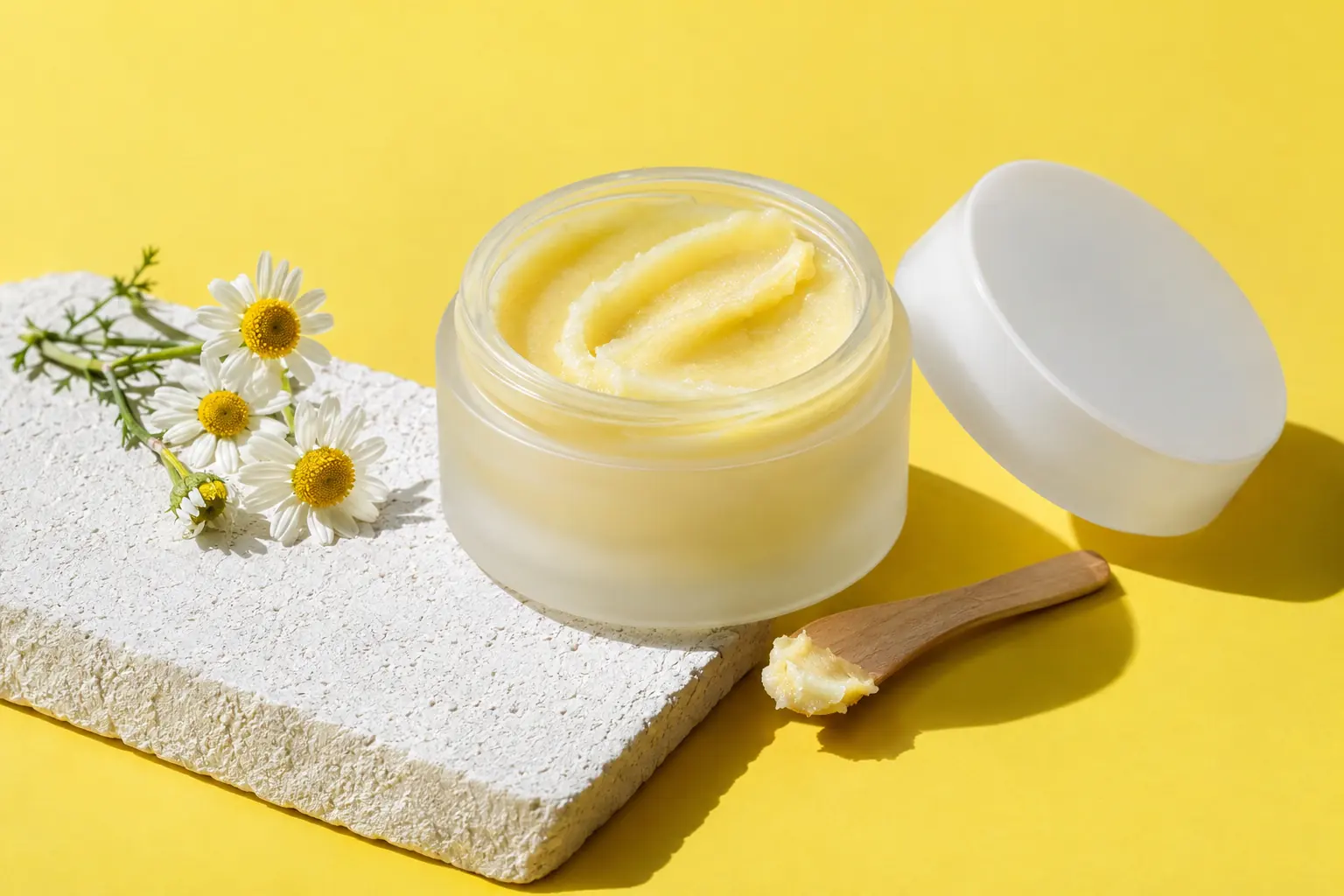
A face cleansing balm is a dense texture built on waxes and oils, applied with dry hands to dry skin: it melts from body heat and dissolves stubborn make-up, water-resistant SPF and excess sebum, and is then emulsified with a splash of water or lifted off with a damp cloth. The format is the classic first step of a double cleanse, followed by a second, water-based product. Its rich texture suits dry skin that a foaming format would over-dry. AKTO develops this balm's formula under the client's brand.
02
Composition requirements for a wax-and-oil balm
Annex II of Regulation (EC) No 1223/2009 constrains the wax-and-oil phase and preservatives permitted in a cleansing balm. Because the balm is ultimately emulsified with water or lifted off with a damp cloth, the Annex III fragrance-allergen labelling threshold of 0.01% applies, a less strict level than the threshold for a product that stays on the skin. Phenoxyethanol, a preservative option for the aqueous phase of a balm-in-oil, is permitted under Annex V at up to 1.0% in the ready-for-use preparation. A pack claim such as 'melts away make-up' or 'dissolves impurities' must meet the six criteria of Commission Regulation (EU) No 655/2013.
03
EU and Ukraine regulatory notes
Article 19(1)(g) requires the ingredient list on the packaging to be given in descending order of weight of the ingredients at the time they are added to the cosmetic product. In Ukraine, a face cleansing balm falls under the general Technical Regulation on Cosmetic Products (Resolution No. 65), and AKTO manufactures to the ISO 22716 standard.
04
Development and testing at AKTO
AKTO runs mandatory stability and compatibility testing on every new formula, including a wax-and-oil balm - important so the texture stays uniform and melts predictably at room and skin temperature for the full shelf life. AKTO's own lab develops the balm's formula from a reference composition or a brand-submitted sample.
05
Getting started
MOQ for cosmetics starts from 50 kg; manufacturing takes place at plants in Kyiv (Ukraine) and Warsaw (Poland), certified to ISO 9001:2015, ISO 22000:2018 (HACCP) and ISO 22716 (GMP).
- The brand submits a technical brief: skin type, melting temperature, removal method.
- AKTO's lab develops the formula and checks it against Annexes II, III and V.
- Texture-stability and component-compatibility testing follows.
- The brand approves the sample, AKTO selects the jar or tube, and production begins.
06
See also
See also: Face Cleansers, Face Cleansing Oil and Face Cleansing Cream.
Frequently Asked Questions
What is a face cleansing balm for?
What allergen-labelling threshold applies to a cleansing balm?
What testing does a balm formula go through at AKTO?
What technical regulation applies to a cleansing balm in Ukraine?
Expert review
Reviewed by
 Illia Mariutsa
Researcher, organic chemistry
Google Scholar Anastasiia Bespalova
Paediatric orthopaedic and trauma surgeon
ORCID
Standards we work to
 ISO 22716 (GMP)
 ISO 22000 (HACCP)
 Regulation (EC) No 1223/2009
 Directive 2002/46/EC
 Halal
Why AKTO
- First step of a double cleanse for dry skin and stubborn make-up
- Mandatory stability testing of the wax-and-oil phase's texture
- MOQ for cosmetics starts from 50 kg
- Manufacturing to ISO 22716 (GMP) at plants in Kyiv (Ukraine) and Warsaw (Poland)