
Private Label
Face Enzym Peel
AKTO develops and manufactures face enzyme peels to order on its serum and emulsion peel lines, in a dropper bottle or tube of 50-100 ml.
- ISO 22716 GMP
In brief
Company AKTO LLC (AKTO) develops and manufactures face enzyme peels to order on the same lines that already produce its serum and emulsion acid peels, filled into dropper bottles or tubes of 50-100 ml. The enzyme type and concentration are agreed individually per brand, and safety is governed by Article 3 of Regulation (EC) No 1223/2009.
01
How enzymatic exfoliation works
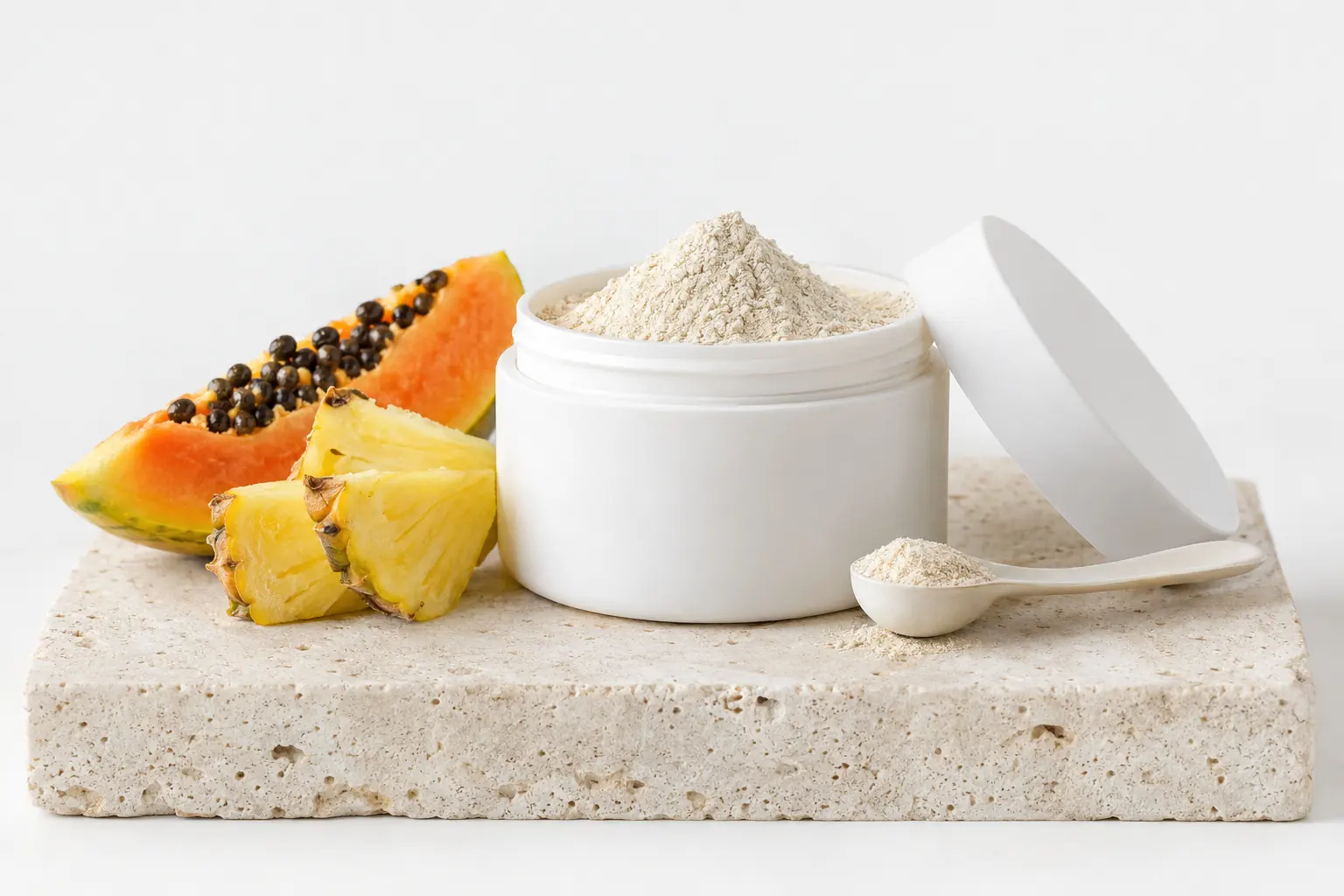
Enzymatic exfoliation removes dead cells from the skin's outer layer using proteolytic enzymes rather than acids or mechanical friction: the enzyme breaks down the protein bonds holding dead cells together, giving a gentler renewal effect than an acid peel. Brands typically position this format as a softer option for sensitive skin, or as a course-based product used between rounds of acid exfoliation rather than a daily cream. Within a range, it broadens the exfoliation choice without changing the core routine, and works well as an upsell alongside acid peels.
02
The format AKTO develops to order
AKTO develops and manufactures face enzyme peels to order on the same lines already used for its serum and emulsion acid peels, filled into dropper bottles or tubes of 50-100 ml. One of AKTO's AHA-line peel labels already carries the wording 'AHA acid & enzymes', so an enzyme component is already part of AKTO's formulation practice. The specific enzyme, its concentration and the fill format are agreed individually during recipe development, depending on the target effect and skin type.
03
Safety requirements for enzyme peels
Article 3 of Regulation (EC) No 1223/2009 sets the general safety obligation that governs enzyme (proteolytic) peels, since neither Annex II nor Annex III lists a substance-specific restriction for cosmetic proteolytic enzymes. Annex I Part A Section 8 requires the safety report's toxicological profile to give particular focus to local toxicity - skin and eye irritation - and skin sensitisation, the main safety endpoints for this exfoliation mechanism. ISO 22716 governs production, control, storage and shipment of the finished product regardless of the active-ingredient class.
04
AKTO's production capability
The minimum batch is 50 kg of finished formulation at AKTO's facilities in Kyiv (Ukraine) and Warsaw (Poland). The dossier testing package for actives-driven formulas includes physicochemical analysis and stability/compatibility testing. A dedicated enzyme peel would typically go through AKTO's 'Formula for Success' package: recipe development against a brief or reference sample, up to 7 formulation rounds, and internal quality testing. Production is certified to ISO 9001:2015, ISO 22000:2018 (HACCP; combined certificate No. 44600111204) and ISO 22716 (GMP).
05
Getting started
A brand defines the target exfoliation effect, enzyme type and packaging format; AKTO then adapts an existing serum or emulsion base, or develops a new recipe under the Formula for Success package, runs physicochemical testing and prepares the technical documentation for the chosen market. Both facilities let a brand pick a production site to match its target market. See also: Exfoliation / Peels (Face), Face Exfoliating Peel (AHA), Face Exfoliating Peel (BHA) and Face Exfoliating Peel (PHA).
Frequently Asked Questions
Does AKTO manufacture enzyme peels for the face?
How is enzymatic exfoliation different from an acid peel?
What EU safety rules apply to enzyme peels?
Which AKTO service package fits developing a new enzyme peel?
Expert review
Reviewed by
 Illia Mariutsa
Researcher, organic chemistry
Google Scholar Anastasiia Bespalova
Paediatric orthopaedic and trauma surgeon
ORCID
Standards we work to
 ISO 22716 (GMP)
 ISO 22000 (HACCP)
 Regulation (EC) No 1223/2009
 Directive 2002/46/EC
 Halal
Why AKTO
- Enzyme peel developed on already-proven serum and emulsion lines
- Dropper bottle or tube packaging, 50-100 ml
- 'Formula for Success' package with up to 7 formulation rounds
- MOQ from 50 kg, facilities in Kyiv (Ukraine) and Warsaw (Poland)
- Certified to ISO 9001, ISO 22000 (HACCP), ISO 22716