
Private Label
Face Toner Spray
AKTO already manufactures spray-format toning products in 200-250 ml bottles and checks every label claim against Regulation 655/2013.
- ISO 22716 GMP
In brief
Company AKTO LLC (AKTO) already manufactures spray-format facial toners in 200-250 ml trigger-spray bottles and develops new toner-spray formulas to a brand's brief. Preservative concentration and the label's function statement follow Annex V and Article 19(1)(f) of Regulation (EC) No 1223/2009, and claims are substantiated under Regulation (EU) No 655/2013.
01
What a face toner spray is and who it suits
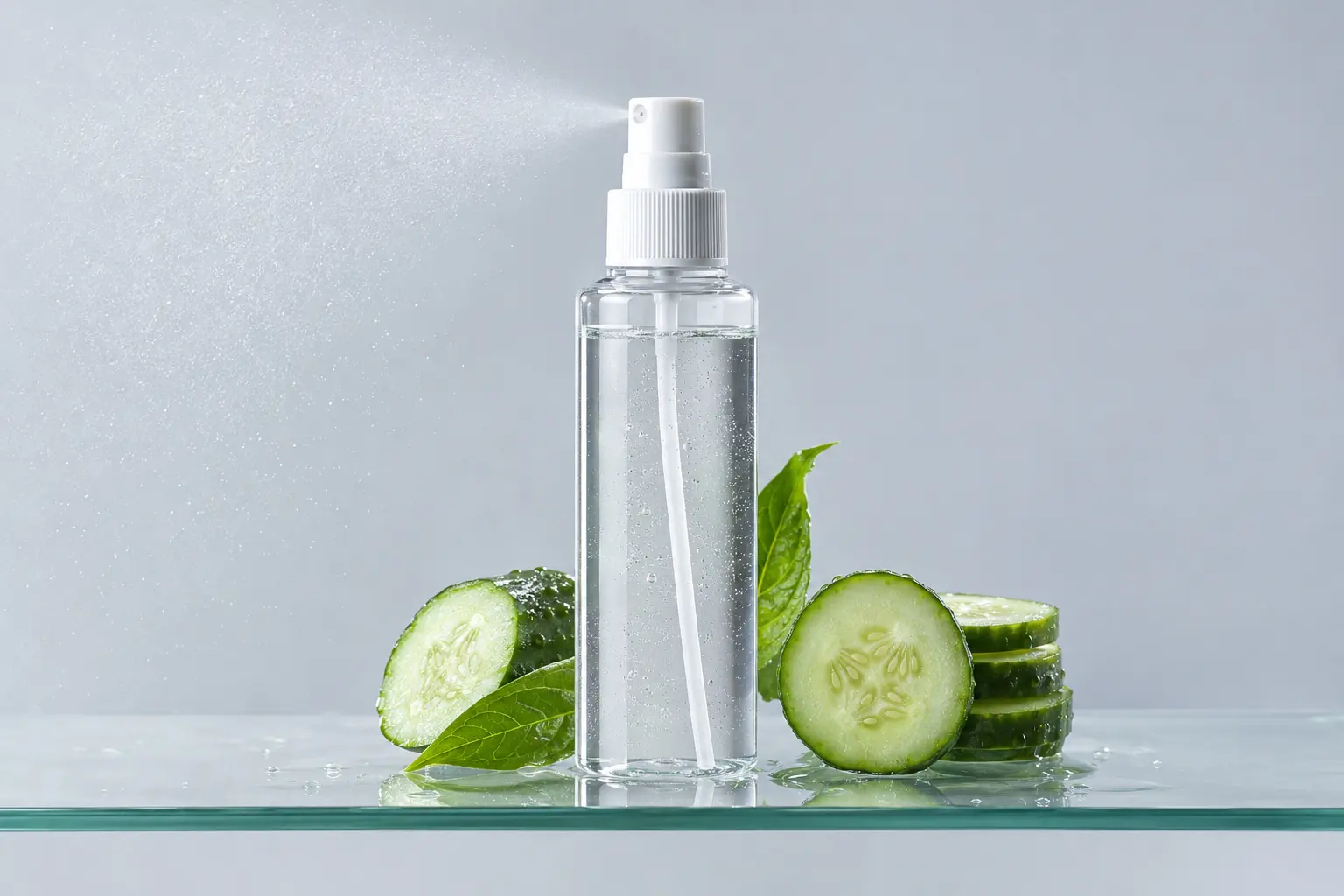
A face toner spray is a leave-on liquid applied by spray to balance skin pH, refine the look of pores, or prep skin before the next step in a routine. Unlike a mist, which simply hydrates and refreshes, a toner states a specific function - toning or balancing - and that function drives how the product must be labelled. The format suits a brand that wants a clearly 'active' product positioned between a mist and an essence, while keeping a light aqueous texture and a spray applicator for easy use.
02
Formula, packaging and label requirements
AKTO already manufactures spray-format toning products on the same line as its two-phase toning lotion, including a spray lotion carrying a fragrance that combines jasmine and melon notes. A technical brief for a new toner spray records the desired active ingredients, free-from claims, texture, fragrance, packaging and volume, and the target market, before formula development starts. For labelling, AKTO uses self-adhesive or shrink-sleeve materials: for round bottles, a label roll of 7.5 cm diameter, with the label height kept at least 2 mm smaller than the bottle height.
03
EU rules: claims, product function, testing
Regulation (EC) No 1223/2009, Annex V, sets a lower maximum authorised concentration for certain preservatives in leave-on products than in rinse-off ones - for example, benzoic acid at 0.5% leave-on versus 2.5% rinse-off - a distinction directly relevant to a toner spray. Article 19(1)(f) requires the product's function to be stated on the label unless it is clear from its presentation, which is exactly what distinguishes a toner from a plain mist. Claims such as 'pH-balancing' or 'pore-refining', typical of a toner, must meet the six criteria of Commission Regulation (EU) No 655/2013. A new leave-on formula's dossier includes mandatory microbiology, preservative challenge testing, physicochemical analysis (pH, viscosity, organoleptics) and stability/compatibility testing.
04
What AKTO offers
AKTO manufactures toner sprays from a minimum order of 50 kg of formulation, at its plants in Kyiv (Ukraine) and Warsaw (Poland), filling the finished product into 200-250 ml trigger-spray bottles. Manufacturing is certified to ISO 9001:2015 and ISO 22000:2018 (HACCP; combined certificate No. 44600111204), ISO 22716 (GMP). The full testing package lets a brand substantiate the stated function before market launch.
05
Getting started
A brand fills in a technical brief - active ingredients, texture, fragrance, packaging, volume and target market - after which AKTO checks preservative concentrations against Annex V, substantiates claims against Regulation 655/2013, and drafts the label's function statement under Article 19(1)(f). The project then moves through formula development, the full testing package, and filling into a 200-250 ml bottle. See also: Toners / Mists / Essences, Face Mist and Toning Lotion.
Frequently Asked Questions
How does a toner spray differ from a face mist?
What label requirements apply to a toner-spray bottle?
What testing does a new toner-spray formula undergo?
What is the minimum order for a face toner spray?
Expert review
Reviewed by
 Illia Mariutsa
Researcher, organic chemistry
Google Scholar Anastasiia Bespalova
Paediatric orthopaedic and trauma surgeon
ORCID
Standards we work to
 ISO 22716 (GMP)
 ISO 22000 (HACCP)
 Regulation (EC) No 1223/2009
 Directive 2002/46/EC
 Halal
Why AKTO
- Already manufactures spray-format toning products on its own line
- Technical brief captures the project before formula development
- Full testing package: microbiology, preservative challenge, stability
- MOQ from 50 kg of formulation
- Plants in Kyiv (Ukraine) and Warsaw (Poland)