
Private Label
Facial Serum (Peptides)
AKTO develops and manufactures a peptide-active facial serum to a brand's brief, on its dropper-bottle liquid-serum line and its cream-formula line.
- ISO 22716 GMP
In brief
Company AKTO LLC (AKTO) develops and manufactures a peptide facial serum to a brand's brief, building on its own dropper-bottle liquid serum and on the peptides Palmitoyl Tripeptide-1 and Palmitoyl Tetrapeptide-7 already confirmed in a cream formula. Production follows Regulation (EC) No 1223/2009 and ISO 22716, with Ukraine registration under AKTO's own TU U 20.4-43961492-001:2020.
01
What a peptide facial serum is
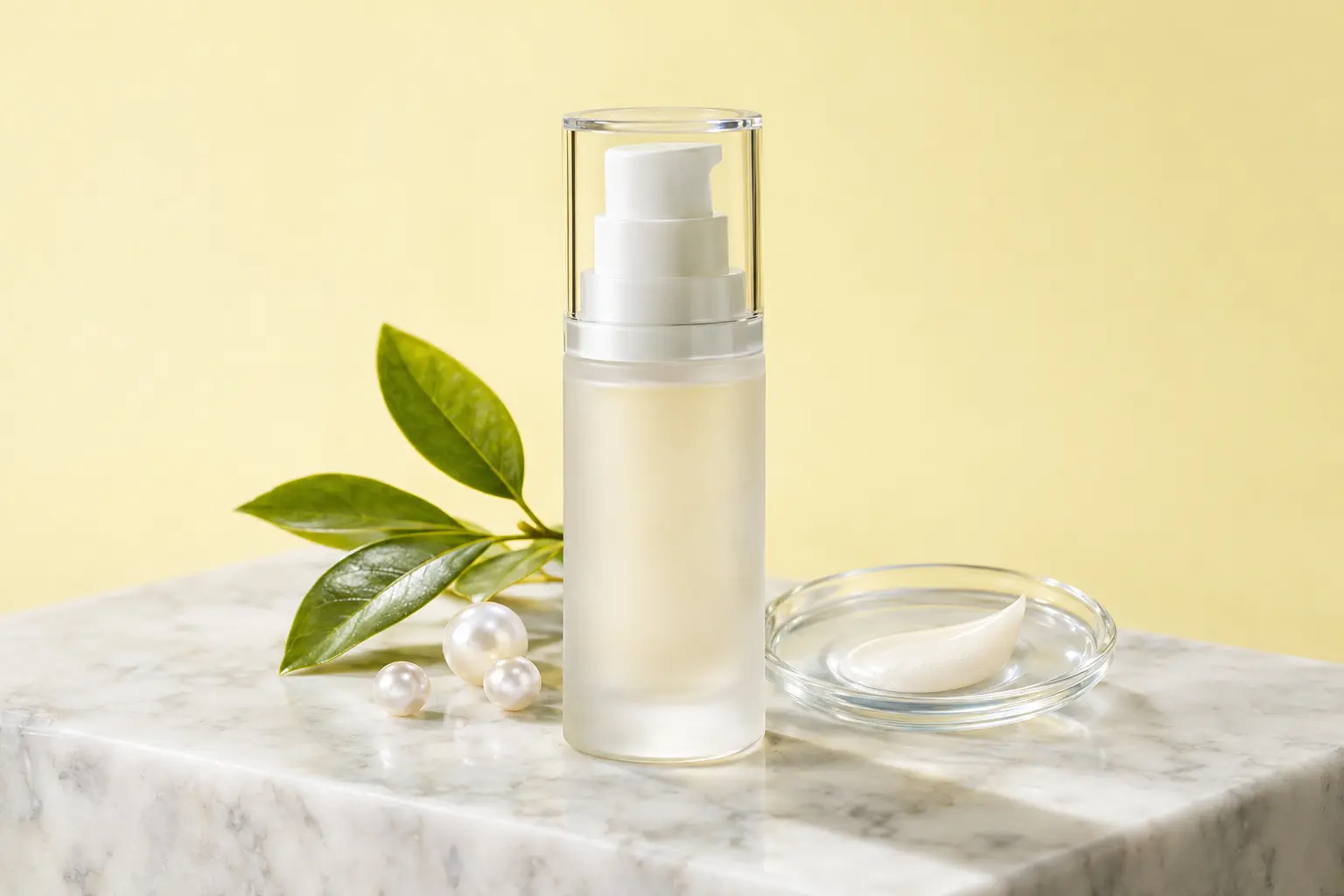
A peptide serum is a light, liquid leave-on product applied under a cream to deliver an active complex at a concentration a standard emulsion cannot carry. For a brand it typically sits above the core cream line as a premium add-on that a customer buys in a dedicated course rather than daily, aimed at firmness and tone. A dropper format keeps dosing visible and easy to explain on pack.
02
Actives, format and packaging
AKTO manufactures a liquid serum built on a complex of AHA and PHA acids, filled into 50 ml and 100 ml dropper bottles — the proven liquid base a peptide version is developed from to a brand's brief. Separately, AKTO already applies the peptides Palmitoyl Tripeptide-1 and Palmitoyl Tetrapeptide-7 in its own cream formula alongside niacinamide and ceramides, so formulation work with these exact actives is production-proven. Beyond dropper bottles, liquid formats can also be filled into airless pumps or PBL tubes.
03
EU regulatory requirements for a peptide serum
Article 10 of Regulation (EC) No 1223/2009 requires a Cosmetic Product Safety Report before a peptide serum is placed on the EU market. Because the product stays on the skin, Article 19 and Annex III set the fragrance-allergen declaration threshold at 0.001% by weight — stricter than the 0.01% threshold for rinse-off products. Under Article 19(1)(g) the ingredient list follows descending order of weight of the ingredients at the time they are added to the cosmetic product, and under Article 19(6) each peptide is named by its common ingredient name (the INCI glossary under Article 33), which is how Palmitoyl Tripeptide-1 or Palmitoyl Tetrapeptide-7 appear on a label. ISO 22716 governs the liquid-production process itself.
04
What AKTO offers
The minimum batch for cosmetic formulas, peptide serum included, starts from 50 kg of finished formulation; production runs across two sites, Kyiv (Ukraine) and Warsaw (Poland), letting a brand pick a facility by target market. The test package for a new formula covers physicochemical analysis (pH, viscosity, organoleptics) plus stability and compatibility testing. Manufacturing holds ISO 9001:2015 and ISO 22000:2018 (HACCP; combined certificate No. 44600111204), ISO 22716 (GMP). In Ukraine the product is registered under AKTO's own TU U 20.4-43961492-001:2020 'Cosmetic Products'.
05
Getting started
A brand specifies the target active complex, dosage format and market; AKTO then builds the formula on its proven liquid base, runs physicochemical testing, and prepares the technical file for the chosen market. See also: Serums / Ampoules / Concentrates, Facial Serum (AHA/BHA), Facial Serum (Soothing) and Face Creams / Moisturizers.
Frequently Asked Questions
Does AKTO manufacture a peptide facial serum?
How are peptides named on the ingredient label?
What allergen-declaration threshold applies to a leave-on serum?
What is the minimum production batch for a peptide serum?
Expert review
Reviewed by
 Illia Mariutsa
Researcher, organic chemistry
Google Scholar Anastasiia Bespalova
Paediatric orthopaedic and trauma surgeon
ORCID
Standards we work to
 ISO 22716 (GMP)
 ISO 22000 (HACCP)
 Regulation (EC) No 1223/2009
 Directive 2002/46/EC
 Halal
Why AKTO
- Liquid serum on an AHA/PHA acid complex in 50 ml and 100 ml dropper bottles
- Palmitoyl Tripeptide-1 and Palmitoyl Tetrapeptide-7 already confirmed in AKTO's own cream formula
- Test package: physicochemical analysis, stability and compatibility testing
- MOQ from 50 kg, facilities in Kyiv (Ukraine) and Warsaw (Poland)
- Certified to ISO 9001:2015, ISO 22000:2018 (HACCP) and ISO 22716 (GMP)