
Private Label
Glass Cleaner
AKTO develops and manufactures a streak-free, alcohol-based glass-cleaning spray to order, checking its flammability classification.
- CLP 1272/2008
In brief
A glass cleaner is a thin, clear spray that dries fast without streaks, typically alcohol-based. Regulation (EC) No 1272/2008 (CLP) requires such a formula to be classified as a flammable liquid, Category 2 or 3, depending on the solvent and concentration used. In Ukraine, the Technical Regulation on Detergents (CMU Resolution No. 717/2008) applies once surfactant content exceeds 0.2%. AKTO develops and manufactures this product to order in a 250 ml trigger-spray bottle, from a 50 kg batch, with a lead time from 4 weeks against 100% prepayment.
01
What a glass cleaner is
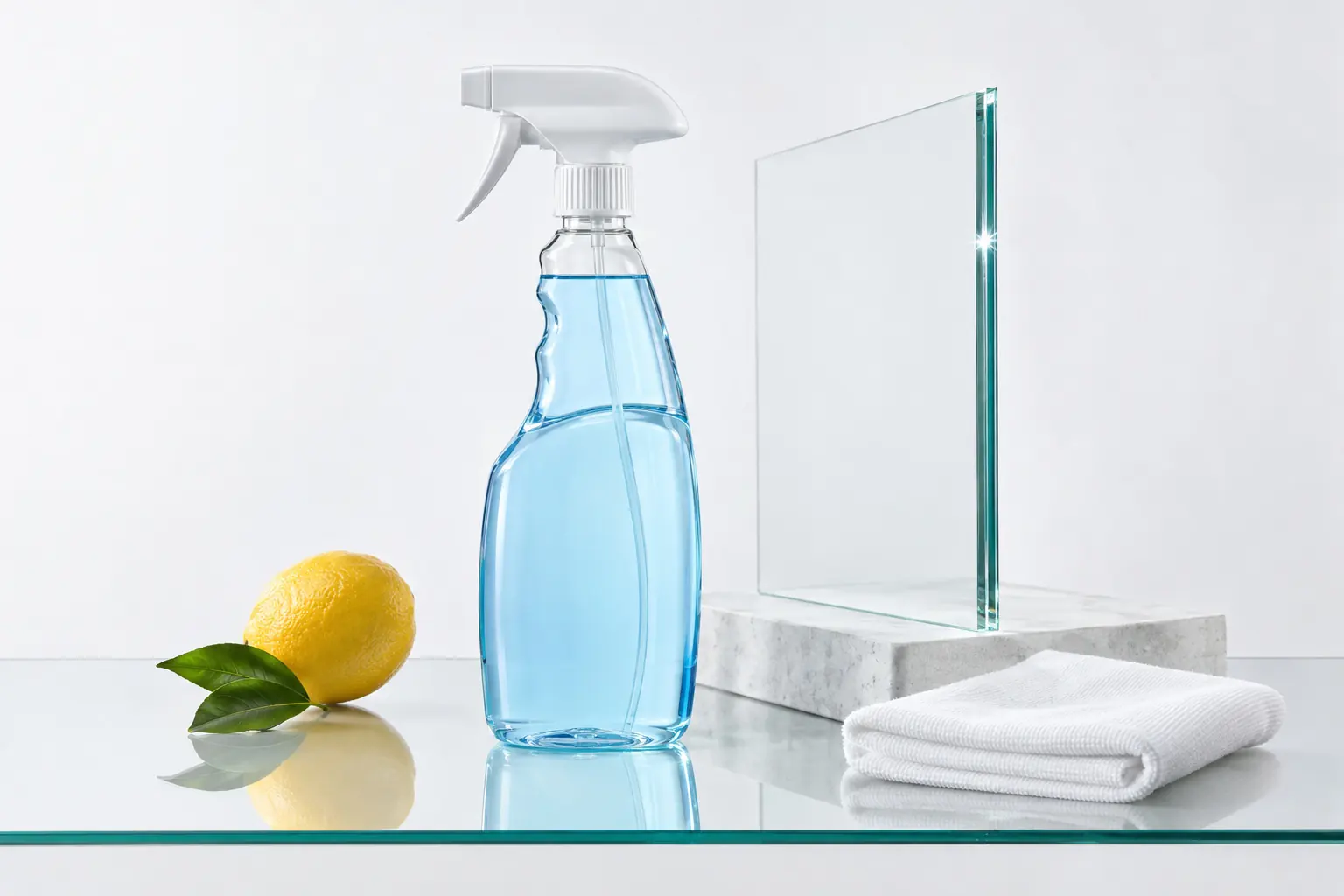
Company AKTO LLC (AKTO) develops and manufactures a glass cleaner to order. It is a thin, clear spray for cleaning glass surfaces and shop windows, formulated to evaporate quickly without streaks or residue. Unlike a heavier kitchen or bathroom product, the formula here is typically thin, often alcohol-based for fast drying, which brings flammability and hazard labelling to the front of the formulation decision. A brand already selling a mirror or floor cleaner can add a glass cleaner to the same packaging line without changing the bottle format.
02
Flammability and classification under CLP
Table 2.6.1 of Annex I to Regulation (EC) No 1272/2008 (CLP) separates Flammable Liquid Category 2 (flash point below 23 degC and initial boiling point above 35 degC - the range covering isopropanol) from Category 3 (flash point 23-60 degC); the category assigned to a glass-cleaner formulation depends on its actual solvent and concentration. For a formula classified as flammable, Article 17 of the same regulation requires the label to show the product identifier, the flame hazard pictogram, signal word, precautionary statements and supplier details. A formula that is not classified as flammable is still subject to the general detergent-labelling rules below.
03
Regulatory position in Ukraine
The Technical Regulation on Detergents (CMU Resolution No. 717/2008, as amended) applies to a glass-cleaning spray as a surface-cleaning detergent once soap and/or surfactant content exceeds 0.2% by weight, independently of whether the formula is also classified as flammable under a separate regulation. A brand therefore checks both regulations separately rather than assuming one covers the other.
04
What AKTO offers for this category
AKTO develops and manufactures a glass cleaner in a 250 ml trigger-spray bottle, from a 50 kg batch of finished formulation. The Warsaw (Poland) plant's stated bottle-filling capacity reaches up to 200,000 a month, and the Kyiv (Ukraine) plant's up to 500,000. The standard production lead time is from 4 weeks, against 100% prepayment. Production runs under the combined ISO 9001:2015 and ISO 22000:2018 (HACCP) certificate (No. 44600111204) and ISO 22716 (GMP).
05
Getting started with AKTO
The brand defines the solvent (alcohol-based or alcohol-free) for its target market.
- AKTO checks the formula's flammability and hazard classification under CLP.
- Prepares the flame-pictogram label if the formula is classified as flammable.
- Agrees the 250 ml trigger-spray bottle and batch size with the brand.
- Starts series production at the Kyiv (Ukraine) or Warsaw (Poland) plant.
See also: Glass / Mirrors, Mirror Cleaner and Home Care & Cleaning.
Frequently Asked Questions
Does AKTO manufacture a finished glass cleaner?
Why does an alcohol-based glass cleaner need special labelling?
When does the Technical Regulation on Detergents apply to a glass cleaner?
What is AKTO's bottle-filling capacity?
 Kateryna Khromykh
 Oleksandra Vovk
Standards we work to
 ISO 22716 (GMP)
 ISO 22000 (HACCP)
 Regulation (EC) No 1223/2009
 Directive 2002/46/EC
 Halal
Why AKTO
- Development of an alcohol-based glass-cleaning spray to order
- 250 ml trigger-spray bottle, MOQ from 50 kg
- Formula checked for flammability under CLP
- Bottle-filling capacity up to 500,000 a month in Kyiv (Ukraine)