
Private Label
Glycine
AKTO develops and manufactures glycine capsules to order on its own lines, distinct from glycine's E 640 food-additive function.
- Reg. 432/2012
In brief
Glycine is the simplest amino acid, with no EU-authorised health claim as a supplement ingredient; separately, glycine is authorised as the food additive E 640. AKTO develops and manufactures glycine capsules to order from a minimum of 10 kg of raw material or 20,000 capsules.
01
What glycine is in a dietary supplement
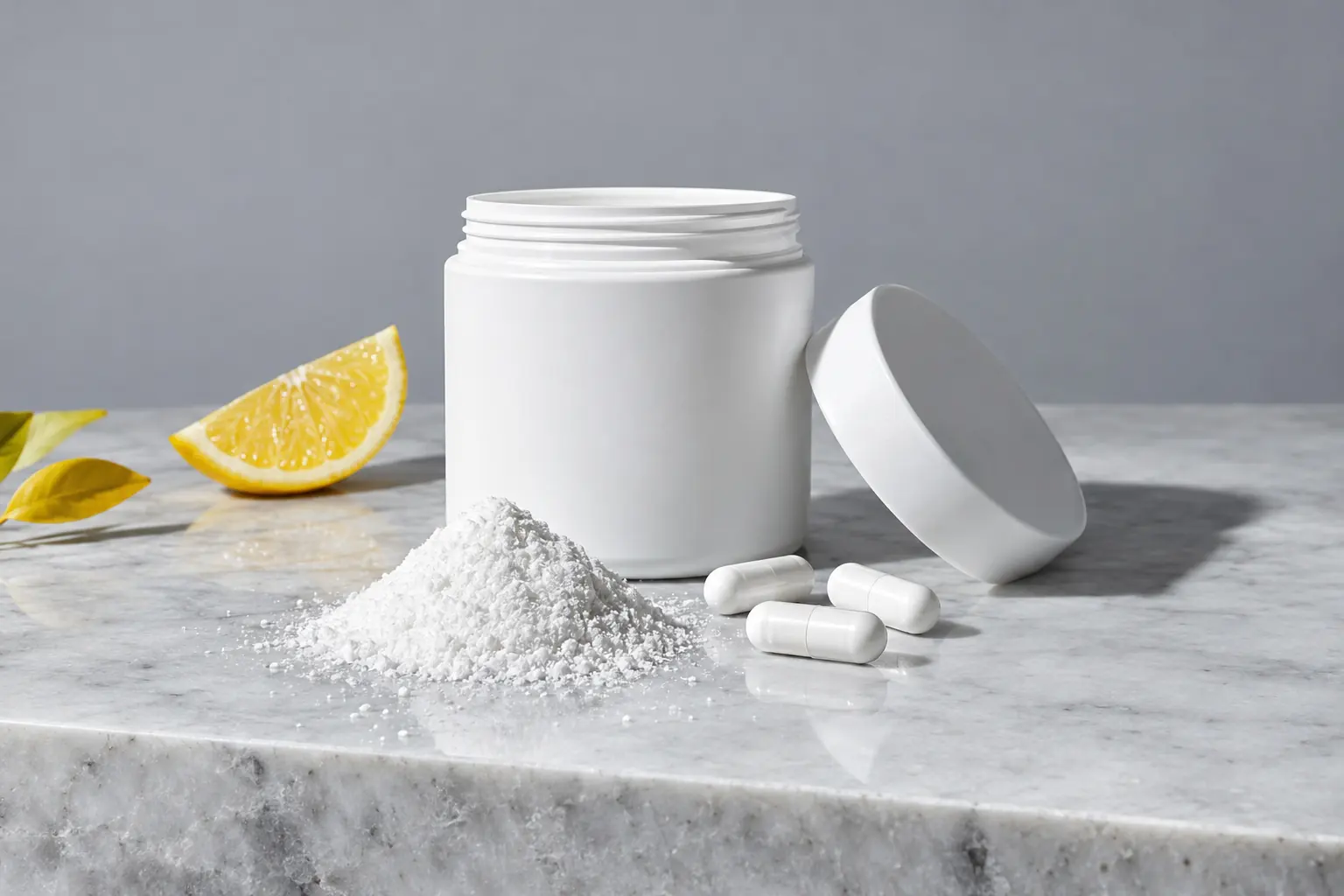
Glycine is the simplest proteinogenic amino acid, which brands launch as a standalone capsule or add into combined formulas. AKTO develops and manufactures glycine capsules to order on its own lines, agreeing the dose and label wording with each brand individually, without health-benefit claims, since none exist for glycine as a supplement ingredient in the EU. Brands pick glycine either as a standalone line item or as one ingredient of a combined formula, and in both cases the label describes the ingredient rather than promising a result.
02
Dosage form and glycine's dual legal status
Glycine is not among the vitamins or minerals listed in Annex I to Directive 2002/46/EC, so as a free amino acid in a supplement it sits under general EU food-safety law rather than a harmonised positive list. Separately, glycine and its sodium salt are authorised as the food additive E 640 under Regulation (EC) No 1333/2008 (Annex II, quantum satis in the listed categories) — a distinct legal basis that covers a flavour-enhancer function in finished foods, not glycine as a standalone ingredient in a supplement capsule.
03
Regulatory status in the EU, UK and Ukraine
Glycine does not appear in the Annex to Commission Regulation (EU) No 432/2012's list of permitted health claims, so no EU health claim currently covers it. Regulation (EU) 2015/2283 requires novel-food authorisation for an ingredient without a documented history of significant EU consumption before 15 May 1997. In the UK, E 640's food-additive status is authorised separately in England, Scotland and Wales under the domestic implementation of Regulation 1333/2008, while supplement rules mirror Directive 2002/46/EC through the Food Supplements (England) Regulations 2003. In Ukraine, MOZ Order No. 1114 of 19.12.2013 sets the hygiene requirements.
04
What AKTO manufactures
AKTO takes glycine capsule orders from a minimum of 10 kg of raw material or 20,000 capsules, packaged in a jar or blister, with a hard gelatine capsule of 500 mg as the reference format. Production runs in Kyiv (Ukraine) and Warsaw (Poland). The team checks the ingredient against the Regulation 432/2012 claims register and keeps glycine's E 640 additive function separate from its role as a standalone capsule ingredient before agreeing the label text. The glycine dose per capsule is agreed individually to the brand's formula, and both production sites let a brand choose the location by target market. Manufacturing is certified to ISO 9001:2015 and ISO 22000:2018 (HACCP, certificate No. 44600111204, valid to 28.12.2026).
05
Getting started
A brand sets the target glycine dose per capsule and its intended positioning; AKTO checks the ingredient against the Regulation 432/2012 claims register, confirms the novel-food status, and prepares documentation without health-benefit claims. AKTO's team supports the project from the first dose agreement through to a trial batch, keeping one documentation cycle for both of glycine's functions. See also: Functionals & Antioxidants, L-Theanine and Taurine.
Frequently Asked Questions
Does glycine have an EU-authorised health claim?
What's the difference between glycine as a supplement ingredient and E 640?
What is the reference capsule format for glycine?
What is the minimum order?
 Svitlana Mysiura
 Anastasiia Bespalova
Standards we work to
 ISO 22716 (GMP)
 ISO 22000 (HACCP)
 Regulation (EC) No 1223/2009
 Directive 2002/46/EC
 Halal
Why AKTO
- Glycine capsule manufacturing to order
- Glycine's ingredient and E640 additive functions kept separate
- Reference format: hard gelatine capsule, 500 mg
- MOQ from 10 kg of raw material or 20,000 capsules
- Certified to ISO 9001:2015 and ISO 22000:2018 (HACCP)