
Private Label
Grease Remover
AKTO develops a grease remover for baked-on grime on stovetops and extractor hoods and manufactures it under the client's brand.
- ISO 22716 GMP
In brief
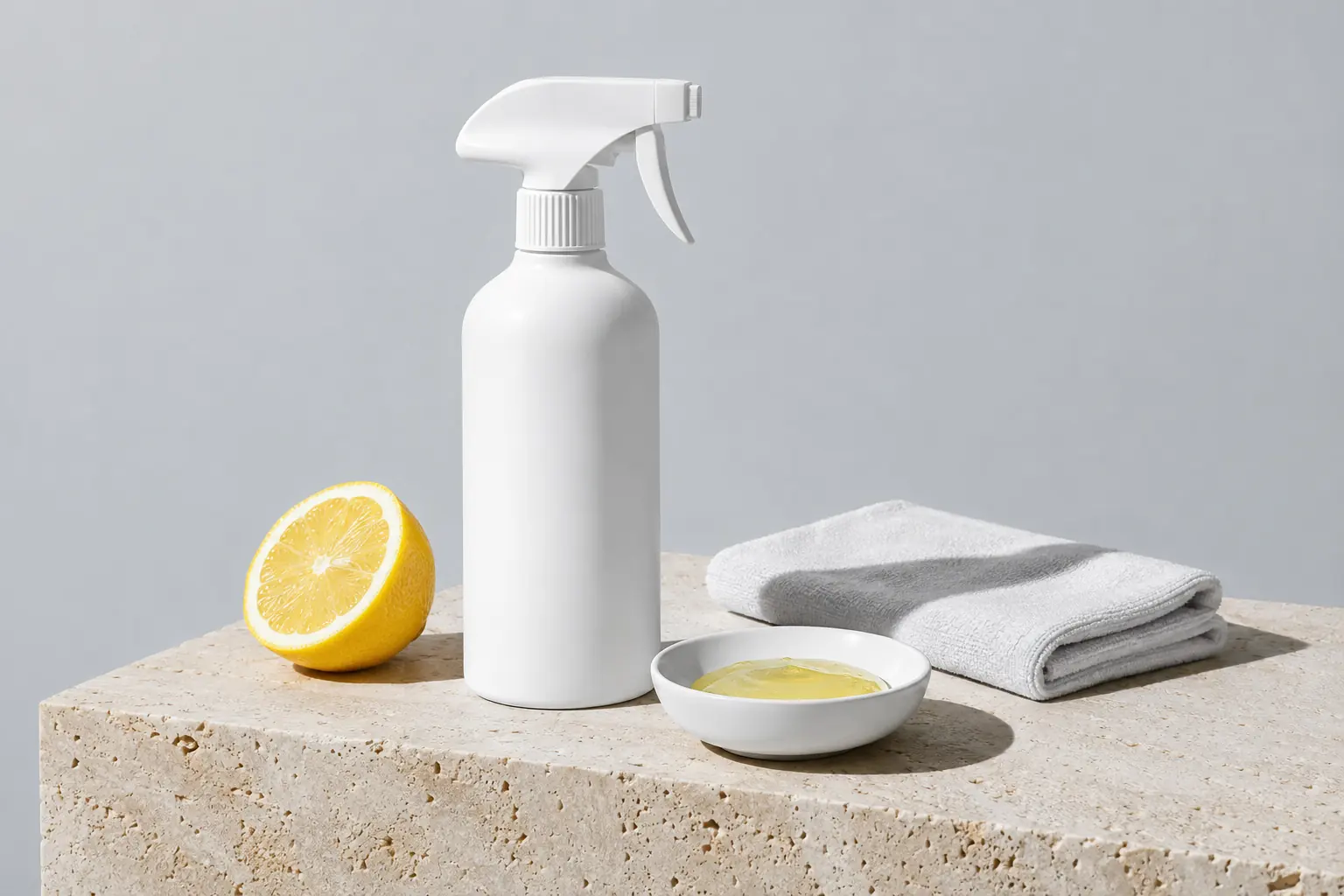
A grease remover targets dense, baked-on grease build-up on stovetops, extractor hoods and kitchen work surfaces. Company AKTO LLC (AKTO) develops and manufactures this product to order in 2 to 6 weeks, in a 250 ml trigger-spray bottle, choosing the surfactant system to match the brand's claimed action.
01
What soiling a grease remover targets
A grease remover is built for dense, baked-on or aged grease build-up on stovetops, extractor hoods and kitchen work surfaces - the point where an everyday degreaser is no longer enough. A brand building a kitchen-cleaning range positions this product as the 'heavy artillery' next to a milder everyday cleaner: the customer keeps it on hand for a deep clean rather than a daily wipe-down. The formula is usually tuned for fast grease dissolution without prolonged scrubbing, which is why it is positioned separately from a light everyday degreaser or an all-surface multi-purpose cleaner. In a kitchen-cleaning range this product is often sold in a larger fill size, since the customer reaches for it less often but uses a larger volume during a deep clean.
02
Composition requirements
Annex VII, Section A of Regulation (EC) No 648/2004 requires a grease remover's label to declare anionic, cationic, amphoteric and non-ionic surfactant content, once above 0.2% by weight, in defined weight-percentage bands. Any surfactant in the formulation must meet Annex III of the Regulation: at least 60% ultimate aerobic biodegradation within 28 days, under the EN ISO 14593:1999 reference method.
03
EU and Ukraine regulatory notes
Where a disinfecting claim for food-preparation surfaces is placed on a grease remover, Product-Type 4 of Annex V to Regulation (EU) No 528/2012 applies - the category covering disinfection of equipment, containers, tableware, surfaces or pipework associated with the production, transport, storage or consumption of food. These labelling and biodegradability rules remain in force until 23 September 2029, when the new Regulation (EU) 2026/405, published 2 March 2026, applies and repeals Regulation (EC) No 648/2004. In Ukraine, the product falls under the Technical Regulation on Detergents (KMU Resolution No. 717/2008), within the scope of AKTO's KVED 20.41.
04
What AKTO manufactures
AKTO develops and manufactures a grease remover to order: the standard development timeline from an initial concept to an approved sample runs 2 to 6 weeks. Responsibility for the final label text rests with the client brand under AKTO's standard labelling-responsibility declaration, while AKTO's lab agrees the formulation itself with the brand during sample approval. Every production batch comes with a free quality passport. The product is offered as a spray or liquid, in a 250 ml trigger-spray bottle; manufacturing takes place at plants in Kyiv (Ukraine) and Warsaw (Poland), letting the brand choose the site based on its target market.
05
Getting started
- The brand defines the target soiling (stovetop, hood, work surface) and the format - spray or liquid.
- AKTO develops the formula and checks the surfactants against Annexes III and VII of Regulation 648/2004.
- A disinfecting claim, if needed, is aligned with Product-Type 4.
- The brand approves the sample within 2-6 weeks, and AKTO starts production in the 250 ml trigger-spray bottle.
06
See also
See also: Kitchen-Cleaning Products, Oven Cleaner, Kitchen Degreaser and Multi-Purpose Cleaner.
Frequently Asked Questions
What kind of soiling does a grease remover handle?
Which surfactants must be declared on a grease remover's label?
When does Product-Type 4 of Regulation 528/2012 apply to a grease remover?
How long does AKTO take to develop a new grease-remover formula?
 Kateryna Khromykh
 Oleksandra Vovk
Standards we work to
 ISO 22716 (GMP)
 ISO 22000 (HACCP)
 Regulation (EC) No 1223/2009
 Directive 2002/46/EC
 Halal
Why AKTO
- New formula development in 2 to 6 weeks
- 250 ml trigger-spray bottle
- Free quality passport with every batch
- Surfactant biodegradability confirmed under Annex III of Regulation 648/2004
- MOQ from 50 kg, plants in Kyiv (Ukraine) and Warsaw (Poland)