
Private Label
L-Tryptophan
AKTO develops and manufactures L-tryptophan capsules to order on its own lines, without health-benefit claims.
- Reg. 432/2012
In brief
L-tryptophan is an essential amino acid with no EU-authorised health claim, and it is not listed in Annex III to Regulation 1925/2006. AKTO develops and manufactures L-tryptophan capsules to order from a minimum of 10 kg of raw material or 20,000 capsules.
01
What L-tryptophan is in a dietary supplement
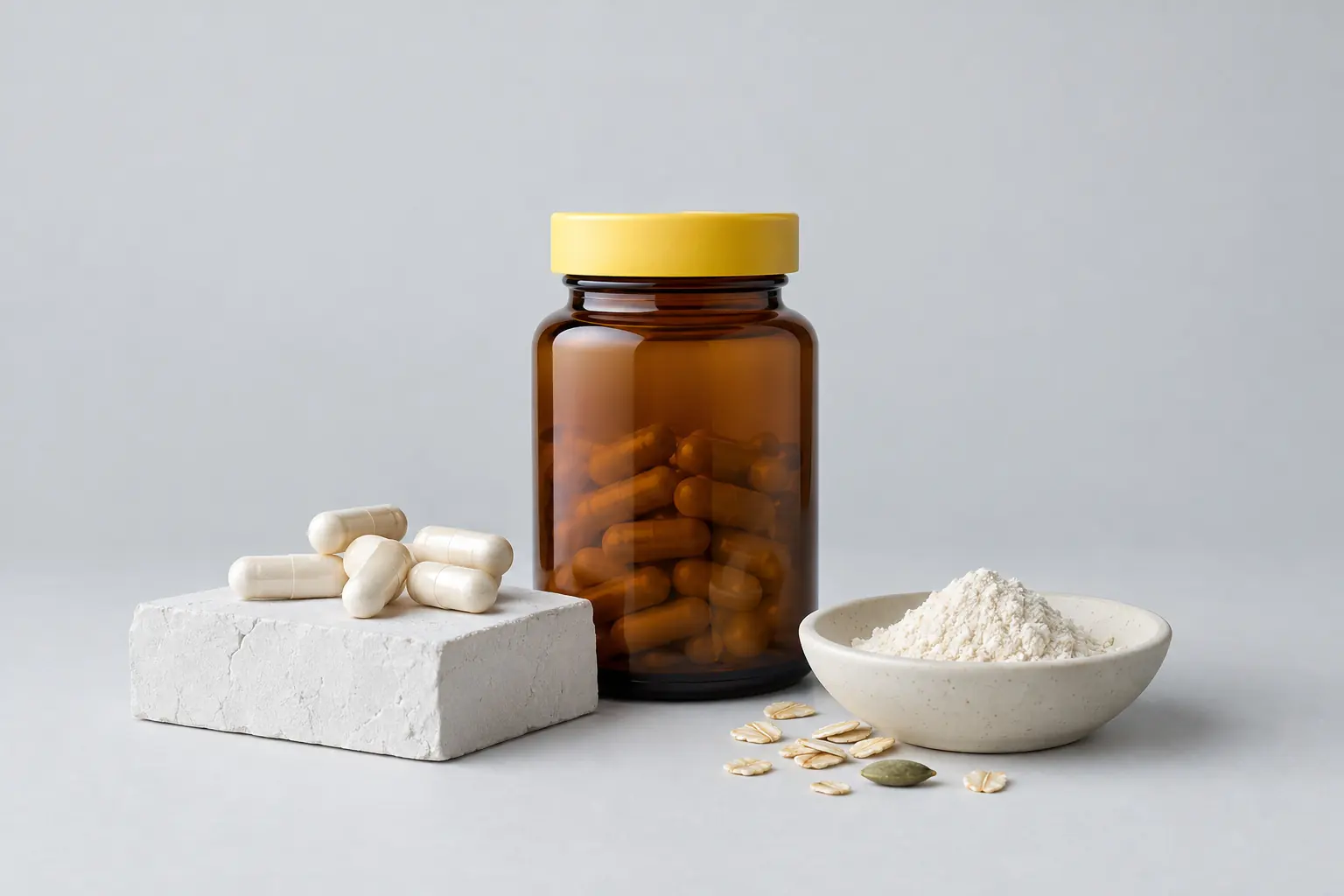
L-tryptophan is an essential amino acid, meaning the body does not make it and it comes from the diet. For a supplement brand it is usually a single-ingredient capsule, and the EU claims register contains no authorised health claim for it, so the label names the ingredient and states the amount per capsule without promising any outcome. AKTO produces L-tryptophan capsules to order, and the dose, excipients and label text are set together with the brand at the start of the project.
02
Where L-tryptophan sits in supplement law
Directive 2002/46/EC harmonises only vitamins and minerals in its Annex I, and L-tryptophan is neither, so a capsule containing it is regulated by general EU food-safety law, with novel-food rules applying where relevant.
03
Regulatory status in the EU, UK and Ukraine
The Annex to Commission Regulation (EU) No 432/2012 lists no permitted health claim for L-tryptophan. Separately, Regulation (EC) No 1925/2006 gives the Commission a tool for substances other than vitamins and minerals: under Article 8, after an EFSA assessment, an amino acid or similar substance can be moved into Annex III as prohibited (Part A), restricted (Part B) or under Union scrutiny (Part C) if it is added to food at levels well above normal dietary intake or represents a potential risk to consumers. L-tryptophan has not been placed in any of these parts; the entries there today include ephedra, yohimbe, hydroxyanthracene derivatives, green tea EGCG extracts and red yeast rice monacolins. National rules in individual EU countries can differ, so the target market is confirmed before the dose is fixed. An ingredient with no significant EU consumption history before 15 May 1997 would need novel-food authorisation under Regulation (EU) 2015/2283. Ukrainian hygiene requirements for supplements come from MOZ Order No. 1114 of 19.12.2013, and the UK applies its domestic version of Regulation 1925/2006.
04
What AKTO manufactures
Orders for L-tryptophan capsules start at 10 kg of raw material or 20,000 capsules; finished capsules go into a jar or blister, and the base format is a 500 mg hard gelatine capsule. AKTO produces them at its Kyiv (Ukraine) and Warsaw (Poland) sites under ISO 9001:2015 and ISO 22000:2018 (HACCP, certificate No. 44600111204, valid to 28.12.2026). Before the label text is agreed, the ingredient is checked against the 432/2012 claims register and the current Annex III of Regulation 1925/2006.
05
Getting started
The brand gives AKTO a target dose per capsule and its target markets. AKTO then checks the claims register and novel-food status, prepares label documentation that contains no health-benefit wording, and makes a trial batch whose laboratory testing confirms the formulation matches its declared parameters. See also: Functionals & Antioxidants, L-Arginine / L-Citrulline and Taurine.
Frequently Asked Questions
Does L-tryptophan have an EU-authorised health claim?
Is L-tryptophan listed in Annex III to Regulation 1925/2006?
What is the reference capsule format?
What is the minimum order?
 Svitlana Mysiura
 Anastasiia Bespalova
Standards we work to
 ISO 22716 (GMP)
 ISO 22000 (HACCP)
 Regulation (EC) No 1223/2009
 Directive 2002/46/EC
 Halal
Why AKTO
- L-tryptophan capsule manufacturing to order
- Checked against Annex III to Regulation 1925/2006
- Reference format: hard gelatine capsule, 500 mg
- MOQ from 10 kg of raw material or 20,000 capsules
- Certified to ISO 9001:2015 and ISO 22000:2018 (HACCP)