
Private Label
Marble Cleaner
AKTO develops and manufactures a marble cleaner to order - a pH-neutral formula that won't dull or etch calcareous stone.
- ISO 22716 GMP
In brief
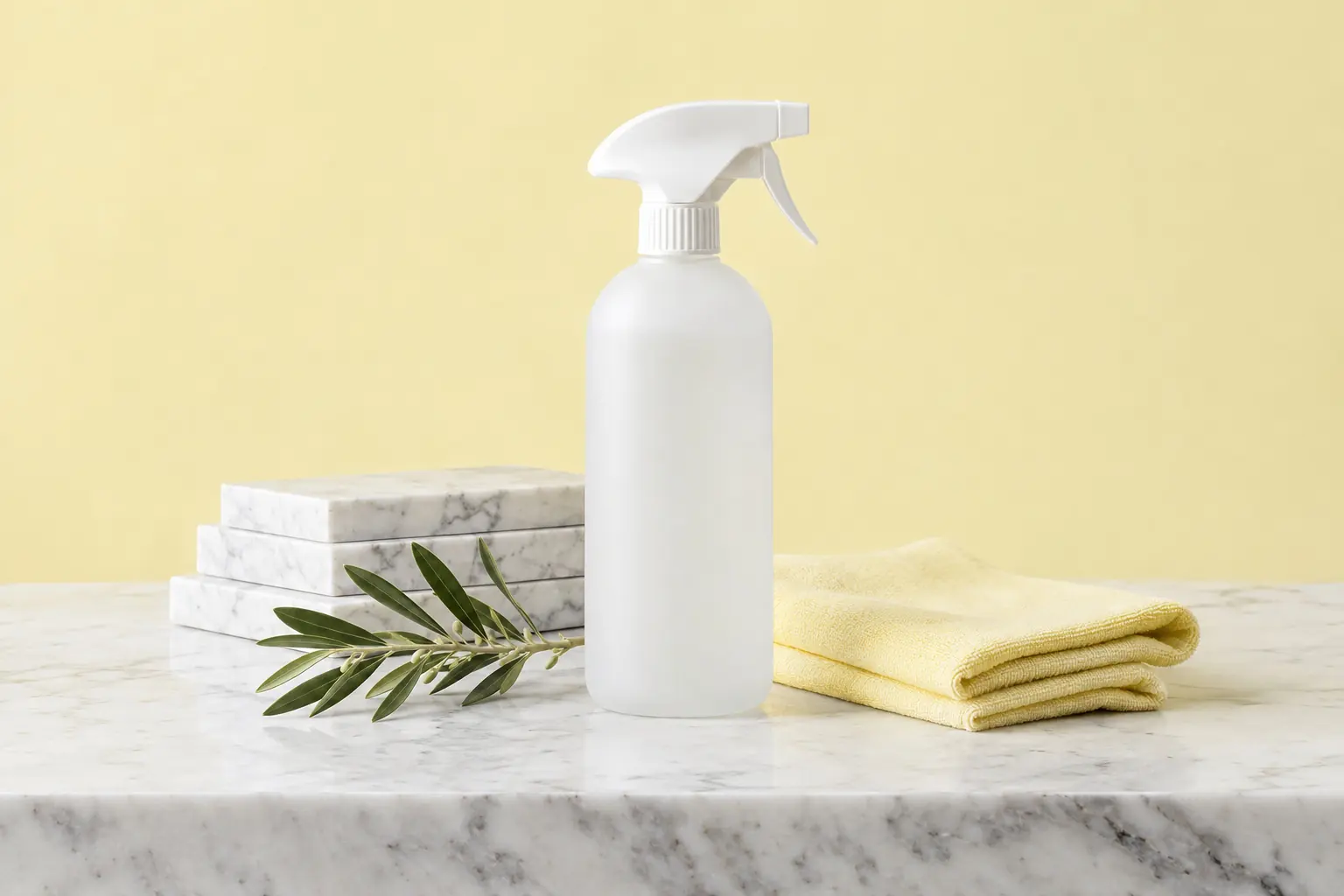
Company AKTO LLC (AKTO) develops and manufactures a marble cleaner to order: a pH-neutral liquid for a trigger-spray bottle, or a paste-type polish in a 50-250 g jar. Marble is calcium carbonate and etches on contact with acids, so the formula deliberately avoids the acidic actives common in ordinary limescale removers; AKTO runs first batches from 50 kg at its Kyiv (Ukraine) and Warsaw (Poland) plants.
01
Why marble needs a pH-neutral formula of its own
Marble is calcium carbonate and reacts chemically with acids, not just abrasively: even the mild acid typical of an ordinary limescale remover or bathroom all-purpose cleaner can leave a dull etch mark or damage a polished surface within minutes of contact. A marble cleaner is therefore formulated as pH-neutral, deliberately leaving out the acidic actives that work well on tile or glass but attack calcareous stone. That is a fundamental difference from a granite cleaner, since granite resists acids, and it is exactly what determines which product a brand chooses for a stone-care line.
02
AKTO's formats and packaging
AKTO develops and manufactures a marble cleaner to order as a pH-neutral liquid for a trigger-spray bottle, for everyday cleaning of countertops and floors, and as a paste-type polish in a 50-250 g jar for periodic shine restoration. AKTO runs first batches from 50 kg at its Kyiv (Ukraine) and Warsaw (Poland) plants.
03
EU regulatory notes: Ecolabel, REACH and CLP
Commission Decision (EU) 2017/1217, Article 1, limits the EU Ecolabel 'hard surface cleaning products' group to all-purpose, kitchen, window and sanitary cleaners within the scope of Regulation (EC) No 648/2004; a pH-neutral marble cleaner, deliberately free of the acidic ingredients found in an ordinary limescale remover, is not one of these four categories and sits outside that Ecolabel scheme. Regulation (EC) No 1907/2006 (REACH) Article 31 requires a Safety Data Sheet for a hazard-classified formula - for example an alkaline poultice or polish concentrate classified as skin- or eye-irritant - supplied to professional customers. Regulation (EC) No 1272/2008 (CLP) Article 17 requires full labelling for such a formula: product identifier, hazard pictograms, signal word, hazard and precautionary statements, and supplier details. Regulation (EU) 2023/988, the General Product Safety Regulation, applies to a consumer marble cleaner not covered by sector-specific law.
04
AKTO's production conditions in Ukraine
A marble cleaner is registered under KVED code 20.59; AKTO's own technical specification, TU U 20.4-43961492-001:2020, covers cosmetics only, so a marble cleaner is produced to order under the KVED registration. AKTO applies the same private-label principle to stone-care products as to every other category: the formula belongs to the client brand. Manufacturing is certified to ISO 9001:2015, ISO 22000:2018 (HACCP, No. 44600111204) and ISO 22716 (GMP) at plants in Kyiv (Ukraine) and Warsaw (Poland).
05
Getting started
A brand chooses the format - a liquid for everyday cleaning or a paste polish for periodic shine restoration - and confirms the formula stays pH-neutral for calcareous stone. AKTO prepares the formula, the REACH Safety Data Sheet, a CLP Article 17 label, and runs a first batch from 50 kg. See also: Surface & Material Care, Granite Cleaner, Stone Cleaner and Sticky Stuff Remover.
Frequently Asked Questions
Why does a marble cleaner need to be pH-neutral?
What packaging does AKTO use for a marble cleaner?
How does a marble cleaner differ from a granite cleaner?
What is AKTO's minimum batch for a marble cleaner?
 Kateryna Khromykh
 Oleksandra Vovk
Standards we work to
 ISO 22716 (GMP)
 ISO 22000 (HACCP)
 Regulation (EC) No 1223/2009
 Directive 2002/46/EC
 Halal
Why AKTO
- pH-neutral formula free of acidic actives
- Two formats: everyday liquid and shine-restoring polish
- REACH Safety Data Sheet and CLP Article 17 labelling
- First batches from 50 kg at Kyiv (Ukraine) and Warsaw (Poland) plants