
Private Label
Micellar Water
AKTO develops and manufactures micellar water to order: a no-rinse liquid that lifts off makeup and impurities with a cotton pad, no water needed.
- ISO 22716 GMP
In brief
Micellar water is a no-rinse liquid built on mild nonionic surfactants and solubilisers that is wiped off with a cotton pad rather than washed off with water. Company AKTO LLC (AKTO) develops and manufactures micellar water to order on its no-rinse liquid facial-care lines, checking the formula against EU rules and running a full stability-testing cycle before handover.
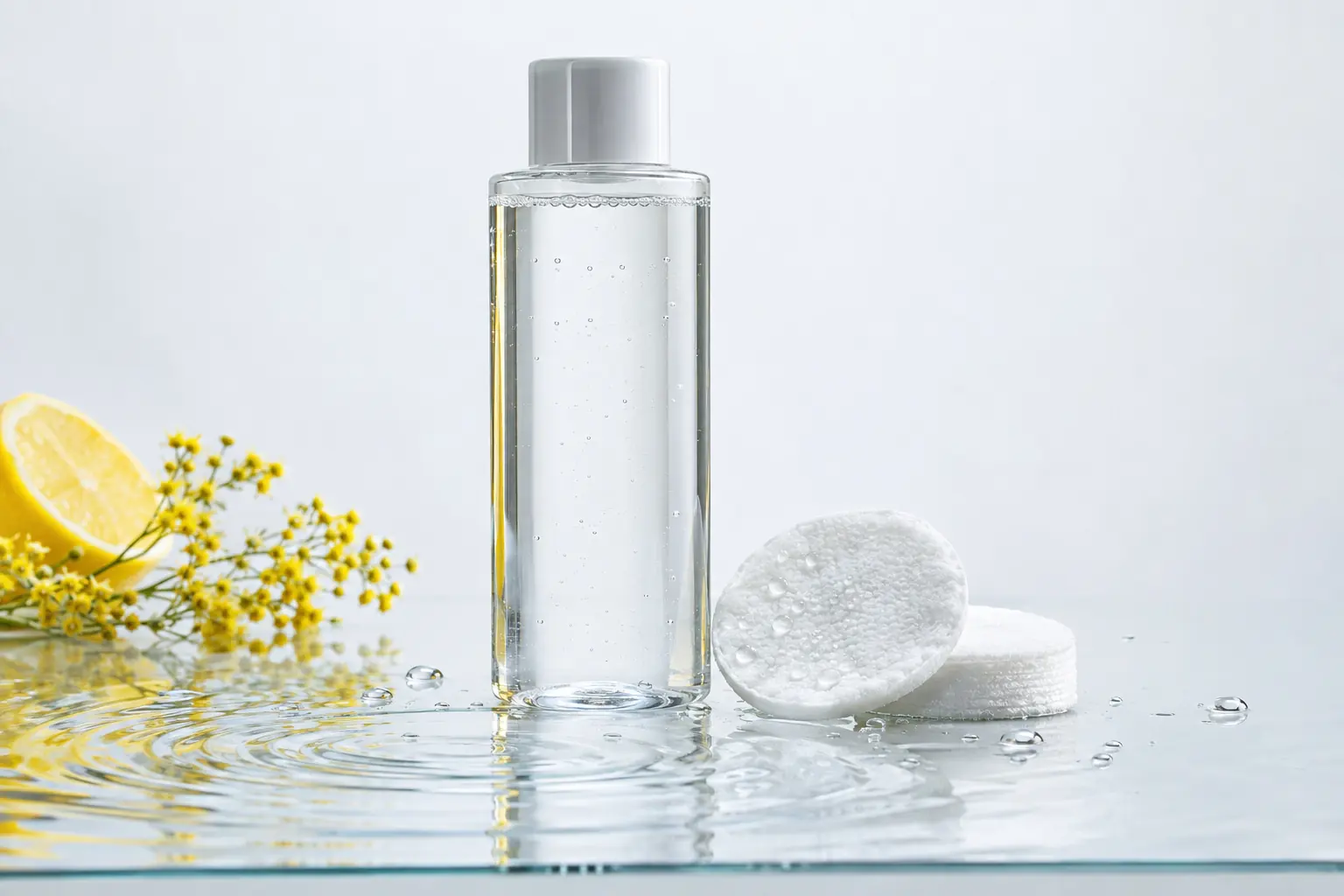
01
What micellar water is and who it suits
Micellar water is a liquid cleanser applied to a cotton pad and wiped away rather than rinsed off in the shower or over a sink, the way a foam or gel cleanser would be. The formula relies on mild nonionic surfactants and solubilisers that dissolve sebum, makeup and grime and hold them in solution rather than smearing them across the skin. The format suits a brand that wants a single flexible first step for morning and evening use, with or without makeup, without adding a separate rinse-with-water stage. AKTO develops the formula against a brand's technical brief: target skin type, claimed effect and preferred texture.
02
Why the formula differs from a rinse-off cleanser
Because micellar water is wiped off rather than rinsed with water, Regulation (EC) No 1223/2009, Annex III, sets its fragrance-allergen labelling threshold at 0.001% - ten times stricter than the 0.01% threshold that applies to a rinse-off foam or gel in the same product family. That narrows the choice of fragrance components compared with a rinse-off format. Article 15 of the same regulation bans the use in cosmetic products of substances classified under CLP as carcinogenic, mutagenic or toxic to reproduction (CMR): categories 1A and 1B save for rare exceptions under the conditions of Article 15(2), category 2 unless the SCCS has found them safe; the specific prohibited substances are listed in Annex II. This is a further constraint on the surfactants and solubilisers available for the formula. Phenoxyethanol, a common preservative for water-based formulas, has a single 1.0% limit for all product types under Annex V entry 29, regardless of whether a product is rinsed off or left on. The ingredient list (INCI names) must be given in descending order of weight of the ingredients at the time they are added to the cosmetic product, per Article 19(1)(g).
03
Claims on the label and packaging
Wording such as 'no-rinse' or 'removes makeup and impurities in one step' falls under Commission Regulation (EU) No 655/2013: before it reaches a label, the shelf or an advert, the claim must meet six common criteria - legal compliance, truthfulness, evidential support, honesty, fairness and allowing informed decisions by the buyer. Regulation (EC) No 1223/2009 also bans placing on the EU market a cosmetic product or ingredient that has been tested on animals to demonstrate safety.
04
What AKTO manufactures
AKTO develops and manufactures micellar water to order on its no-rinse liquid facial-care lines, filled into 200-250 ml PET bottles or 50-100 ml dropper bottles depending on how a brand wants the dosage presented on the label. Manufacturing runs at plants in Kyiv (Ukraine) and Warsaw (Poland), certified to ISO 22716 (GMP) and the combined ISO 9001:2015/ISO 22000:2018 (HACCP) standard (certificate No. 44600111204). The minimum order for cosmetics is from 50 kg.
05
Getting started
- The brand sets out a technical brief: skin type, claimed effect, texture and bottle format.
- AKTO develops the formula and checks it against Annexes II, III and V of the regulation.
- Label claims are substantiated against the six criteria of Regulation 655/2013.
- Stability testing runs before the brand approves the sample and specification for full production.
06
See also
See also: Face Cleansers and Eye Makeup Remover.
Frequently Asked Questions
How does micellar water differ from a foaming cleanser?
Can a label say 'removes makeup in one step'?
What bottle sizes does AKTO use for micellar water?
What is the minimum order for manufacturing micellar water?
Expert review
Reviewed by
 Illia Mariutsa
Researcher, organic chemistry
Google Scholar Anastasiia Bespalova
Paediatric orthopaedic and trauma surgeon
ORCID
Standards we work to
 ISO 22716 (GMP)
 ISO 22000 (HACCP)
 Regulation (EC) No 1223/2009
 Directive 2002/46/EC
 Halal
Why AKTO
- Formula development against the brand's technical brief
- Formula checked against Annexes II, III and V of Regulation 1223/2009
- 200-250 ml bottles or 50-100 ml dropper bottles
- Manufacturing to ISO 22716 (GMP) at plants in Kyiv (Ukraine) and Warsaw (Poland)