
Private Label
Powder Contour
AKTO develops and manufactures a powder contour to order as a pressed or loose formula, built for compact packaging and brush application.
- ISO 22716 GMP
In brief
A powder contour is an anhydrous pressed or loose formula used to shade and shape the face with a brush, holding a matte finish without blending by hand. Company AKTO LLC (AKTO) develops and manufactures a powder contour to order on its pressed- and loose-powder lines. Iron oxides are checked against Annex IV of Regulation (EC) No 1223/2009, and the anhydrous base carries a lighter preservative-testing burden than a cream formula.
01
Powder contour: format and audience
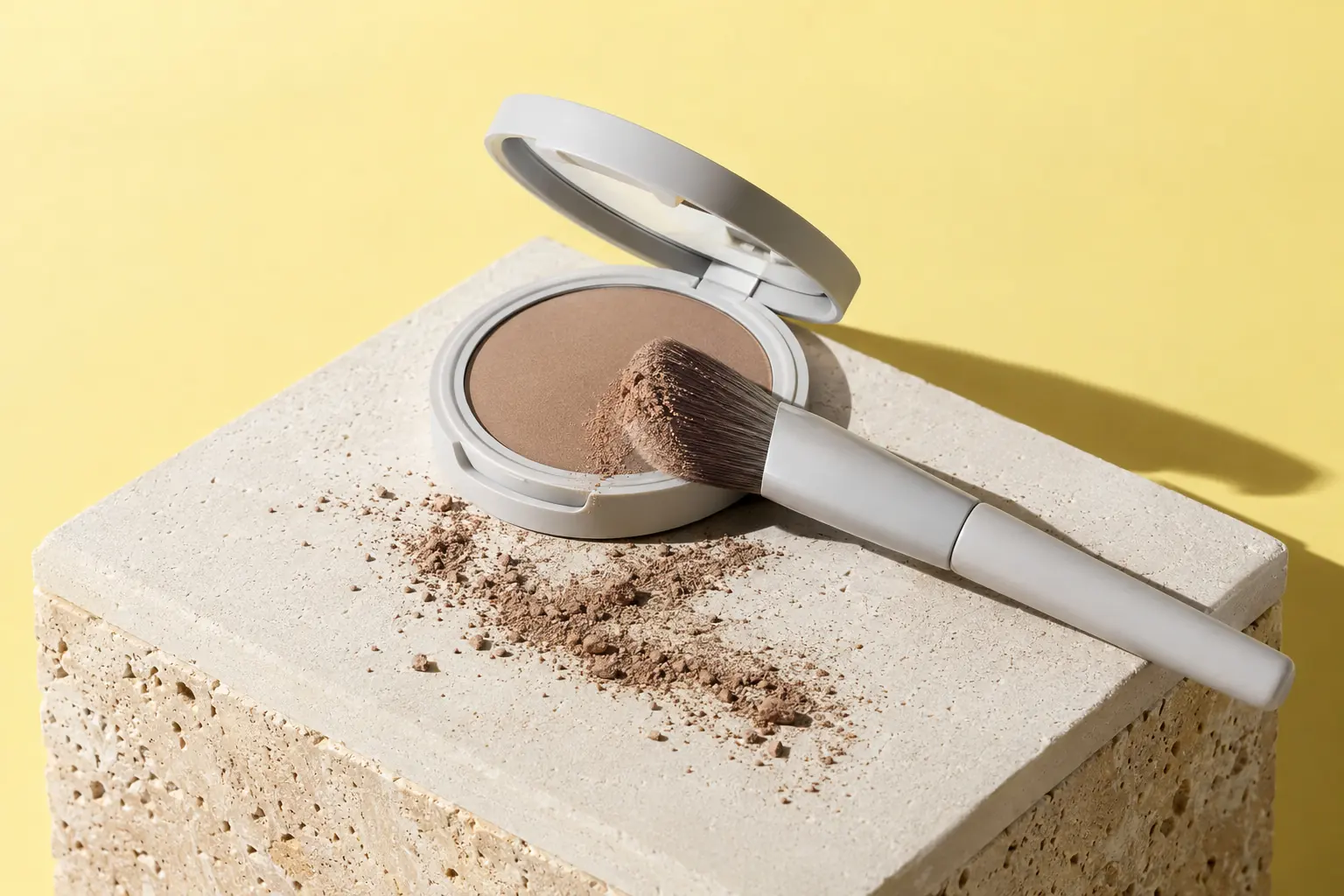
A powder contour is an anhydrous, cool-toned pressed or loose powder used to shade the hollows of the face with a brush. Unlike a cream texture, powder gives a more controlled, matte result and does not need blending by hand, so brands position it for experienced makeup users and for oily skin, where a cream formula can shift during the day. Its compact format travels easily in a makeup bag, which keeps a powder contour a steady SKU in a brand's travel-friendly line. A palette often ships with two or three shades at once — cool, warm and a universal middle tone — so a customer can mix her own undertone instead of picking a single fixed shade.
02
Pigments and the anhydrous formula
The shading pigments in a powder contour are mostly iron oxides. Annex IV of Regulation (EC) No 1223/2009 permits CI 77491, CI 77492 and CI 77499 with no restriction by product type, subject to the purity criteria of Commission Directive 95/45/EC (E172). Because a powder is an anhydrous formula, it carries a lighter preservative-system burden than a cream contour, though microbiology and physicochemical checks stay mandatory. Article 10 of the Regulation requires a safety assessment of the finished formula before it reaches the EU market.
03
Production standards and registration
ISO 22716 sets out the rules for production, control, storage and shipment of pigmented cosmetic products, including pressed and loose powder formats. The dossier testing package for a pigmented formula includes mandatory microbiology and physicochemical analysis.
04
What AKTO offers
AKTO develops and manufactures a powder contour to order on its general pressed- or loose-powder lines, adjusting how firmly the powder is pressed to fit the chosen packaging — a compact, a jar or a refill pan. A technical brief intake form fixes the target shade or shade set, press firmness and price per kilogram before a trial batch goes into production.
- Format: pressed or loose powder
- Packaging: compacts, jars, refill pans
- Minimum order: from 50 kg for a new private-label line
- Production: Kyiv, Ukraine, and Warsaw, Poland
- Certification: ISO 9001:2015 + ISO 22000:2018 (HACCP; certificate No. 44600111204), ISO 22716 (GMP)
05
How to start a project
A brand shares its target shade, press firmness and packaging type; AKTO checks the iron oxides against Annex IV, develops the formula and prepares the dossier testing package. Colour-payoff testing with a brush checks whether the powder lays down evenly on the first stroke or needs building up, and customers usually judge a formula on that before they judge the shade itself. See also: Makeup Base & Complexion, Cream Contour and Face Sculptor.
Frequently Asked Questions
Does AKTO manufacture a powder contour?
Why is a powder contour lighter to test than a cream one?
Which pigments are permitted in a powder contour under EU rules?
What packaging does AKTO use for a powder contour?
Expert review
Reviewed by
 Illia Mariutsa
Researcher, organic chemistry
Google Scholar Anastasiia Bespalova
Paediatric orthopaedic and trauma surgeon
ORCID
Standards we work to
 ISO 22716 (GMP)
 ISO 22000 (HACCP)
 Regulation (EC) No 1223/2009
 Directive 2002/46/EC
 Halal
Why AKTO
- Powder contour developed to order on pressed- or loose-powder lines
- Iron oxides checked against Annex IV of Regulation (EC) No 1223/2009
- Lighter preservative-testing burden thanks to the anhydrous formula
- MOQ from 50 kg for a new private-label line
- Certified ISO 9001:2015, ISO 22000:2018 (HACCP), ISO 22716 (GMP)