
Private Label
Self-Tanning Drops
AKTO develops and manufactures a self-tanning drop concentrate that a customer mixes into their own moisturiser, to order.
- ISO 22716 GMP
In brief
Self-tanning drops are a liquid DHA concentrate a customer adds into their own moisturiser to build a custom tan intensity. AKTO develops and manufactures a drop concentrate to order, in dropper bottles of 50-100 ml, through up to 7 sample iterations, with DHA capped at 10% under EU Regulation 1223/2009 Annex III.
01
A concentrate the customer mixes into their own routine
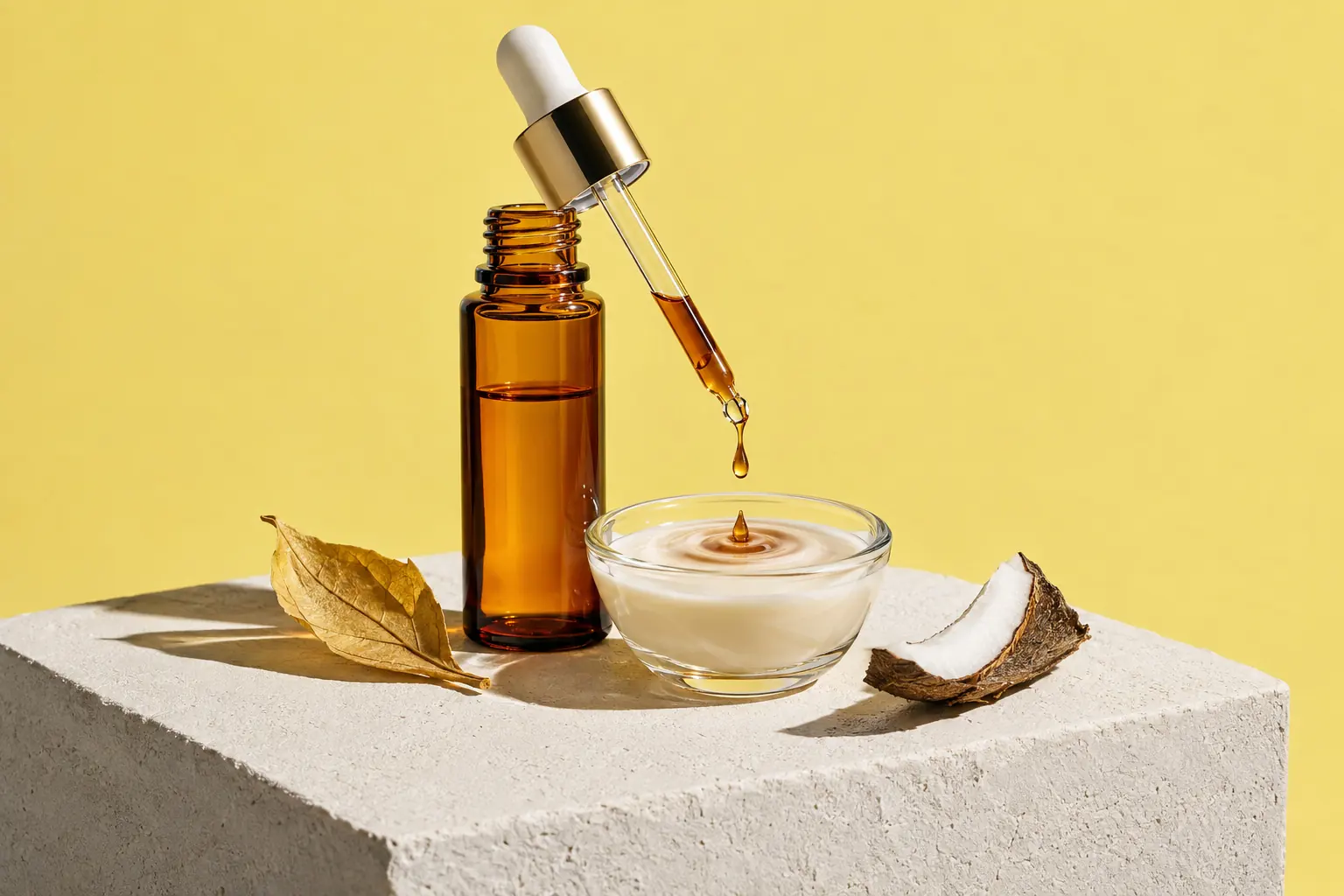
Self-tanning drops are a liquid DHA concentrate the customer adds, drop by drop, into their own moisturiser or body lotion, rather than a ready-mixed lotion applied straight from the bottle. That makes the format inherently customisable: the customer controls tan depth by the number of drops added per application, which a brand can market as a "build your own intensity" product rather than a single fixed-strength cream. It's a distinct SKU from a ready-to-use face self-tanning emulsion, aimed at a customer who already has a preferred moisturiser and wants to add colour to it rather than switch products.
02
Same DHA ceiling, whichever way it's delivered
Regulation (EC) No 1223/2009 Annex III entry 322 caps dihydroxyacetone (DHA) at a maximum of 10% in a self-tanning product - the same ceiling whether the DHA is delivered as a stand-alone drop concentrate or already mixed into a finished cream. The delivery format doesn't change the substance ceiling; it changes how and where the customer applies it.
03
The general sulfite ceiling for a product not labelled for the face
Regulation (EC) No 1223/2009 Annex III entry 99 caps inorganic sulfites and bisulfites, used for a non-preservative purpose, at 0.40% in a self-tanning product not specifically labelled for the face - the ceiling that applies to a drop concentrate meant to be mixed into whatever moisturiser the customer already uses, for face or body alike. A "build your own intensity" or "add more drops for a deeper tan" claim needs evidence proportionate to what's claimed, under the same legal-compliance, truthfulness, honesty, fairness and informed-decision-making criteria that Regulation (EU) No 655/2013 sets for any cosmetic claim.
04
What AKTO offers for a drop concentrate
AKTO develops and manufactures a self-tanning drop concentrate to order on its liquid-formulation lines, packaged in dropper bottles of 50-100 ml - a format AKTO already uses for a liquid acid concentrate and equally suited to a self-tanning drop product. Development runs up to 7 sample iterations against a client-supplied reference sample of at least 50 g before the formula is finalised. The minimum order is a 50 kg batch. ISO 22716:2007's guidelines for production, control, storage and shipment cover a low-volume concentrate such as this the same way as a higher-volume format, and manufacturing holds ISO 9001:2015 combined with ISO 22000:2018 (certificate No. 44600111204).
05
Starting a self-tanning drops project
A brand supplies a reference sample or target intensity and the preferred dropper-bottle size; AKTO works through its usual sample-iteration process, then prepares the technical file for the target market. A brand looking for a ready-mixed alternative can pair this concentrate with the face self-tanning emulsion above.
See also: Sun Protection & Self-Tan (Face), Sunscreen Fluid SPF, Sunscreen Stick SPF and Face Self-Tanning.
Frequently Asked Questions
What are self-tanning drops, and how do they differ from a ready-mixed emulsion?
Does the DHA ceiling change for a drop concentrate?
What sulfite ceiling applies to a drop concentrate not labelled for the face?
How many sample iterations does AKTO run for a new formula like this?
Expert review
Reviewed by
 Illia Mariutsa
Researcher, organic chemistry
Google Scholar Anastasiia Bespalova
Paediatric orthopaedic and trauma surgeon
ORCID
Standards we work to
 ISO 22716 (GMP)
 ISO 22000 (HACCP)
 Regulation (EC) No 1223/2009
 Directive 2002/46/EC
 Halal
Why AKTO
- Develops and manufactures a self-tanning drop concentrate to order on liquid-formulation lines
- Dropper-bottle packaging, 50-100 ml
- Up to 7 sample iterations against a client reference sample
- ISO 22716 (GMP), ISO 9001:2015 + ISO 22000:2018