
Private Label
Synbiotic Sachets (Probiotic + Prebiotic)
Live cultures and dietary fibre in one sachet: AKTO develops and manufactures this combined format to order on its sachet powder line.
- ISO 22000 (HACCP)
In brief
A synbiotic sachet combines a live microbial culture and dietary fibre in one powder serving, unlike a plain probiotic sachet, which carries the strain alone. AKTO develops and manufactures synbiotic sachets to order on its sachet powder line, with a minimum order from 10 kg of raw material and a production lead time from 4 weeks.
01
A synbiotic sachet: live cultures and fibre in one sachet
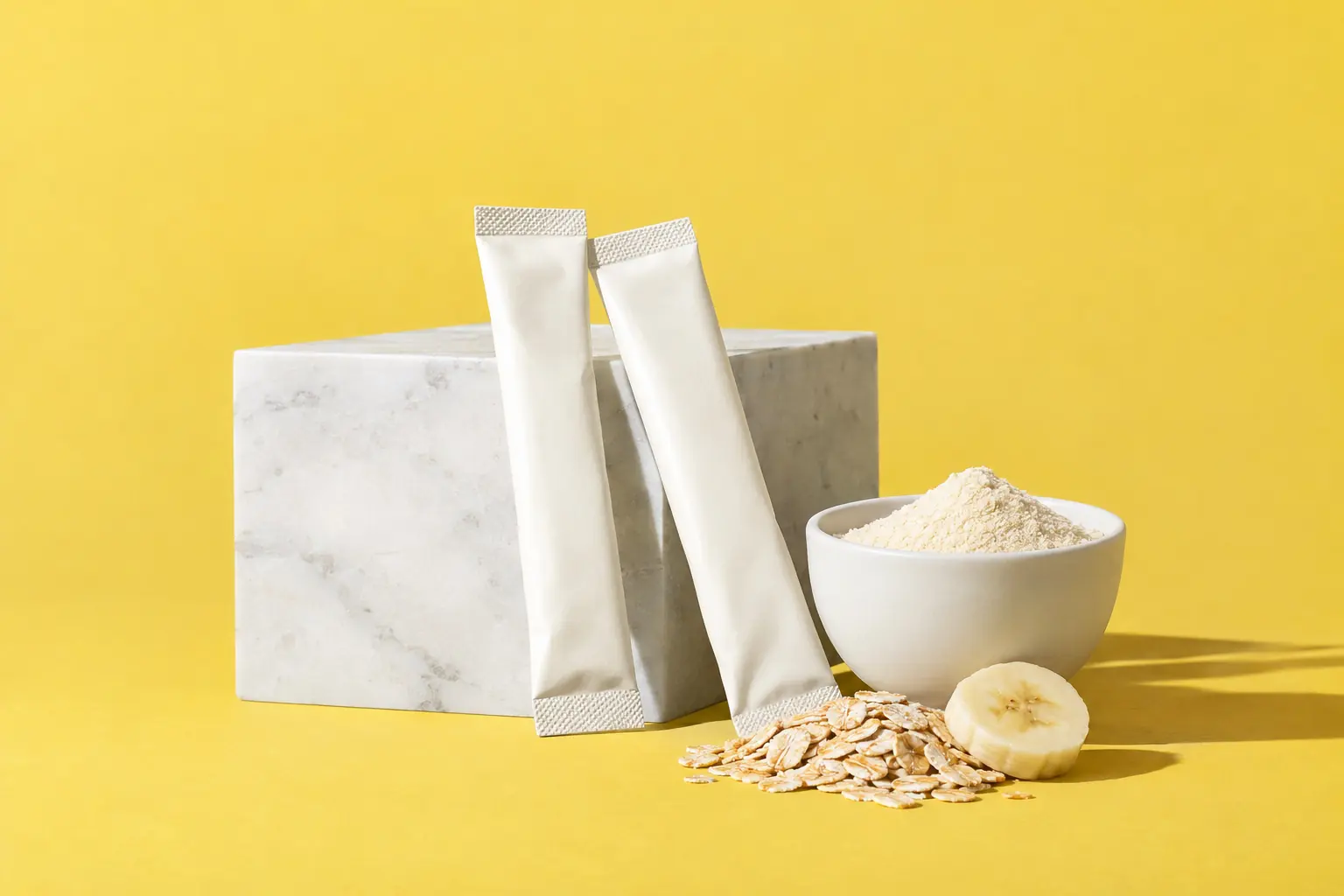
A synbiotic sachet combines two components in one powder serving: a live microbial culture and dietary fibre, often called the prebiotic component, unlike a plain probiotic sachet, which in its simple form carries only the strain itself without added fibre. This format suits a brand that wants to position a supplement as a combined two-in-one product instead of two separate sachets. AKTO develops and manufactures synbiotic sachets to order on its sachet powder line, agreeing the strain, the fibre component and their ratio with the brand at the technical-brief stage.
02
Probiotic, prebiotic and synbiotic sit outside the register of authorised claims
Regulation (EC) No 1924/2006 does not define or mention the word prebiotic or probiotic; the European Commission's implementation guidance of 14 December 2007 classifies wordings such as "contains probiotics/prebiotics" and "with prebiotic fibres" as health claims, because they imply a health benefit, and they are prohibited under Article 10(1) unless an authorised claim exists. Applying the same reasoning to the word synbiotic is an interpretation by analogy, not the literal text of the Regulation; the safe option for a finished sachet is neutral wording, live cultures, without any of the three words in any description of the product's effect.
03
A fibre claim: separate from the live culture, and only under conditions
Separate from the health-claim question, the fibre component of a synbiotic sachet can carry a defined nutrition claim under the Annex to Regulation (EC) No 1924/2006: "source of fibre" requires at least 3 g of fibre per 100 g of the product (or 1.5 g per 100 kcal), and "high fibre" requires at least 6 g of fibre per 100 g (or 3 g per 100 kcal). These conditions apply only to the fibre component and are separate from whether the words probiotic, prebiotic or synbiotic may be used at all.
04
Where both components stand under EU regulations
Annex I to Directive 2002/46/EC covers only vitamins and minerals, so neither the live microbial culture nor the fibre ingredient of a synbiotic sachet falls within that list at all, both components are instead governed by general food-safety law, with the strain additionally subject to novel-food rules. A bacterial strain without a documented history of significant consumption in the EU before 15 May 1997 requires authorisation as a novel food under Regulation (EU) 2015/2283 before it can be formulated into the live-culture component. Ukraine's Ministry of Health Order No. 1114 of 19.12.2013 (current revision of 17.04.2026) sets hygiene requirements for dietary supplements, including synbiotic sachets.
05
What AKTO offers
AKTO develops and manufactures synbiotic sachets to order on its sachet powder line: the formula is built against a brand's technical brief, combining the live and fibre components in one powder. The minimum order for a dietary-supplement sachet starts from 10 kg of raw material, production lead time runs from 4 weeks, and payment is 100% upfront. Manufacturing takes place at plants in Kyiv (Ukraine) and Warsaw (Poland), certified to ISO 9001:2015 and ISO 22000:2018 (HACCP; combined certificate No. 44600111204, valid from 29.12.2023 to 28.12.2026).
06
Getting started
- The brand sets out the strain, the fibre component and their ratio in the technical brief.
- AKTO checks the strain's novel-food status and drafts wording that avoids probiotic, prebiotic and synbiotic unless one of them is authorised in the EU register.
- The technologist formulates the combined powder and checks whether the fibre component meets the conditions for a source-of-fibre or high-fibre claim.
- The brand approves the sample, AKTO prepares the technical documentation for the chosen markets, and series production starts.
See also: Portion-Packed Probiotics, Sachets / Sticks and Probiotic Sachets.
Frequently Asked Questions
Does AKTO manufacture synbiotic sachets?
Can the word synbiotic be used on the label?
What does a source-of-fibre claim require?
What is AKTO's minimum order and lead time for a synbiotic sachet?
 Svitlana Mysiura
 Anastasiia Bespalova
Standards we work to
 ISO 22716 (GMP)
 ISO 22000 (HACCP)
 Regulation (EC) No 1223/2009
 Directive 2002/46/EC
 Halal
Why AKTO
- Live culture and fibre components agreed together in the technical brief
- Wording avoids probiotic, prebiotic and synbiotic unless authorised in the EU register
- Fibre component can meet the conditions for a source-of-fibre or high-fibre claim
- Minimum order from 10 kg of raw material, lead time from 4 weeks