
Private Label
Tile / Grout Floor Cleaner
AKTO develops and manufactures an acidic tile and grout floor cleaner on its liquid lines, to a brand's brief.
- CLP 1272/2008
In brief
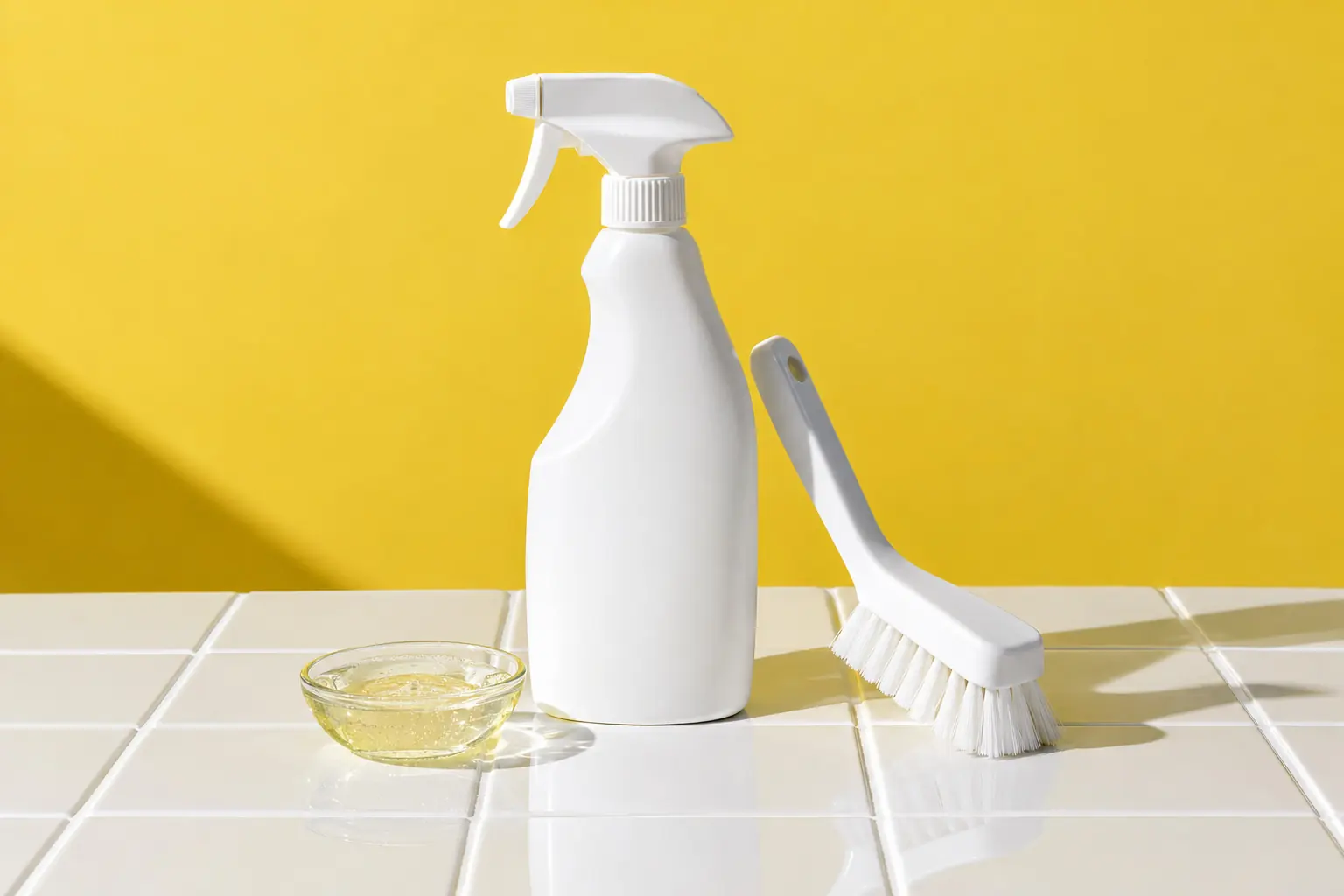
AKTO develops and manufactures a tile/grout floor cleaner as a separate line item alongside its hardwood floor cleaner within the Floors category. The acidic tile formula is classified under Regulation (EC) No 1272/2008 (CLP) through Annex I's tiered approach - by pH or by the threshold content of a corrosive or irritant ingredient. The minimum batch is 50 kg, packaged in a 250 ml trigger-spray bottle or a 200-1,000 ml pump bottle.
01
What a tile/grout cleaner is and who it's for
A tile and grout cleaner is a separate line item alongside AKTO's hardwood floor cleaner within the Floors category: the acidic formula dissolves mineral scale and limescale on ceramic tile and in grout lines, while a hardwood cleaner runs on a gentler, closer-to-neutral chemistry for wood. For a brand, this is a bathroom-and-kitchen product that sells naturally alongside plumbing-fixture cleaners within the same range.
02
Classifying the acidic formula under CLP
Annex I to Regulation (EC) No 1272/2008 (CLP), sections 3.2.3 and 3.3.3, sets out a tiered approach to classifying an acid-containing mixture: first data on the mixture itself, then bridging principles, and only then ingredient-based rules. For strong acids, the additivity method may not apply (point 3.2.3.3.4.1): pH becomes the criterion instead, with a value of 2 or below triggering Skin Corr. 1 / Eye Dam. 1 unless acid-reserve data show otherwise; otherwise, Table 3.2.4 applies - a corrosive ingredient at 1% or more triggers Skin Corr. 1, and an irritant ingredient at 3% or more triggers Skin Irrit. 2.
03
Labelling and Ukraine's regulatory position
Article 17 of the same Regulation requires the label of a classified acidic tile-cleaner mixture to display the product identifier, hazard pictograms, signal word, hazard and precautionary statements, and supplier details before EU market placement. Regulation (EU) 2023/988 on general product safety additionally requires an internal risk analysis and technical documentation under Article 9(2). In Ukraine, a surfactant-containing tile cleaner falls under the Technical Regulation on Detergents (CMU Resolution No. 717/2008, as amended); its phosphorus limits take effect 90 days after martial law ends.
04
What AKTO offers
The minimum batch is 50 kg of finished formulation at AKTO's facilities in Kyiv (Ukraine) and Warsaw (Poland); the Warsaw (Poland) plant's stated liquid-production capacity reaches up to 50 tonnes a month and up to 200,000 filled bottles. AKTO states legalisation support across Ukraine, the EU, the UK and the Middle East - useful when a brand launches a tile cleaner across several markets at once. The 'Big Game' development tier supports up to 10 formulation attempts across up to 25 samples for relaunching an existing line. Production runs under the combined ISO 9001:2015 and ISO 22000:2018 (HACCP) certificate (No. 44600111204), ISO 22716 (GMP).
05
Getting started
The brand defines the formula's acidity level and its target sales markets; AKTO checks the pH and Annex I classification, prepares Article 17 labelling for a classified formula, and supports legalisation for each chosen market. A single documentation cycle lets a brand plan entry into several markets at once, rather than assembling a separate package per country. See also: Floors, Hardwood Floor Cleaner and Textile / Laundry.
Frequently Asked Questions
Does AKTO manufacture a tile/grout floor cleaner?
How is an acidic tile cleaner classified under CLP?
Which markets does AKTO support for legalising a tile cleaner?
How many formulation attempts does the 'Big Game' tier support?
 Kateryna Khromykh
 Oleksandra Vovk
Standards we work to
 ISO 22716 (GMP)
 ISO 22000 (HACCP)
 Regulation (EC) No 1223/2009
 Directive 2002/46/EC
 Halal
Why AKTO
- Acidic tile/grout cleaner developed to a brand's brief
- Formula classification checked against CLP Annex I
- Legalisation support across Ukraine, the EU, the UK and the Middle East
- Up to 10 formulation attempts across up to 25 samples in the 'Big Game' tier
- MOQ from 50 kg, facilities in Kyiv (Ukraine) and Warsaw (Poland)