
Private Label
Tinted Lip Balm
Tinted lip balm developed to order with natural colourants checked against EU Annex IV, from brief to approved concept in 2-6 weeks.
- ISO 22716 GMP
In brief
Tinted lip balm combines a caring balm base with a light, sheer colour effect built on natural colourants. AKTO develops and manufactures tinted lip balm to order: its technologist responds to a brief within 1 working day, and the quoted concept-to-approval timeline is 2-6 weeks, starting from a reference sample from 50 g.
01
What tinted lip balm is
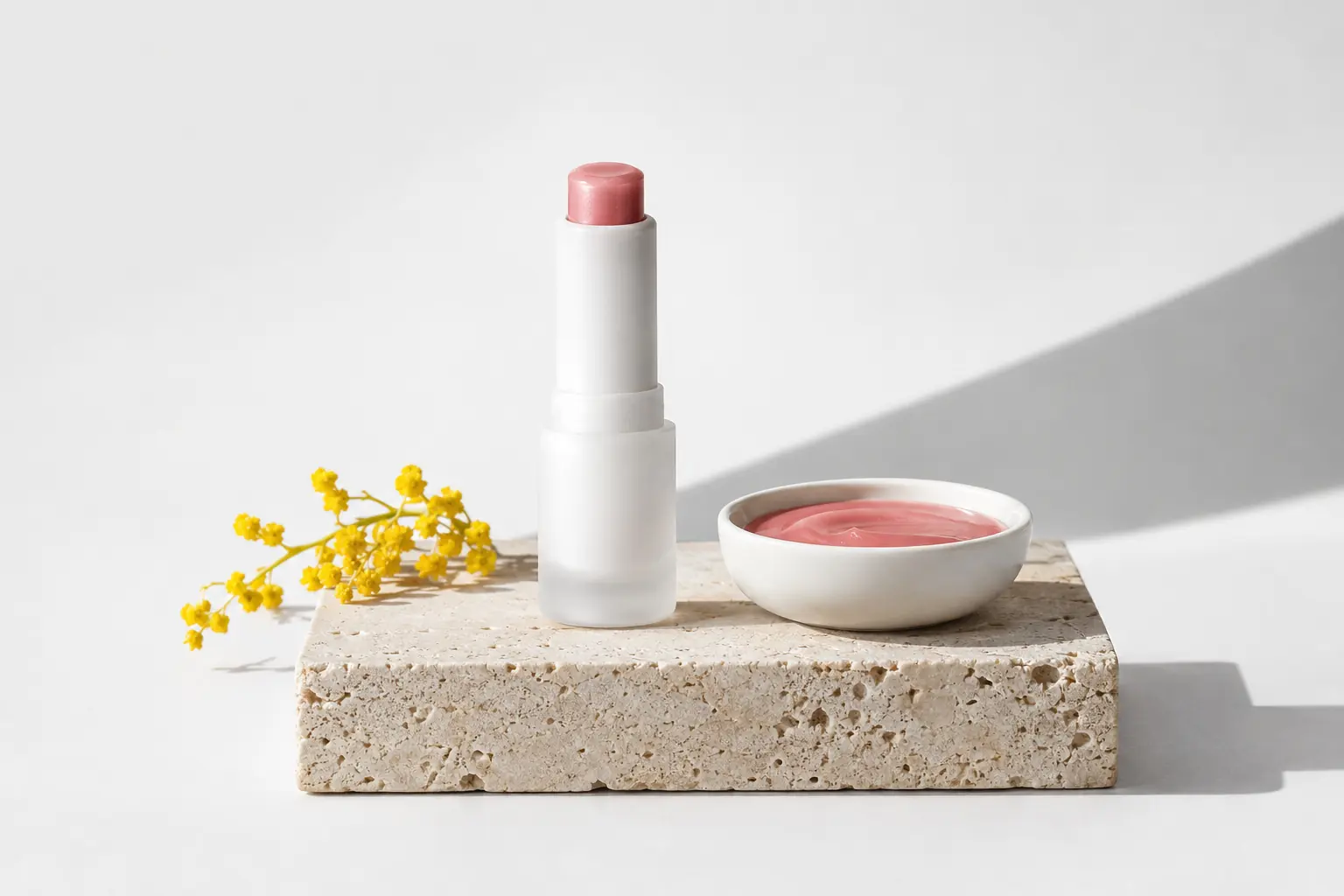
Tinted lip balm combines a caring balm base - hydration and protection for the lips - with a light, sheer colour effect, unlike a tint or lipstick where colour is the main function. Brands choose this format when they want a two-in-one product, care plus a hint of colour, extending a lip-care line into a tinted version without moving into full makeup. AKTO develops and manufactures tinted lip balm to order on its production lines.
02
Natural colourants and benzyl alcohol labelling
Annex IV entry 147 of Regulation (EC) No 1223/2009 authorises paprika extract, capsanthin and capsorubin as a natural orange colourant subject to the purity criteria of Directive 95/45/EC (E 160c), a good fit for a naturally-tinted balm base. Entry 148 authorises beetroot red (CAS 7659-95-2) as a natural red colourant under the E 162 purity criteria. Annex III entry 45 authorises benzyl alcohol for purposes other than inhibiting micro-organism growth, provided that purpose is apparent from the product's presentation, and requires its disclosure in the ingredient list above 0.001% in leave-on and 0.01% in rinse-off products; as a preservative, benzyl alcohol is separately authorised under Annex V entry 34 up to 1.0%.
- Paprika extract, capsanthin, capsorubin: natural orange colourant under E 160c
- Beetroot red: natural colourant under E 162
- Benzyl alcohol: disclosure above 0.001% (leave-on) / 0.01% (rinse-off); as a preservative, up to 1.0%
03
EU regulatory basis
Article 13 of Regulation (EC) No 1223/2009 requires the responsible person to notify the European Commission electronically before placing a cosmetic product, such as a tinted lip balm, on the market, stating the product category, the responsible person and any nanomaterial content.
04
What AKTO offers
AKTO's technologist responds to a new product brief, including for a tinted lip balm, within 1 working day. Starting recipe development requires a reference sample from 50 g. Technical documentation for a new product runs from an OLR (development operating sheet) to an OLP (production operating sheet) and a raw-material loading table, with a first-production report covering the first 3-5 batches. AKTO's quoted concept-to-approval timeline is 2-6 weeks.
- Technologist response to a brief: within 1 working day
- Reference sample to start development: from 50 g
- Documentation: OLR to OLP to raw-material loading table, with a first-production report for the first 3-5 batches
- Concept-to-approval timeline: 2-6 weeks
05
Getting started
A brand sends a brief with its target shade and care actives, AKTO's technologist responds within 1 working day, and formulation starts from a reference sample from 50 g, running to an approved concept in 2-6 weeks. See also: Lip Tint, Liquid Lipstick, Lip Liner, Lip Plumper and Lip Makeup.
Frequently Asked Questions
Does AKTO already manufacture a finished tinted lip balm?
What natural colourants suit a tinted balm?
How is benzyl alcohol labelled in a balm formula?
How long does the concept-to-approval process take?
Expert review
Reviewed by
 Illia Mariutsa
Researcher, organic chemistry
Google Scholar Anastasiia Bespalova
Paediatric orthopaedic and trauma surgeon
ORCID
Standards we work to
 ISO 22716 (GMP)
 ISO 22000 (HACCP)
 Regulation (EC) No 1223/2009
 Directive 2002/46/EC
 Halal
Why AKTO
- Technologist responds to a tinted-balm brief within 1 working day
- Natural colourants E 160c (paprika/capsanthin) and E 162 (beetroot) under Annex IV
- Reference sample from 50 g, concept-to-approval in 2-6 weeks
- OLR-to-OLP documentation with a first-production report for the first 3-5 batches
- European Commission notification under Article 13 before market placement