
Private Label
Toilet Bowl Active Foam
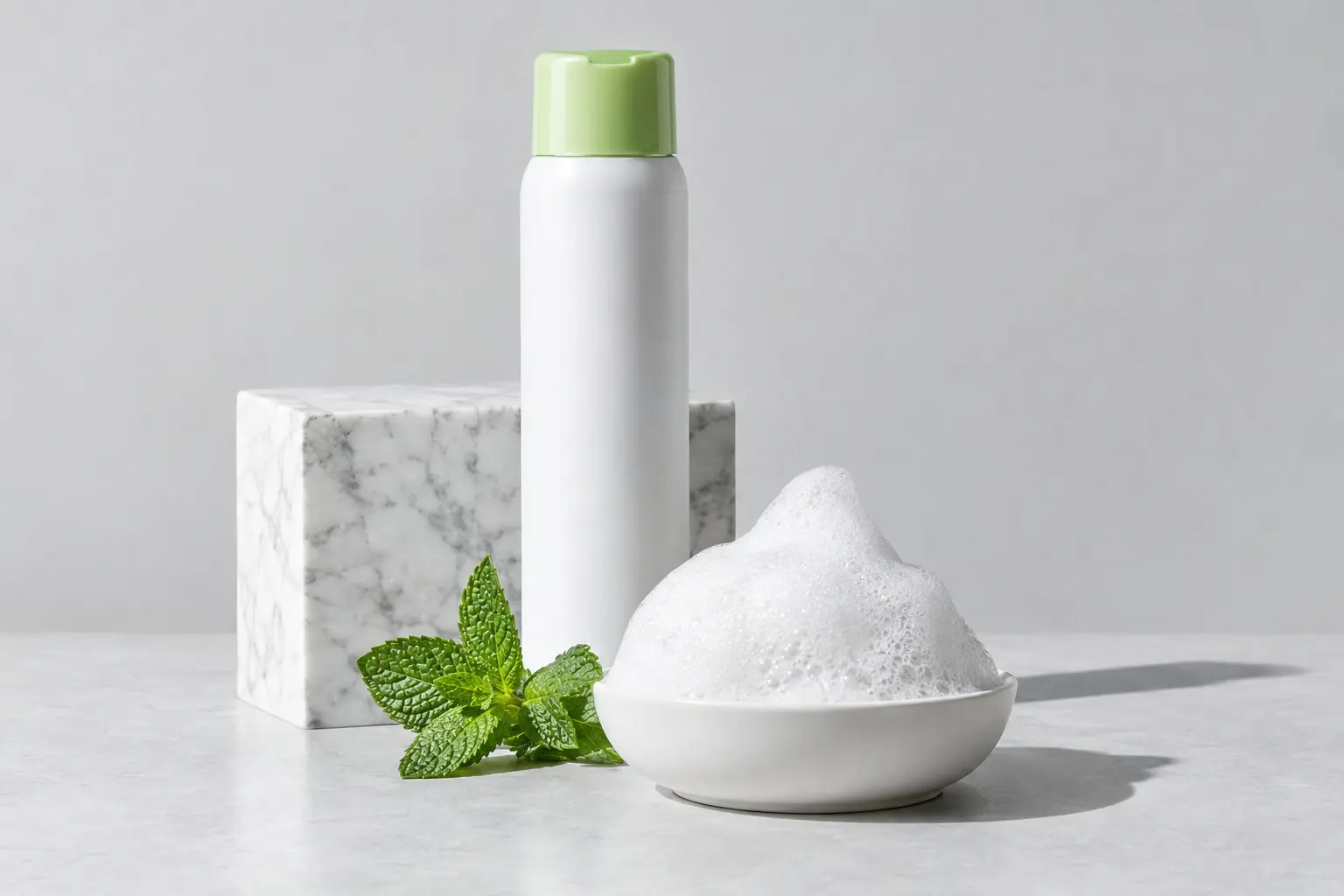
AKTO develops and manufactures a toilet bowl active foam to order, dispensed from a foam-pump bottle as an alternative texture to a gel.
- Regulation (EU) No 528/2012
In brief
A toilet bowl active foam relies on a bubble structure rather than gel thickeners, dispensed through a foam-pump for even bowl coverage. A germ-killing claim puts the formula within Product-Type 2 of Regulation (EU) No 528/2012 (BPR) and requires product authorisation. In Ukraine, the Technical Regulation on Detergents (CMU Resolution No. 717/2008) applies once soap or surfactant content exceeds 0.2%. AKTO develops and manufactures this foam to order in a 50-200 ml foam-pump bottle, from a 50 kg batch.
01
What a toilet bowl active foam is
Company AKTO LLC (AKTO) develops and manufactures a toilet bowl active foam to order. Unlike a gel, which clings to the bowl wall through its thickness, a foam holds its shape through a bubble structure and is dispensed by a foam-pump, giving more even bowl coverage per press. AKTO documents the gel and the foam as two distinct sub-types within the same category, differing in physical form and dispensing rather than in active ingredients. A brand can launch both sub-types within one line, giving the customer a texture choice without changing the underlying formulation.
02
Where cleaning ends and biocide regulation begins
Where a toilet bowl active foam is marketed with a disinfecting or antibacterial claim, it falls within Product-Type 2 of Regulation (EU) No 528/2012 (BPR) and needs an approved active substance and product authorisation under Article 17(1), or compliance with the transitional regime under Article 89(2). AKTO develops and manufactures the foam as a cleaning product; AKTO manufactures biocidal products (disinfectants) separately, to order, and they need authorisation under the BPR before being placed on the EU market.
03
Labelling requirements and Ukraine's regulatory position
Article 17 of Regulation (EC) No 1272/2008 (CLP) requires the label of a classified hazardous foam to show the product identifier, hazard pictograms, signal word, precautionary statements and supplier details. In Ukraine, the Technical Regulation on Detergents (CMU Resolution No. 717/2008, as amended) applies to a toilet bowl foam as a surface-cleaning detergent once soap and/or surfactant content exceeds 0.2% by weight.
04
What AKTO offers for this category
AKTO's packaging for this category is a foam-pump bottle sized 50-200 ml, a distinct format from the pump-jar or trigger bottle used for a gel. AKTO's technologist gives feedback on a brand's technical brief within 1 working day. AKTO allows a 2-3% overage on client-supplied labels, bottles and dispensers to cover production losses during foam filling. The minimum batch is 50 kg of finished formulation at AKTO's Kyiv (Ukraine) and Warsaw (Poland) facilities, the same lines that produce the category's gel format. Production runs under the combined ISO 9001:2015 and ISO 22000:2018 (HACCP) certificate (No. 44600111204) and ISO 22716 (GMP).
05
Getting started with AKTO
The brand decides whether the foam needs only a cleaning claim or an added antibacterial claim, and whether the same foam-pump bottle should carry every product in the line.
- AKTO checks whether the claimed effect brings the formula within BPR scope.
- The technologist responds to the brief within 1 working day.
- Agrees the 50-200 ml foam-pump bottle and batch size with the brand.
- Starts series production at the Kyiv (Ukraine) or Warsaw (Poland) plant.
See also: Bathroom / Toilet / Pipes, Toilet Bowl Cleaner (Gel), Drain Opener (Gel) and Home Care & Cleaning.
Frequently Asked Questions
Does AKTO manufacture a finished toilet bowl foam?
How does a toilet bowl foam differ from a gel?
Does AKTO develop a disinfecting toilet bowl foam?
How fast does AKTO respond to a technical brief?
 Kateryna Khromykh
 Oleksandra Vovk
Standards we work to
 ISO 22716 (GMP)
 ISO 22000 (HACCP)
 Regulation (EC) No 1223/2009
 Directive 2002/46/EC
 Halal
Why AKTO
- Development of a toilet bowl active foam to order
- 50-200 ml foam-pump bottle, MOQ from 50 kg
- Technologist feedback on a brief within 1 working day
- 2-3% overage allowance on client-supplied materials