
Private Label
Tooth Powder
AKTO develops and manufactures tooth powder to order on its own lines in Kyiv (Ukraine) and Warsaw (Poland).
- ISO 22716 GMP
In brief
AKTO develops and manufactures tooth powder to order on its own lines in Kyiv (Ukraine) and Warsaw (Poland). Under ISO 11609:2017, a powder counts as a dentifrice but is not formally a 'toothpaste' by the standard's own definition, and any fluoride in the formula is capped at 0.15% calculated as F. The minimum batch is 50 kg of finished formulation.
01
What tooth powder is and how it differs from a paste
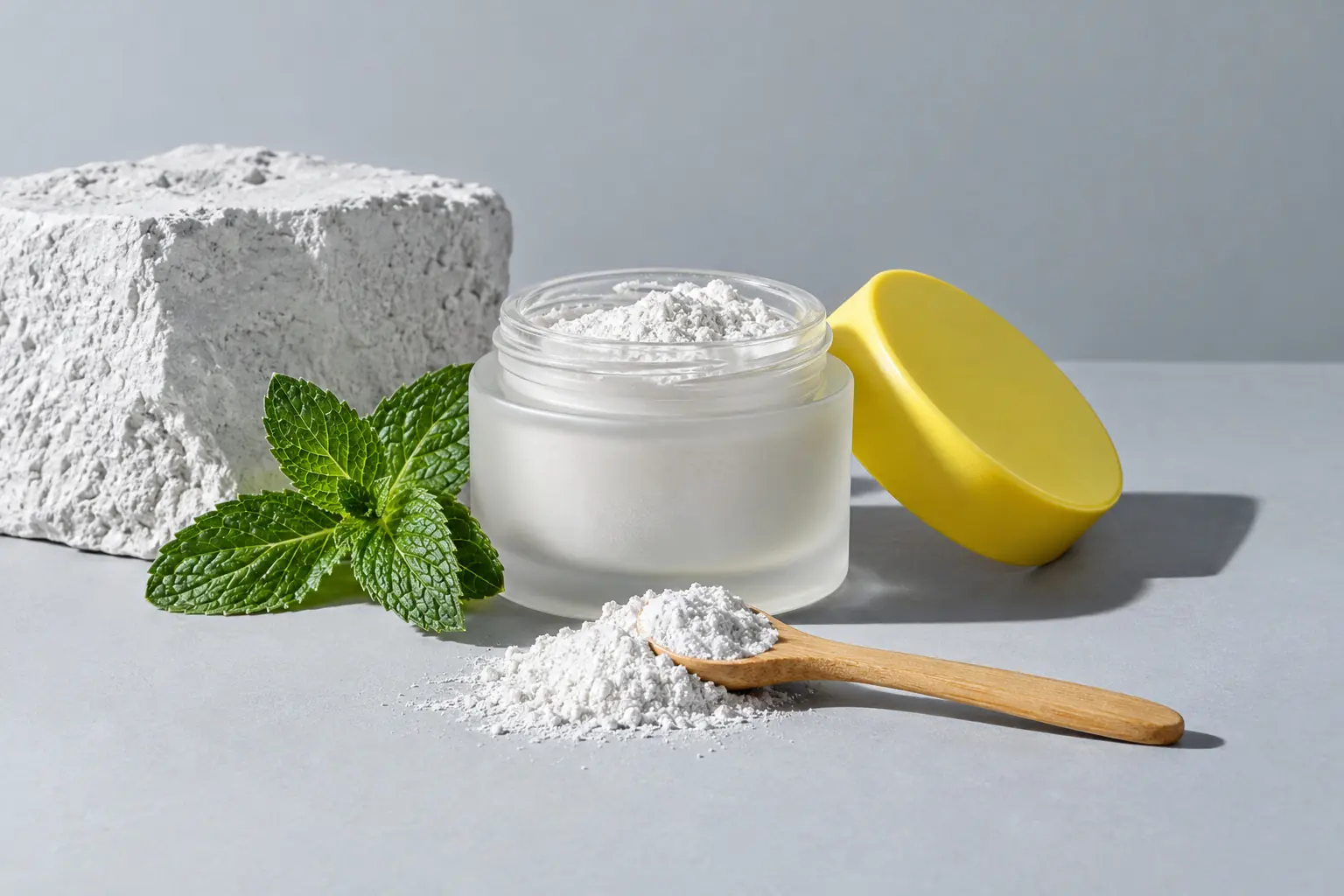
Tooth powder is a dry dentifrice format with no water or gelling agent, applied to a dampened brush. ISO 11609:2017 defines a "dentifrice" broadly as any substance or combination of substances specially prepared for the hygiene of the accessible surfaces of teeth and surrounding tissues, while separately defining a "toothpaste" as a semi-solid preparation in the form of a paste, cream or gel. A dry powder therefore sits within the standard's general dentifrice scope without being a "toothpaste" in the standard's own terms - a distinction that affects which of ISO 11609's sections apply to the powder's labelling and testing.
02
Weight declaration and formulation limits
Article 19(1)(b) of Regulation (EC) No 1223/2009 requires the nominal content of a cosmetic product to be stated by weight or volume at the time of packaging, except for packs under 5 grams or 5 millilitres, free samples and single-application packs - a rule that, for an anhydrous tooth powder, is naturally met by weight rather than volume, unlike a paste or liquid. Where the formula contains fluoride, Annex III entry 31 caps it at 0.15% calculated as F in the finished product - the same ceiling as for a paste or gel, with no separate dry-mass basis.
03
Label claims and staying outside CLP
Regulation (EU) No 655/2013 requires a claim such as "polishes" or "whitens" on the powder's label to be supported by adequate and verifiable evidence, on the same evidential basis required for a gel-format claim in this product family. As a finished cosmetic product, tooth powder falls outside CLP (Regulation (EC) No 1272/2008) under Article 1(5)(c); CLP classification applies to the raw abrasive, fluoride or flavouring ingredients, not the finished jar or sachet.
04
What AKTO offers
AKTO packs powder formats into jars, sachets/sticks and tubes; its labelling specification requires self-adhesive or heat-shrink labels, with round jars and tubes using roll labelling at a 7.5 cm roll diameter and a label height at least 2 mm less than the container height. Sachet/stick-format filling capacity reaches up to 100,000 units a month in Kyiv (Ukraine) and up to 50,000 in Warsaw (Poland). AKTO offers two production modes - on the client's own raw materials (tolling) or on its own - both suited to a powder dentifrice. The minimum batch is 50 kg of finished formulation. Production is certified to ISO 9001:2015, ISO 22000:2018 (HACCP; combined certificate No. 44600111204) and ISO 22716 (GMP).
05
Getting started
A brand sets the abrasive composition, whether to include fluoride, and the packaging format - jar, sachet or tube; AKTO prepares the formula, the weight declaration under Article 19(1)(b) and the labelling for the chosen claims. This water-free format works well alongside a paste or gel line as a distinct texture. See also: Gels / Powders, Household, Hygiene & Specialty Care, Sensitive Teeth Tooth Gel and Tooth Gel.
Frequently Asked Questions
Is tooth powder a 'toothpaste' under ISO 11609?
How is tooth powder's weight declared?
What is the fluoride limit in tooth powder?
What packaging does AKTO use for tooth powder?
 Kateryna Khromykh
 Oleksandra Vovk
Standards we work to
 ISO 22716 (GMP)
 ISO 22000 (HACCP)
 Regulation (EC) No 1223/2009
 Directive 2002/46/EC
 Halal
Why AKTO
- Tooth powder developed to order on AKTO's own lines
- Weight declared under Article 19(1)(b) of Regulation (EC) No 1223/2009
- Fluoride, where used, capped at 0.15% calculated as F
- Jars, sachets/sticks and tubes, up to 100,000 sachets/sticks a month in Kyiv (Ukraine)
- MOQ from 50 kg, facilities in Kyiv (Ukraine) and Warsaw (Poland)