
Private Label
Under-Eye Patches (Hydrogel)
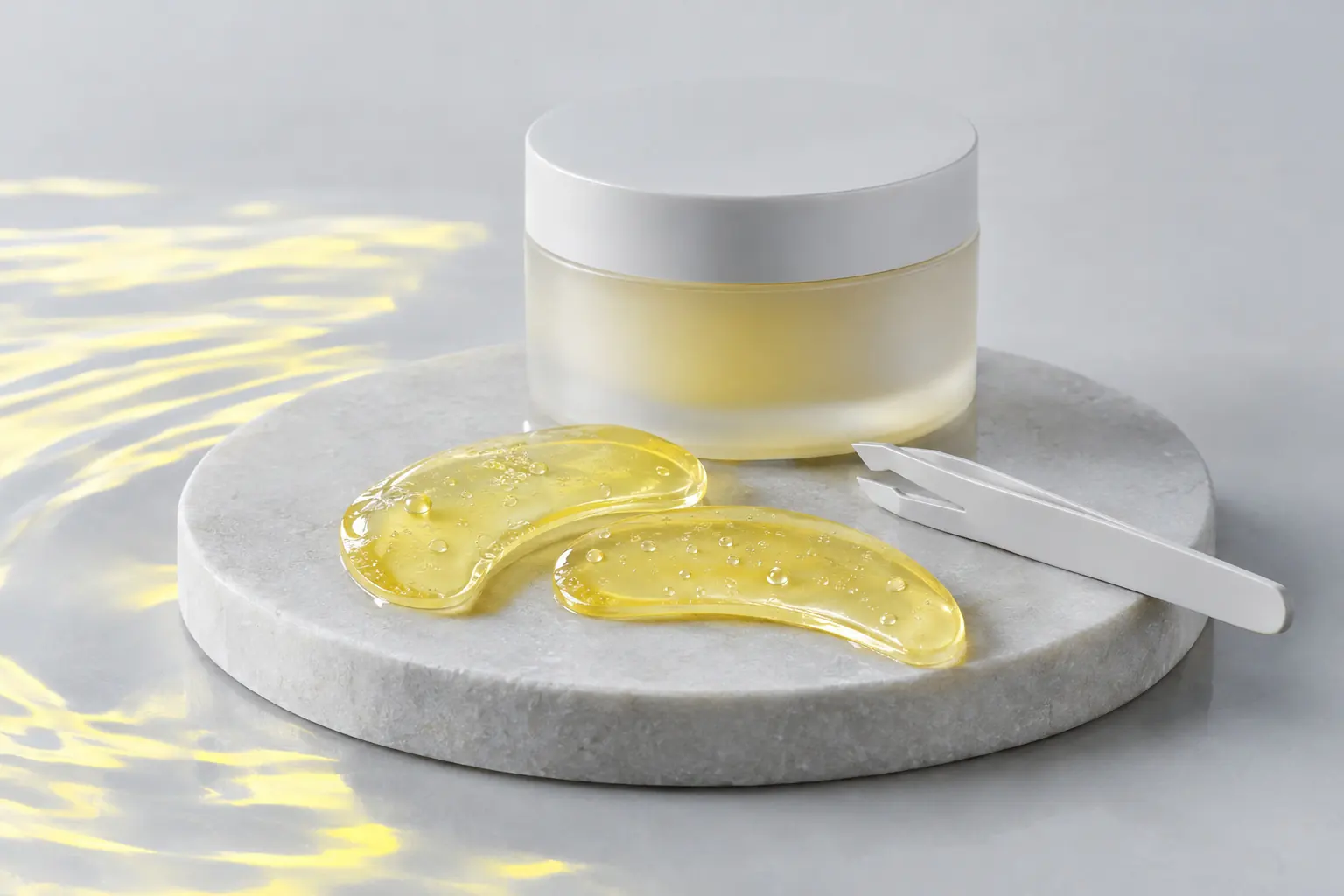
AKTO develops and manufactures hydrogel under-eye patches to order on its emulsion/cream/liquid lines, packed in single-use sachets.
- ISO 22716 GMP
In brief
Company AKTO LLC (AKTO) develops and manufactures hydrogel under-eye patches to order for a brand, building on its own emulsion/cream/liquid formula base for the eye area, packed in sachets. The product is registered in Ukraine under AKTO's own technical specification. The minimum batch is 50 kg, with GTIN-13 barcode registration and label-compliance checking available as standalone services.
01
What hydrogel under-eye patches are
Unlike a cream, gel or serum that is applied and left on the skin, an under-eye patch is a single-use hydrogel product in a sealed sachet, designed for a clearly defined contact time: the brand sets a specific duration and on-pack instructions rather than a daily ritual. This format works well as a standalone SKU for one-off or course-based use - a gift set, a spa-style ritual or a quick-effect product before an event.
02
Composition, format and packaging requirements
AKTO develops and manufactures hydrogel under-eye patches on its emulsion/cream/liquid lines - the base it already uses for other eye-area products - with the formula tailored to each brand's project. AKTO's technical-brief (TZ) intake form for developing a new product line lists sachet as a selectable packaging type alongside tube, jar and stick - the format that suits a single-use hydrogel patch.
03
EU and Ukraine regulatory requirements
Annex I Part A Section 5 of Regulation (EC) No 1223/2009 requires the reasoning on a product's normal and reasonably foreseeable use to be justified in light of the labelling's warnings and other instructions - relevant to a single-use patch's defined contact time and application instructions. Section 8 requires a toxicological profile with particular focus on skin and eye irritation, directly relevant to a product in contact with the eye-contour skin for a set period. Article 19(1)(c) requires a period-after-opening (PAO) symbol for a product with a durability of more than 30 months, except where that concept is not relevant - a clause that applies directly to a sealed, single-use sachet. In Ukraine, hydrogel patches manufactured by AKTO are registered under its own technical specification TU U 20.4-43961492-001:2020, backed by sanitary-epidemiological expert opinion No. 12.2-18-2/2361 dated 15.02.2021.
04
What AKTO offers
Alongside full recipe development, AKTO offers GTIN-13 barcode registration and label-compliance checking as standalone services - useful when a brand adds a new-format SKU, such as an eye patch, to an existing line. The minimum batch is 50 kg of finished formulation at AKTO's facilities in Kyiv (Ukraine) and Warsaw (Poland), certified to ISO 9001:2015 and ISO 22000:2018 (HACCP; combined certificate No. 44600111204), ISO 22716 (GMP).
05
Getting started
A brand sets the contact time and the product promise; AKTO develops the hydrogel formula on its emulsion/cream/liquid lines, prepares the sachet packaging, and registers the product under the Ukrainian technical specification before a batch from 50 kg starts. GTIN-13 registration and label checking are available as standalone services for a faster new-SKU launch. See also: Eye Area, Eye Cream and Eye Serum.
Frequently Asked Questions
Does AKTO manufacture hydrogel under-eye patches?
Why are patches regulated differently from a cream or gel?
Does a patch pack need a PAO symbol?
What document registers patches in Ukraine?
Expert review
Reviewed by
 Illia Mariutsa
Researcher, organic chemistry
Google Scholar Anastasiia Bespalova
Paediatric orthopaedic and trauma surgeon
ORCID
Standards we work to
 ISO 22716 (GMP)
 ISO 22000 (HACCP)
 Regulation (EC) No 1223/2009
 Directive 2002/46/EC
 Halal
Why AKTO
- Hydrogel formula development on AKTO's own eye-area lines
- Sachet packaging for single-use application
- Registration under the Ukrainian technical specification and expert opinion
- Standalone GTIN-13 and label-compliance check services
- MOQ from 50 kg, facilities in Kyiv (Ukraine) and Warsaw (Poland)