
Blog
How to Launch Your Own Supplement Brand: Market, Sales Channels and First Steps
How to launch a supplement brand: the market, formats, documents and sales channels, plus the mistakes people make at the start.
- Supplements
- Own brand
In brief
A dietary supplement is a food product with its own requirements for composition, labelling and notification to the state, so the path differs from cosmetics. The article covers the market in Ukraine, choosing a product and format, agreeing the formula and dosage with a technologist, contract manufacturing, notification, labelling, claims, sales channels and typical mistakes.
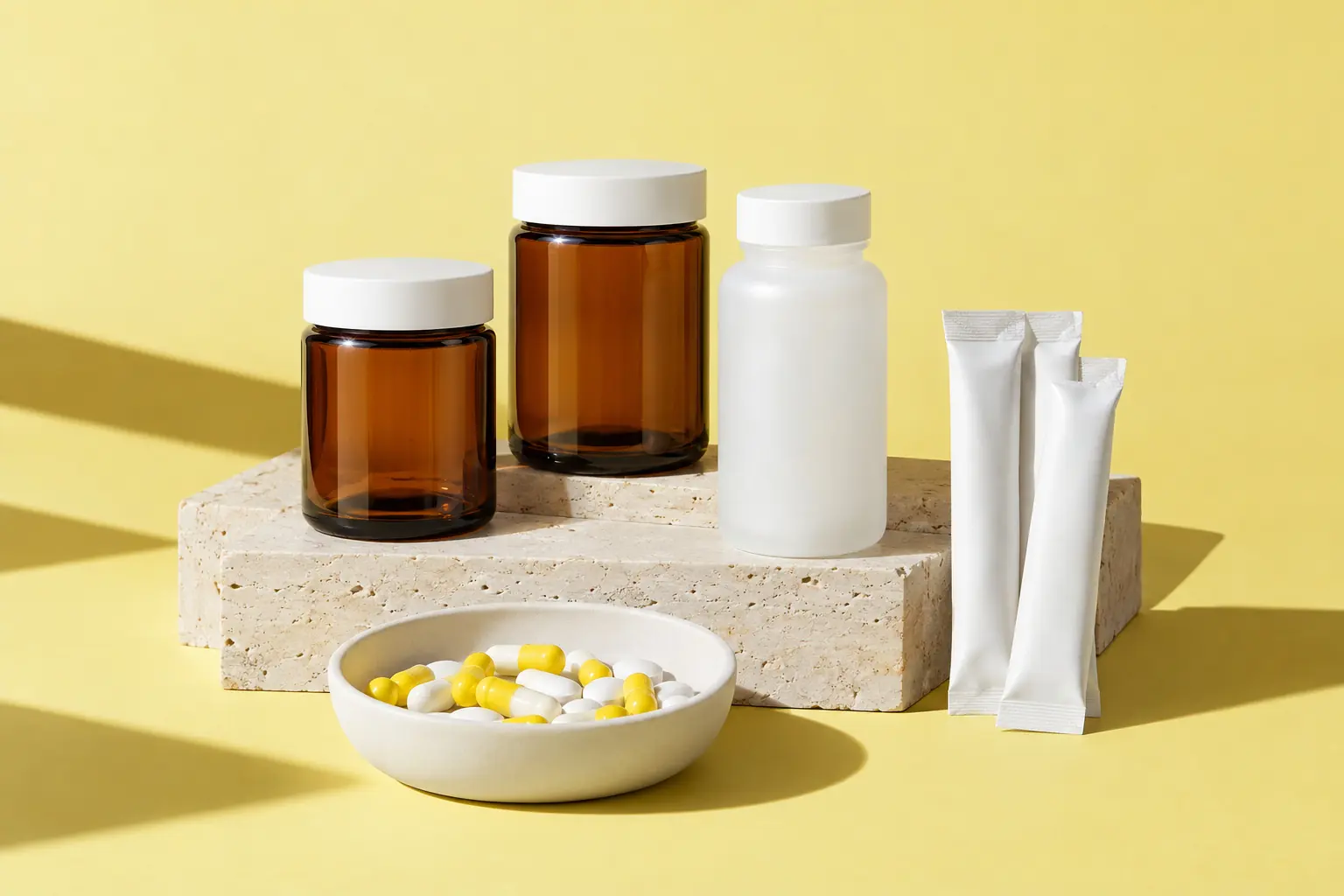
Pharmacies, fitness clubs, bloggers and cosmetics brands expanding their range all launch their own supplement brands. This path differs from cosmetics: a dietary supplement is a food product with its own requirements for composition, labeling and notification to the state. We go through the market, formats, documents and sales channels, as well as typical mistakes at the start.
01
The dietary supplement market in Ukraine
Pharmacy sales of dietary supplements in Ukraine are growing faster than any other category in the pharmacy range. According to Apteka.ua analysts, in 2024 they grew by 28% in money terms and 13% in packs, and the average price of a pack was about UAH 188 (Forbes Ukraine, 3 February 2025). In 2025, supplement sales in pharmacies grew by a further 24.8% (Slovo i Dilo, 19 May 2026).
Demand exists, but so does heavy competition: there are hundreds of brands on pharmacy and marketplace shelves. Stricter rules for placing supplements on the market have applied since 27 September 2025. The transitional period, when products could be placed on the market under the previous requirements, ended on 26 March 2026. So the market is left to those who are ready to work with documents and correct labeling.
02
Choosing the product and format
Start with the category and the audience. At AKTO we produce supplements with vitamins and minerals, plant extracts and their blends, probiotics, collagen drink blends and powder blends based on plant raw materials. Next comes the choice of format, and dosage, cost price and consumer convenience depend on it.
| Format | Advantages | Limitations | At AKTO |
|---|---|---|---|
| Capsules | Precise dosage, mask the taste, easy to take | Limited fill weight: large doses require several capsules a day | Hard gelatin, standard fill weight 500 mg |
| Tablets | More active ingredients per unit, lower cost price | Excipients are needed, large tablets are harder to swallow | On request |
| Powders, sachets, sticks | Suitable for large doses: collagen, drink blends | Work on taste and solubility is needed | Yes |
| Syrups and other liquid forms | Convenient for those who do not like swallowing capsules | Shelf life after opening must be considered; heavier to ship | Yes |
| Drops | Small single dose, flexible intake | Dose accuracy depends on the consumer | Yes |
03
Formula and dosage: what to agree with the technologist
For the product to comply with the requirements and be safe, agree the following with the technologist before development:
- forms of vitamins, minerals and other substances: in Ukraine only those listed in Annexes 1–3 to the Hygienic Requirements for Dietary Supplements (Ministry of Health Order No. 1114 as amended by Order No. 203 of 19 February 2026) are permitted; they are aligned with Annexes I and II of Directive 2002/46/EC;
- the daily dose: it must not exceed the tolerable upper intake level set by EFSA or the maximum levels in the Hygienic Requirements; and the number of units per intake;
- the status of ingredients as novel foods (Novel Food), if you plan atypical plants or extracts;
- compatibility of active and auxiliary substances, stability throughout the shelf life;
- taste and solubility for powders and syrups;
- claims on the packaging: only nutrition claims and health claims from the lists approved by Ministry of Health Order No. 1145 of 15 May 2020 may be used, and under the conditions set for each of them.
Our R&D laboratory selects a formula within the permitted lists, checks ingredient compatibility and stability, and checks whether the planned claim is on the permitted list. How development works is described on the page supplement formulation development.
04
Contract manufacturing: where to start your own supplement brand
A dedicated supplement workshop pays off only at large volumes, so new brands find it more convenient to work with a contract manufacturer. The minimum batch at AKTO is from 10 kg of raw material or 20,000 capsules. For reference: 20,000 capsules is about 333 jars of 60 capsules. Production is certified to ISO 22000 (HACCP) and ISO 9001, and the capacity is designed for both first batches and scale-up: up to 10 million capsules per month in Ukraine and up to 2 million in Poland. Terms, formats and stages are on the page private label dietary supplements, and lines and formats are on the page supplement manufacturing.
05
Documents: notification, labeling, claims
The new rules for placing supplements on the market were introduced by the Law of Ukraine No. 4122-IX of 5 December 2024 "On Amendments to Certain Laws of Ukraine on Improving the Regulation of the Production and Circulation of Dietary Supplements and Resolving Other Issues in the Field of Health Care". Among other things, it amended the Law "On Basic Principles and Requirements for Food Safety and Quality". The Law was published on 26 March 2025, and its main requirements, including the notification of first placing on the market, apply from 27 September 2025. This is the part most often underestimated at the start.
Notification of intent to place on the market for the first time
The food business operator submits the notification to the State Service of Ukraine on Food Safety and Consumer Protection at least 10 working days before first placing the supplement on the market. According to the clarification of the State Service, the package includes:
- a cover letter from the operator;
- a notification in the prescribed form;
- a sample label in Ukrainian and, for imported products, also the original label;
- a text version of the mandatory consumer information;
- documents of the competent authorities of EU or EFTA countries, if the product is sold there.
The rule is "one notification — one package of documents", and the name of the supplement in the notification must match the name on the label. The notification is entered into an open list, and selling a supplement that is not on it results in a fine. A new notification is also submitted when the mandatory information about the supplement or the packaging material changes. How we help with this stage is described on the page about dietary supplement notification. The supplement documentation service will also help prepare the package of documents.
Labeling and claims
In addition to the general mandatory information under Article 6 of the Law "On Consumer Information on Food Products", the label must show: the name "dietary supplement"; the names of the nutrients or other substances that characterize the product; the recommended daily portion; a warning not to exceed it; that the supplement should not be used as a substitute for a balanced diet; that it must be kept out of the reach of children; and that the product is not a medicinal product. The amount of substances is given per daily portion and, for vitamins and minerals, also as a percentage of the reference intake values. These requirements are set by the Hygienic Requirements for Dietary Supplements (Ministry of Health Order No. 1114 as amended by Order No. 203) and are aligned with Directive 2002/46/EC.
It is prohibited to attribute to a food product, including a dietary supplement, the property of preventing, treating or curing human disease. For dietary supplements, the Ministry of Health Hygienic Requirements separately prohibit in labeling and advertising statements about a therapeutic effect or pain relief, letters of gratitude and testimonials related to treatment, and wording that causes fear of worsening health without the supplement. This is laid down in the Law On Consumer Information on Food Products. Only permitted nutrition and health claims may be used on packaging and in advertising. General requirements for composition and safety are collected on the page requirements for dietary supplements, and help with texts is provided by labels and claims review.
06
Where to sell supplements: channels and their requirements
- Pharmacies. Pharmacy sales of supplements are growing faster than any other category in the pharmacy range. Pharmacy chains usually check the documents, whether the product is on the notification list and the correctness of claims; getting into a chain can take several months.
- Marketplaces. A quick start and a broad audience, but high competition and a need for quality content. Platforms may ask for product documents and confirmation of the notification.
- Your own website. It lets you sell in courses and by subscription and keep in touch with the buyer. You will have to attract traffic yourself.
- Sports shops and fitness clubs. Suitable for collagen blends, electrolytes and vitamin-mineral complexes for an active lifestyle.
- Beauty salons and cosmetologists. A channel for a brand that already has a cosmetics line and adds supplements to it.
07
Mistakes at the start
- Promising a therapeutic effect or publishing treatment testimonials — on the packaging, in a marketplace listing, on the website or in advertising.
- Placing the product on the market before 10 working days have passed after submitting the notification, or without it being entered in the list.
- Choosing a format that is inconvenient for the dose: if the daily dose fits only in five capsules, the buyer is unlikely to come back.
- Copying a competitor's composition without checking the forms of ingredients and doses.
- Printing labels before the text of the mandatory information is approved.
- Launching a wide range instead of two or three products with clear positioning.
If you are planning your own supplement brand, send us a brief: the direction, desired ingredients, format and approximate volume. AKTO's technologist will propose a formula within the permitted lists, and a manager will calculate the cost of the first batch. The terms of cooperation are described on the page private label dietary supplements.
Frequently Asked Questions
Can I sell supplements under my own trademark without my own production?
Who submits the notification to the State Service of Ukraine on Food Safety and Consumer Protection?
What is the minimum batch to start?
Can the packaging say that a supplement helps with a particular disease?
How much does it cost to launch a supplement brand?
Standards we work to
 ISO 22716 (GMP)
 ISO 22000 (HACCP)
 Regulation (EC) No 1223/2009
 Directive 2002/46/EC
 Halal
Why AKTO
- R&D formulation based on reference analogues and regulatory requirements
- MOQ from 10 kg of raw material or 20,000 capsules
- Up to 10 million capsules a month in Kyiv (Ukraine), 2 million in Warsaw (Poland)
- Manufacturing under ISO 22000 (HACCP) with conformity checks at every phase
- Full dietary-supplement notification package prepared in one cycle