
Private Label
Body Cream
Body cream built on AKTO's emulsion formula at a higher viscosity, made in a reactor with a homogenizer to EU allergen and preservative rules.
- ISO 22716 GMP
In brief
Company AKTO LLC (AKTO) manufactures body cream on the same emulsion formula as its body lotion, at a higher viscosity, in 250-500 ml pump bottles. Every product is documented through OLR and OLP operating sheets, with an OPP report for the first 3-5 production batches; cosmetics MOQ starts from 50 kg.
01
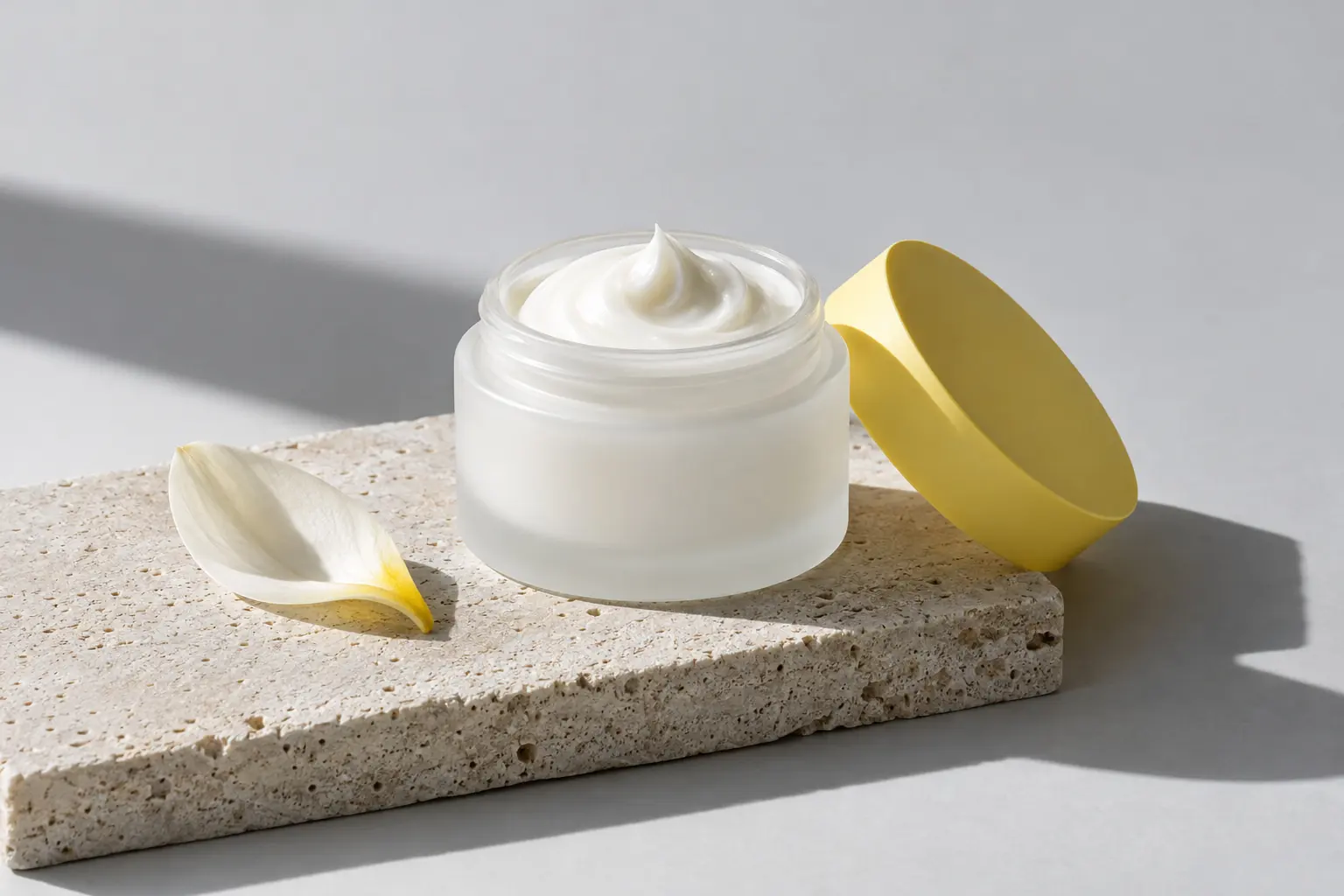
Body cream: a thicker texture on the same line
Body cream is a leave-on product with a higher viscosity than lotion, the density-forward option a brand adds next to its everyday hydration item. AKTO manufactures a body cream built on the same emulsion formula as its body lotion, at a higher viscosity, in 250-500 ml pump bottles; the company's files do not currently separate a distinct cream-only SKU with a different composition from that lotion emulsion.
02
Production process: the reactor and paperwork
AKTO's cosmetic emulsions, cream-viscosity products included, are made in a cosmetic reactor fitted with a homogenizer - a 70 l vessel for the aqueous phase and a 35 l vessel for the oil phase - under vacuum, with pH checked throughout the batch. Every product, a body cream included, is documented through a development operating sheet (OLR), a production operating sheet (OLP) and a raw-material loading table; the first 3-5 production batches of a new product additionally receive a first-production report (OPP).
03
Allergens, the preservative and label claims
Regardless of viscosity, a fragranced body cream falls under the same Annex III threshold of Regulation (EC) No 1223/2009 - 0.001% for a leave-on product. Annex V entry 34 permits Benzyl Alcohol as a cream-base preservative up to 1.0% in the finished product; footnote (7) to that entry points to Annex III entry 45, under which Benzyl Alcohol used for other purposes is a fragrance allergen to be declared above 0.001% (leave-on) or 0.01% (rinse-off). Article 19(1) requires a date of minimum durability or, past 30 months of shelf life, a PAO symbol. A 'regenerating' or 'renewing' claim on the label needs adequate, verifiable evidence under Regulation (EU) No 655/2013.
04
What AKTO manufactures
The cream-viscosity variant is produced on the same liquid-systems line as the lotion, under the same allergen controls and paperwork described above. Cosmetics MOQ starts from 50 kg. Manufacturing runs at plants in Kyiv, Ukraine, and Warsaw, Poland, certified to ISO 9001:2015 and ISO 22000:2018 (combined certificate No. 44600111204), ISO 22716 (GMP). In Ukraine, body cream is classified as a cosmetic product under Cabinet of Ministers Resolution No. 65 of 20 January 2021.
05
Getting started with a body cream project
A brand sets the target viscosity and the label claim it wants - a 'regenerating' effect, for instance - and AKTO lines up the supporting evidence and checks the Benzyl Alcohol concentration before production begins.
- Brief: viscosity, actives, label claim
- Formulation and pH control in the reactor
- OLR-OLP-OPP paperwork and first production batches
- Samples, stability testing and launch
See also: Body Moisturizers & Oils, Body Lotion, Body Butter and Whipped Body Cream.
Frequently Asked Questions
How does AKTO's body cream differ from its body lotion?
Which preservative is allowed in a body cream?
What paperwork does a new AKTO body cream receive?
What does a 'regenerating' claim on a body cream label require?
Expert review
Reviewed by
 Illia Mariutsa
Researcher, organic chemistry
Google Scholar Anastasiia Bespalova
Paediatric orthopaedic and trauma surgeon
ORCID
Standards we work to
 ISO 22716 (GMP)
 ISO 22000 (HACCP)
 Regulation (EC) No 1223/2009
 Directive 2002/46/EC
 Halal
Why AKTO
- Cream built on the same emulsion formula
- Made in a reactor with a homogenizer under vacuum with pH control
- OLR-OLP-OPP paperwork for every new product
- Cosmetics MOQ from 50 kg