
Private Label
Charcoal Face Mask
AKTO develops and manufactures a charcoal face mask to order on its dry/powder mask line, from a minimum batch of 50 kg.
- ISO 22716 GMP
In brief
A charcoal mask is built around activated carbon, a functional adsorbent that physically binds excess sebum and surface impurities. AKTO develops and manufactures this format to order on its dry/powder manufacturing line, following Regulation (EC) No 1223/2009 and ISO 22716, from a 50 kg batch.
01
What a charcoal face mask is
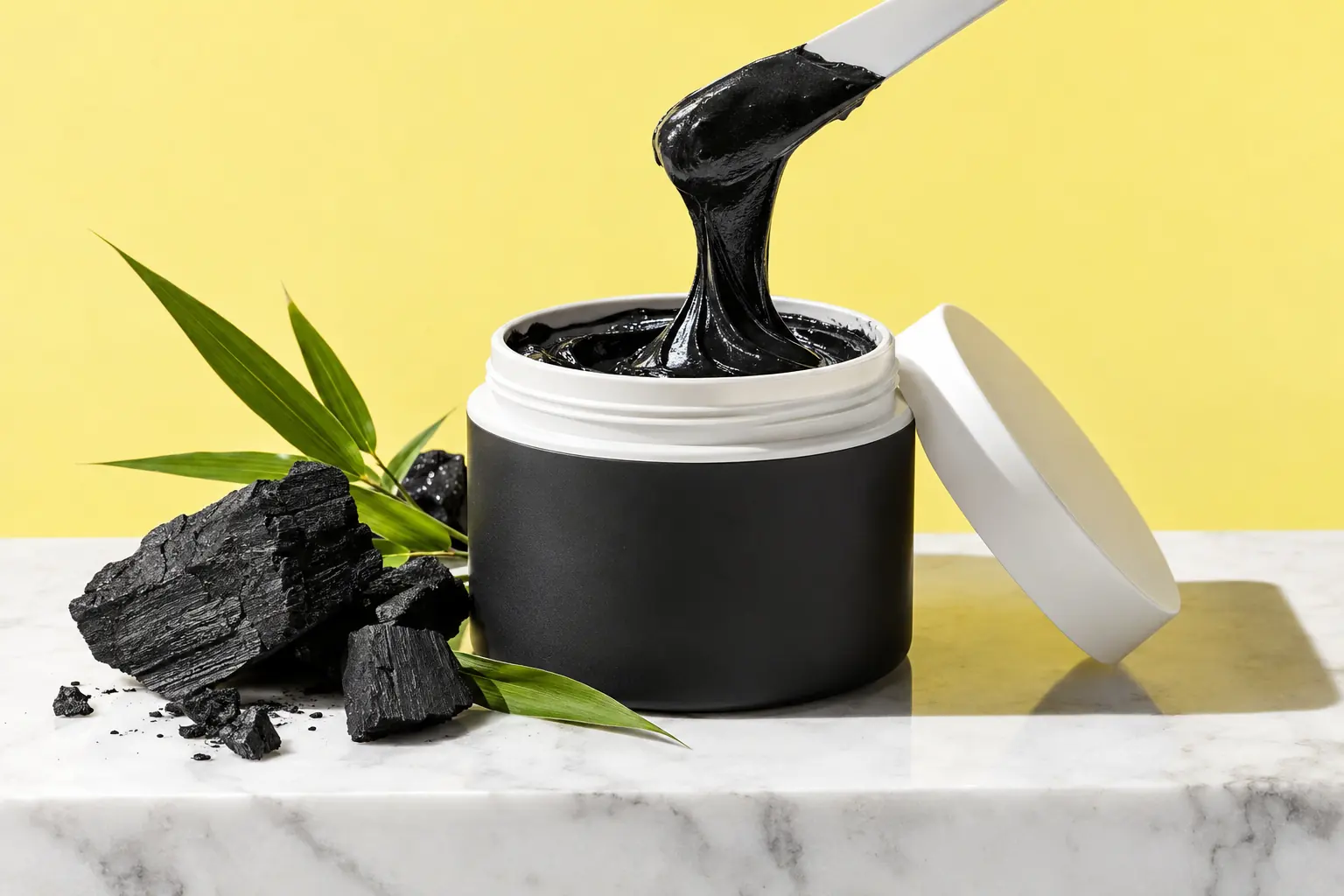
A charcoal mask is built around activated carbon, a porous adsorbent made of elemental carbon, added to the formulation for its physical ability to bind excess sebum and surface impurities rather than for any pharmacological effect. Brands typically position this kind of product as an expert-level at-home treatment, giving customers an extra reason to buy again within a line, rather than as a daily cream. AKTO's declared manufacturing capability for the mask category includes a dry/powder format alongside its confirmed cream-mask in a 100 ml airless pump, and it is on this line that AKTO develops and manufactures a charcoal mask to order.
02
The adsorbent's function and safety assessment
Regulation (EC) No 1223/2009 Annex I Part A Sections 7 and 8 require the safety report to assess exposure to, and the toxicological profile of, every substance in the formulation, including a functional ingredient present for a physical (adsorptive) rather than a pharmacological effect - exactly the role activated carbon plays here. Article 10 of the same Regulation requires a safety assessment covering the full formulation, including any functional filler or adsorbent, before a charcoal mask can be placed on the EU market.
03
Label claims and Ukraine regulatory requirements
A claim such as "detox" or "draws out impurities" on a charcoal mask must meet the six common criteria of Commission Regulation (EU) No 655/2013 - legal compliance, truthfulness, evidential support, honesty, fairness and informed decision-making - since the Regulation itself pre-approves no such wording. ISO 22716 covers the manufacture, control, storage and shipment of a powder-format cosmetic. In Ukraine, AKTO-manufactured cosmetics are registered under its own technical specification TU U 20.4-43961492-001:2020, backed by a 2021 state sanitary-epidemiological expert conclusion.
04
What AKTO offers
The minimum batch is 50 kg of finished formulation, made at AKTO's facilities in Kyiv (Ukraine) and Warsaw (Poland). The mask-category testing package mandatorily includes microbiology, a preservative-challenge test and physicochemical analysis (pH, viscosity, organoleptics); for a rinse-off clay- or carbon-type mask, this also covers the dispersion stability of the insoluble powder ingredient in the base. Production is certified to ISO 9001:2015 and ISO 22000:2018 (HACCP; combined certificate No. 44600111204) and to ISO 22716 (GMP).
05
Getting started
A brand sets the target adsorbent concentration, texture and removal method (rinse-off or otherwise); AKTO adapts the formula on its dry/powder line, checks dispersion stability and microbiological quality, and prepares the product's technical dossier for the chosen market. This lets a brand add a charcoal mask to its range without sourcing a separate manufacturer. See also: Pore-Clearing Mask, Face Cleansing Powder, Anti-Aging Face Mask and Masks (Face).
Frequently Asked Questions
Does AKTO manufacture activated-charcoal face masks?
How does EU law treat activated carbon in a mask formulation?
Can a charcoal mask be labelled 'detox'?
What testing does AKTO run on a charcoal mask formulation?
Expert review
Reviewed by
 Illia Mariutsa
Researcher, organic chemistry
Google Scholar Anastasiia Bespalova
Paediatric orthopaedic and trauma surgeon
ORCID
Standards we work to
 ISO 22716 (GMP)
 ISO 22000 (HACCP)
 Regulation (EC) No 1223/2009
 Directive 2002/46/EC
 Halal
Why AKTO
- Dry/powder format is a declared AKTO manufacturing capability
- Adsorbent safety assessed under Regulation (EC) No 1223/2009 Annex I
- Physicochemical control of powder dispersion in the base
- Registered under TU U 20.4-43961492-001:2020 and a 2021 expert conclusion
- MOQ from 50 kg, facilities in Kyiv (Ukraine) and Warsaw (Poland)