
Private Label
Coffee Machine Descaler
AKTO develops and manufactures a single-dose descaler for the boiler and lines of coffee machines, to order as a liquid or sachet/powder.
- ISO 22716 GMP
In brief
Company AKTO LLC (AKTO) develops and manufactures a coffee-machine descaler to order, built on citric or lactic acid, as a liquid dropper-bottle or a single-dose sachet/powder for one descaling cycle. The formula is classified under EU Regulation (EC) No 1272/2008 (CLP); Regulation (EC) No 1935/2004 governs the machine's own food-contact parts, not the descaling chemical. The minimum batch is 50 kg at AKTO's plants in Kyiv (Ukraine) and Warsaw (Poland).
01
What a coffee-machine descaler is
A coffee-machine descaler is a single-use product for clearing limescale from a machine's boiler and internal lines, run through a dedicated descaling programme rather than used as a daily cleaner. The single-dose format suits home and office coffee machines particularly well: the owner runs the programme once every few weeks, so a brand launching this product is targeting coffee-machine owners specifically, not the wider household-cleaning market. In a brand's range, it typically sits alongside general appliance-care products as an add-on specifically for coffee-machine owners.
02
Acid formula and single-dose packaging
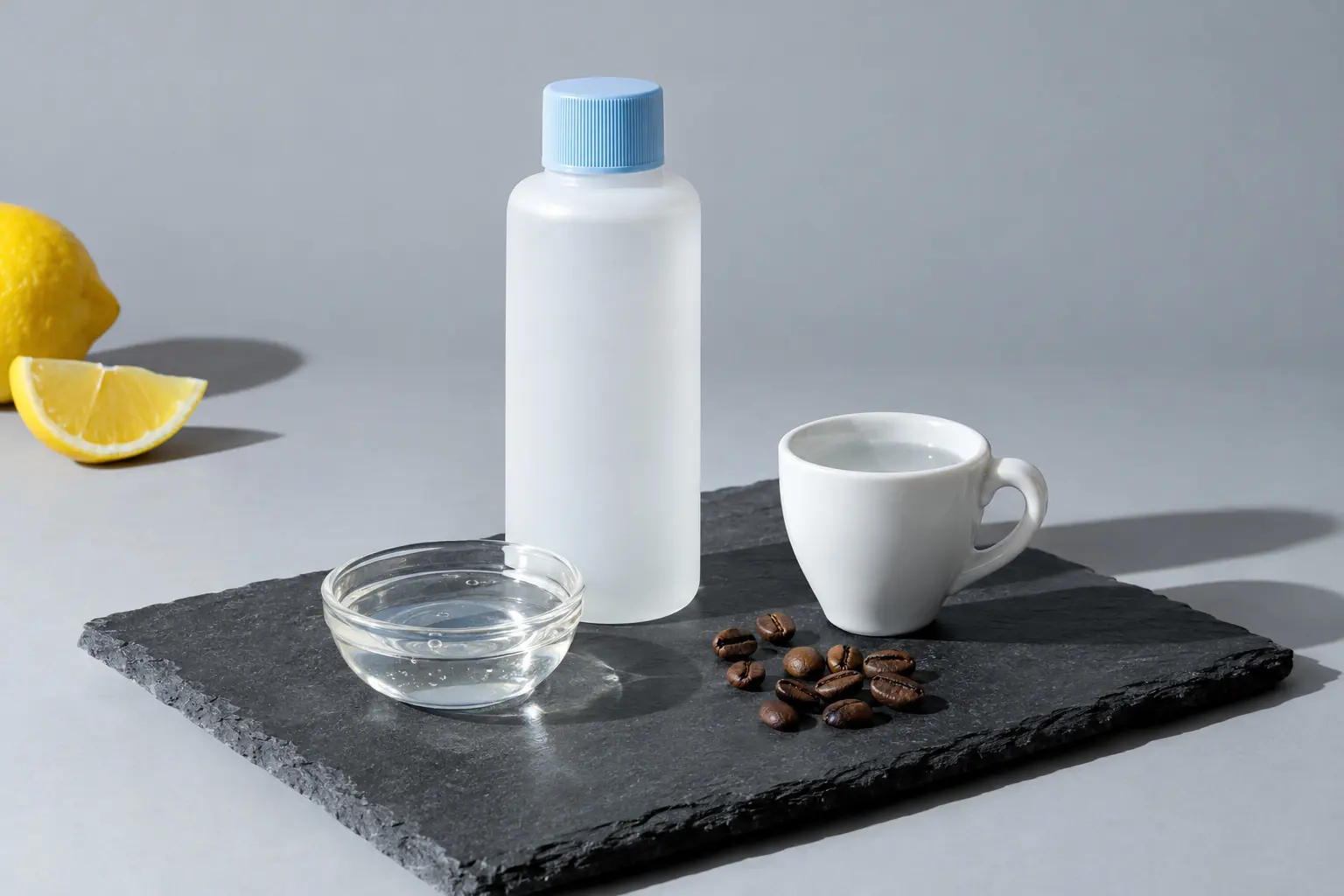
AKTO develops and manufactures a coffee-machine descaler to order on a citric or lactic acid base, as a liquid or a sachet/powder sized for one descaling cycle. The liquid form is dispensed from a 50-100 ml dropper-bottle, while the powder form is packed in a sachet sized for a single run of the machine's cleaning programme.
03
Hazard classification and the limits of Regulation 1935/2004
Regulation (EC) No 1272/2008 (CLP) classifies a citric- or lactic-acid formula through the Annex I tiered approach (sections 3.2 and 3.3): pH is the criterion for a strong acid (pH <= 2 gives Skin Corr. 1, unless the acid reserve indicates otherwise), otherwise the Table 3.2.4 thresholds apply; additivity may not apply to acid mixtures. Regulation (EC) No 1935/2004 Article 1(2) covers materials and articles meant to contact food - that is, the machine's own parts, not the chemical used to clean them - so a 'food-contact safe' claim about the descaler itself is not derived from this Regulation. In Ukraine, the Technical Regulation on Detergents (Resolution No. 717/2008) excludes a surfactant-free acid-based descaler from scope (paras 3 and 5).
04
AKTO's production conditions
The product is registered under KVED code 20.59. Production premises are held at 20-60% relative humidity and 16-25 degC, checked twice per shift. The minimum batch is 50 kg at plants in Kyiv (Ukraine) and Warsaw (Poland), certified to ISO 9001:2015, ISO 22000:2018 (HACCP, No. 44600111204) and ISO 22716 (GMP).
05
Getting started
A brand chooses the acid - citric or lactic - and the format: a dropper-bottle for liquid or a sachet for a single dose, and settles the wording of any food-contact-safety claim carefully, since it is not backed by Regulation 1935/2004. AKTO develops the formula, checks its CLP classification, and runs a batch from 50 kg. See also: Appliance Care & Descalers, Universal Descaler and Kettle Descaler.
Frequently Asked Questions
How often is a coffee-machine descaler used?
What packaging does AKTO use for a coffee-machine descaler?
Does Regulation 1935/2004 apply to the descaler itself?
What is AKTO's minimum batch for a coffee-machine descaler?
 Kateryna Khromykh
 Oleksandra Vovk
Standards we work to
 ISO 22716 (GMP)
 ISO 22000 (HACCP)
 Regulation (EC) No 1223/2009
 Directive 2002/46/EC
 Halal
Why AKTO
- Single-dose descaler to order: citric or lactic acid
- Liquid dropper-bottle or single-dose sachet/powder
- CLP hazard classification checked per acid and concentration
- Registered under KVED 20.59, minimum batch from 50 kg
- Plants in Kyiv (Ukraine) and Warsaw (Poland), ISO 9001, ISO 22000, ISO 22716