
Private Label
Universal Descaler
AKTO develops and manufactures an acid-based descaling concentrate for household appliances and surfaces, to order as a liquid, gel or powder for dilution.
- ISO 22716 GMP
In brief
Company AKTO LLC (AKTO) develops and manufactures a universal descaler to order, a concentrate built on citric, sulfamic, phosphoric or lactic acid for dilution across kettles, machines, taps and other surfaces. The formula is classified under EU Regulation (EC) No 1272/2008 (CLP) and falls outside Ukraine's Technical Regulation on Detergents when surfactant-free; the minimum batch is 50 kg at AKTO's plants in Kyiv (Ukraine) and Warsaw (Poland).
01
What a universal descaler is
A universal descaler is a concentrate for dissolving mineral scale across several appliances and surfaces - kettles, washing and dishwasher machines, taps, showerheads - rather than a product built for one appliance only. The user dilutes it with water to a ratio set by how much scale has built up, so a brand launching this product is targeting the shopper who wants one bottle for every appliance in the home, not a shelf of narrow single-purpose cleaners.
02
Acid base, format and dilution
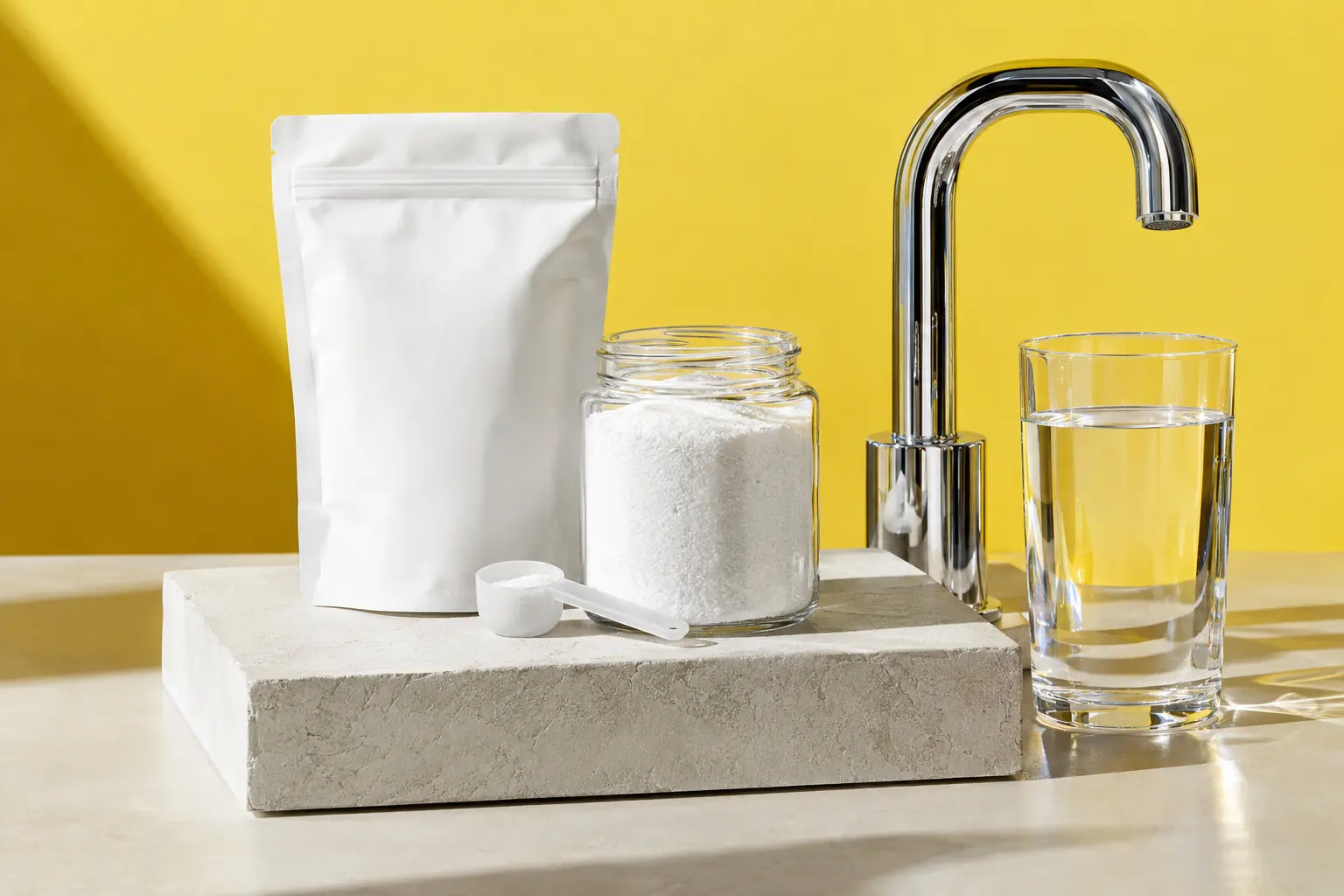
AKTO develops and manufactures a universal descaler to order on a citric, sulfamic, phosphoric or lactic acid base, as a liquid or powder concentrate for dilution. Available formats are liquid, gel and sachet/powder; packaging follows concentration - a 50-100 ml dropper-bottle for a strong concentrate, a 250 ml trigger-spray bottle for a ready-diluted solution, or a sachet for the powder form.
03
CLP hazard classification
Regulation (EC) No 1272/2008 (CLP) classifies an acid concentrate through the same Annex I tiered approach (sections 3.2.3 and 3.3.3): pH is the criterion for a strong acid (pH <= 2 gives Skin Corr. 1, unless the acid reserve indicates otherwise), otherwise the Table 3.2.4 thresholds apply; the additivity method for acid mixtures (point 3.2.3.3.4.1) may not apply. Annex II requires child-resistant fastenings for a formula classified Skin Corr. 1 or Acute Tox. 1-3 (point 3.1.1.1) and a tactile warning for any skin-corrosion or acute-toxicity class (point 3.2.1.1) - and it is the concentrate, not a diluted solution, that more often reaches these thresholds because of its higher acid strength. In Ukraine, the Technical Regulation on Detergents (Resolution No. 717/2008) excludes a surfactant-free acid-based descaler from scope (paras 3 and 5).
04
AKTO's production conditions
The product is registered under KVED code 20.59, separate from code 20.41 for soap and detergents. Production premises are held at 20-60% relative humidity and 16-25 degC, checked twice per shift. The minimum batch is 50 kg at plants in Kyiv (Ukraine) and Warsaw (Poland), certified to ISO 9001:2015, ISO 22000:2018 (HACCP, No. 44600111204) and ISO 22716 (GMP).
05
Getting started
A brand chooses the acid blend and concentration strength - which sets the hazard class and whether child-resistant packaging is required - and the dilution format: dropper-bottle, trigger-spray or sachet. AKTO develops the formula, checks its CLP classification, and runs a batch from 50 kg. See also: Appliance Care & Descalers, Washing Machine Cleaner and Coffee Machine Descaler.
Frequently Asked Questions
How is a universal descaler different from an appliance-specific one?
What acids does AKTO use in a universal descaler?
Why does concentration matter for a universal descaler's packaging?
What is AKTO's minimum batch for a universal descaler?
 Kateryna Khromykh
 Oleksandra Vovk
Standards we work to
 ISO 22716 (GMP)
 ISO 22000 (HACCP)
 Regulation (EC) No 1223/2009
 Directive 2002/46/EC
 Halal
Why AKTO
- Descaling concentrate to order: citric, sulfamic, phosphoric or lactic acid
- Liquid, gel or sachet/powder, for dilution across appliances
- CLP hazard class checked against concentration strength
- Registered under KVED 20.59, minimum batch from 50 kg
- Plants in Kyiv (Ukraine) and Warsaw (Poland), ISO 9001, ISO 22000, ISO 22716