
Private Label
Cream Deodorant
AKTO develops and manufactures cream deodorant to order in a jar or compact — an odour-control product with extra microbiological-quality control.
- ISO 22716 GMP
In brief
AKTO develops and manufactures a cream deodorant to order in a jar or compact format, where the emulsion is touched by fingers with every use. AKTO's testing package for this format mandatorily includes a preservative-challenge test and microbiological analysis at an accredited laboratory — testing this open-jar format specifically requires. It is an odour-control product, with no aluminium or zirconium salts. MOQ is from 50 kg, made in Kyiv (Ukraine) and Warsaw (Poland).
01
What a cream deodorant is, and how it differs from an antiperspirant
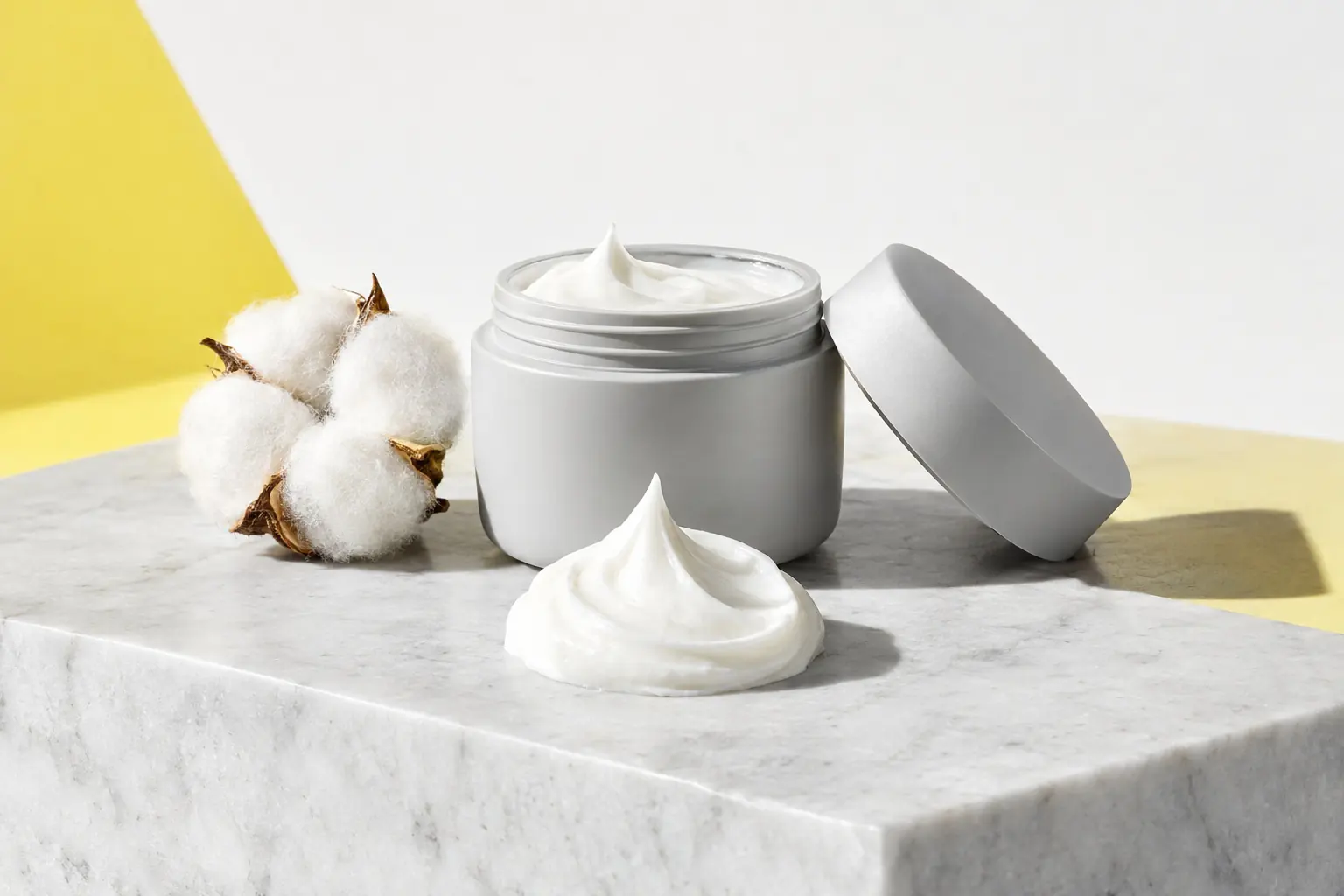
A cream deodorant is an emulsion texture in a jar or compact, applied with the fingers rather than a roller or a spray. The format appeals to brands looking to stand out on texture in a crowded deodorant category. Like the roll-on or spray format, a cream deodorant controls sweat odour rather than perspiration itself: aluminium or zirconium salts and a hyperhidrosis claim, typical of an antiperspirant, are not used in this AKTO format.
02
Formulation, form and packaging requirements
Because a jar or compact is opened repeatedly and touched by fingers with every use, its contamination risk is higher than a dispenser bottle's. AKTO's testing package for this format mandatorily includes a preservative-challenge test and microbiological analysis at an accredited laboratory — testing that is directly relevant to an open-jar format. Phenoxyethanol, a preservative option for this type of emulsion, cannot exceed 1.0% in the ready-for-use preparation under Annex V to Regulation (EC) No 1223/2009; Annex II to the Regulation limits the substances suitable for the odour-control active and the emulsifier.
03
EU and Ukraine regulatory requirements
A finished cosmetic product such as a cream deodorant is outside Regulation (EC) No 1272/2008 on classification and labelling (CLP) and carries no hazard pictograms — labelling is governed by Article 19 of Regulation (EC) No 1223/2009 instead. Article 10 of that same Regulation requires a safety-assessment report covering physicochemical stability and microbiological quality before a cream deodorant is placed on the EU market. An odour-control claim falls under the six common criteria of Commission Regulation (EU) No 655/2013. In Ukraine, the label must carry the responsible person, the manufacturer, the nominal content, the PAO shelf-life symbol and the batch number.
04
What AKTO offers
AKTO develops and manufactures a cream deodorant to order in a jar or compact format, including the mandatory preservative-challenge test and microbiological analysis at an accredited laboratory in its standard testing package. MOQ is from 50 kg of finished formulation, made at AKTO's facilities in Kyiv (Ukraine) and Warsaw (Poland). Production is certified to ISO 9001:2015 and ISO 22000:2018 (combined certificate No. 44600111204), ISO 22716 (GMP).
05
Getting started
A brand sets the odour-control active, the emulsion texture and the jar or compact format; AKTO develops the formula from scratch, runs the preservative-challenge test and microbiological analysis, prepares the safety assessment under Article 10 of Regulation (EC) No 1223/2009, and finalises labelling for the Ukrainian market.
06
See also
See also: Deodorants / Antiperspirants, Roll-on Deodorant and Deodorant Spray Mist.
Frequently Asked Questions
Does AKTO manufacture a cream deodorant?
Is this an antiperspirant?
Why does the jar format need extra testing?
What is the limit on the Phenoxyethanol preservative in a cream deodorant?
Expert review
Reviewed by
 Illia Mariutsa
Researcher, organic chemistry
Google Scholar Anastasiia Bespalova
Paediatric orthopaedic and trauma surgeon
ORCID
Standards we work to
 ISO 22716 (GMP)
 ISO 22000 (HACCP)
 Regulation (EC) No 1223/2009
 Directive 2002/46/EC
 Halal
Why AKTO
- Cream deodorant developed and manufactured to order in a jar or compact
- Mandatory preservative-challenge and microbiological testing for this format
- Clear deodorant/antiperspirant boundary — no aluminium or zirconium salts
- MOQ from 50 kg, facilities in Kyiv (Ukraine) and Warsaw (Poland)
- ISO 22716 (GMP), ISO 9001+22000